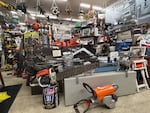
This photo taken on Jan. 22, 2026 shows a view inside Wayne's Chainsaw Museum, which is located a few miles outside of Amboy in Clark County, Washington. Wayne Sutton created the private museum to showcase the thousands of chainsaws he has collected over the years, including decades-old and rare, one-of-a-kind models.
Courtesy of Wayne Sutton
Clark County resident Wayne Sutton was only 7 or 8 years old, he says, when his father, who worked in the logging industry, helped him buy his first chainsaw. That was 60 years ago. Today, Sutton is the founder and curator of Wayne’s Chainsaw Museum, a private museum located a few miles outside of Amboy in Clark County that is free and open to visitors by appointment.
The Columbian recently profiled Sutton and his museum which is big enough to display only about half of the 4,000 or 5,000 chainsaws he has amassed over the years and continues to collect, or have donated to him. Sutton opened the museum in 2000 when he started working for Stihl, the world’s leading maker of gas-powered chainsaws.
Sutton retired from Stihl in 2024. Although his museum boasts hundreds of models made by his former employer, it also showcases other brands and rare, decades-old examples that serve as a time capsule of the evolution of this power tool that is inextricably tied to the logging history of the Pacific Northwest.
Sutton joins us to share his love of chainsaws and future plans for sharing his massive collection with more enthusiasts.
Note: The following transcript was transcribed digitally and validated for accuracy, readability and formatting by an OPB volunteer.
Dave Miller: This is Think Out Loud on OPB. I’m Dave Miller. We start today with some history, some very loud history. For decades now, Wayne Sutton has collected chainsaws. He has 4 or 5 thousand of them at this point. About 25 years ago, as reported recently in The Colombian, he decided to let the public see his collection, and Wayne’s Chainsaw Museum, a few miles outside of Amboy in Clark County was born. Wayne Sutton joins me now to talk about it. It’s great to have you on the show.
Wayne Sutton: It’s good to be here.
Miller: What’s your first memory of using a chainsaw yourself?
Sutton: My very first memory, I was younger than we had talked about earlier, because I was with my dad in the woods. He was a timber cutter, and he was bucking a great big log, and had me come over and hold on to the handles while he was bucking it.
Miller: How old do you think you were?
Sutton: I was probably 5 or 6.
Miller: Whoa.
Sutton: I was very young.
Miller: OK, but he was there, and he said, “Son, hold on here.” What about when it was just you?
Sutton: And pull the trigger.
Miller: He let you do that?
Sutton: I thought it shocked me, because the vibration felt like it was shocking me. And he just giggled at it and he went ahead and finished what he was doing, but that’s my very first memory.
Miller: What about when it was just you?
Sutton: When it was just me, it was probably a couple of years later. I had learned how to start a saw, and these were big professional saws, so they weren’t necessarily easy to start. But I would go out, pull one out of the garage while dad was gone…
Miller: He was a logger.
Sutton: He was a logger.
Miller: And he did not know what you were doing…
Sutton: And he had no idea I was doing this.
Miller: This is terrifying to even just imagine. As I say, as a parent, as a human being, imagining an 8-year-old taking a chainsaw that was maybe about ⅔ of your height…
Sutton: Or probably even bigger.
Miller: Oh my gosh, OK, so what’d you do with it?
Sutton: Well, I’d take it out into the yard and I couldn’t really pick it up because they were big. But I could start it. And so I would sit there and run it till it ran out of gas and then drag it back into the garage and put it where I’d found it.
Miller: Why were you doing that?
Sutton: Just something to do.
Miller: It was fun.
Sutton: Yeah.
Miller: I say that as if, I mean, if my 8-year-old had access to a chainsaw, he would probably want to do the same thing because it would be loud and exciting.
Sutton: That’s it.
Miller: So there were just chainsaws around the property when you were growing up?
Sutton: Yeah. Dad was a timber cutter. It was a farm. There were no neighbors much, and so I was on my own during the day and I played with chainsaws.
Miller: What did you end up doing as a career?
Sutton: Well, I was in the Air Force, and when I got out of the Air Force, while going to college, I decided I needed to do some side job, and I went down to the saw shop and talked to the old guy there, and he was eager to get some help. Within a couple of weeks, we were talking about me buying the place. And so that turned into my career rather than what I had my sights on.
Miller: The saw shop. What did that work entail?
Sutton: That meant selling saws, ordering parts and so on, repairing machines…
Miller: And you knew how to fix them at that point?
Sutton: I thought I did, and I was probably as good as he was.
Miller: And you learned.
Sutton: But I learned.
Miller: When did you start collecting chainsaws yourself?
Sutton: Well, the exact time was hard to say, but somewhere around 1980, I realized I’m collecting saws, because there were way too many of them sticking around.
Miller: In other words, looking back, you realized you’d been collecting saws before you were consciously doing it?
Sutton: That’s it.
Miller: But why?
Sutton: Just because they were interesting or they were old ones, unusual ones, or maybe they were in really great shape and not of any value anymore, but it was so nice, you have to keep it. You know, it’d be like the ’55 Chevy that, in 1960, somebody said, “Man, that one’s cherry, let’s keep it.”
Miller: But that was you for chainsaws.
Sutton: That was me for chainsaws.
Miller: What about other things? Watches, cars, motorcycles? Are you a collector in general, or are you a chainsaw expert and enthusiast?
Sutton: I’m a collector in general. It’s a genetic kind of thing.
Miller: I really do think that there is something, that there are collectors and non-collectors.
Sutton: For me, if there’s two or three things that are similar, but different, I kind of want to have all of them. But chainsaws really took over my collecting hobby and thinking.
Miller: When did you realize, I was gonna say it was a problem, but when did you realize it was really a thing?
Sutton: Well, I ran into a couple of other fellows that collected chainsaws. One who had been a customer of mine and was buying some of the saws that I was willing to part with, and then another one, a fellow up in Seattle who had a tremendous collection going, and it really inspired me. And I thought, “Well, man, I want to have all the weird things he’s got!” And as time went on, I’ve gotten a good portion of those.
Miller: What did your wife think about this activity of yours, of buying, storing and collecting chainsaws?
Sutton: You know, I’ve got the greatest wife in the world, and she really didn’t care. I was doing what made me happy. She knew where to find me. I wasn’t down at the tavern. I was out in the shop with my chainsaws, so she was good with it. But she did tell me, “No, saws in the house,” except for, and she named off three almost unreachable saws, things you weren’t ever going to find.
Miller: Oh, she said, if you can get these impossible ones, those are the ones that you could have in the house?
Sutton: I have those now.
Miller: What was one of the ones, maybe, do you remember? I imagine you do. What were the seemingly impossible to acquire ones?
Sutton: A Dow low-stump, which is a giant chainsaw that has an Indian V-Twin engine on it, and they were –
Miller: Like the motorcycle company Indian?
Sutton: Right. I mean, this is a 600-pound beast on wheels and I didn’t think I’d ever get one, and there are very few of them, but sure enough now I have one.
Miller: It’s a 600-pound chainsaw on wheels?
Sutton: Yeah.
Miller: It sounds like a Mad Max weapon.
Sutton: It looks like it. It should be in a movie, because it really does look like that.
Miller: She said if you got that, that could be in your house. Do you have that in your house?
Sutton: No, it’s in my museum. It looks like a Ditch Witch crossed with a chainsaw because that’s just about what it was.
Miller: And it’s like a stump grinder except it’s a chainsaw?
Sutton: No, it’s for bucking logs or cutting off stumps. Get down low, and they were in the early 1930s, so they were logging with the high arch log, horse logging and so on, and they needed to get the stumps out of the way so they could yard the logs to a cold deck someplace to load them in a train or on a truck.
Miller: What role have chainsaws played in the Northwest?
Sutton: You know, it’s been an important role, and maybe part of that is why I’m so interested in them, but the Northwest was a logging community. Whether it’s Oregon or Washington, it was all about logging, basically until the Second World War. And at that point, other industries really started coming to life. But up to that point, it was all logging. The early chainsaws that were developed came to the Northwest because they knew that’s where they had to be successful. And those that were, some of them are continuing to this day, but some weren’t, and they vanished.
Miller: Do you have any original chainsaws made by the Oregon Saw Chain Company, which was founded in Portland in the 1940s? It’s gone through a lot of name changes, but it’s still around and now once again has Oregon in the name.
Sutton: Yeah, Oregon Cutting Systems or whatever.
Miller: Oregon Tool, now.
Sutton: Yeah. Well, they only built about seven prototype chainsaws, and they were all different, and I don’t have any of those. I would love to get one of their prototypes –
Miller: One of the originals?
Sutton: Yeah, I do have some of their prototype, early chain, and it says Cox on it, because that was the founder of Oregon.
Miller: What are some of the other unusual chainsaws that you are proud of that are in the collection?
Sutton: Well, there’s a number of them, but one that comes to mind right away is a jet-powered chainsaw.
Miller: It has a jet engine?
Sutton: Yes, it’s got a dual-compressor turbine engine, and it’s small. It’s just the same size as a regular saw, looks like it could easily be used like a regular saw. But it was a one-off. It was built by some Stihl engineers. And they built it on a lark.
Miller: Just because they could.
Sutton: Because they could.
Miller: Is it incredibly fast and loud?
Sutton: It’s pretty loud. It turns 190,000 RPM or so.
Miller: How does that compare to a non-jet engine chainsaw?
Sutton: 15,000 RPM is fast for most chainsaws.
Miller: So this is another 25%?
Sutton: Ten times plus, yeah.
Miller: Oh, 150,000 times. OK. So it’s not usable.
Sutton: It would be usable. I mean, the guys that built it geared that speed down, so it ran the chain at appropriate speed, and it gives you the kind of torque that an electric motor gives you, but it has also got a flame coming out the front that helps you burn your wood right away.
Miller: How do people find out about you?
Sutton: You know, most of the time they do a Google search or something on that order, and I’ve had a number of people say, “I did a Google search to decide who I was going to give Grandpa’s saw to, and I looked at all the things and decided, you better have this. What’s your address?” And I’ve gotten a lot of them.
Miller: And they just donate them.
Sutton: They donate them, yeah, I couldn’t possibly buy all the saws that I have. I do, when I have to, if I can get something that’s special.
Miller: What is it like when old loggers or people who really know and care about chainsaws come to visit? What are your conversations like?
Sutton: They’re fun, because most of them are very appreciative of what I’ve put together. They’ve been in the industry their whole life, and they look at that and they go,
“Man, I never saw anything like that. I’ve never,” you know, over and over and over again, and then they’ll see one that was like the one they had, and it kind of brings it into perspective for them, how many things I’ve turned over to come up with all those saws.
Miller: And it’s basically this, this is a very personal museum, so if someone comes to visit, you’re the one who walks them through the holdings. You don’t just say, “It’s over there,” you know, “Knock on the door when you leave. I’m gonna be having my cup of tea.” You walk them around?
Sutton: I walk them around. I try to point out things and talk them through, so they can understand more of what’s there.
Miller: Do you have a favorite chainsaw from the collection of 4 or 5 thousand, or is that like asking your favorite family member?
Sutton: Yeah, I’ve got one grandson and he’s my favorite grandson. No, there’s a couple of machines that I’d have to say are my favorites, and one is a two-cylinder Stihl chainsaw that there was only a couple built. And this one, that friend in Seattle built and put it together and it’s just unbelievable. I didn’t think I would ever see one or have my hands to have one, but now there’s one in the museum. And then, of course, the jet saw, that’s a pretty amazing one. But then I also have a couple of old saws that Peter Stihl gave me for my collection, and those mean a lot to me.
Miller: Do you actually use chainsaws these days as tools, as opposed to objects of affection?
Sutton: I make firewood every year and I usually have a saw to use, a brand new saw, not an old saw. The brand new saws work way better.
Miller: Do you tell the old saws that?
Sutton: I keep it a secret from them. But I also have a battery saw that Stihl came out with a couple of years ago that’s a professional level battery saw. It’s unbelievable and it’s fun to run, so I use it a lot.
Miller: When battery saws first came out, did you think that they would be as good as they are now?
Sutton: I had no idea it was gonna evolve this quickly.
Miller: Wayne, it was a pleasure talking to you. Thanks so much.
Sutton: Thank you.
Miller: That’s Wayne Sutton. He is the founder and curator of Wayne’s Chainsaw Museum. You’ll find it a few miles outside of Amboy in Clark County.
“Think Out Loud®” broadcasts live at noon every day and rebroadcasts at 8 p.m.
If you’d like to comment on any of the topics in this show or suggest a topic of your own, please get in touch with us on Facebook, send an email to thinkoutloud@opb.org, or you can leave a voicemail for us at 503-293-1983.