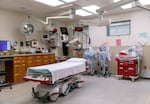
FILE - An empty emergency room at Salem Health, Jan. 27, 2022.
Kristyna Wentz-Graff / OPB
Logan Patterson graduated in May 2025 from Washington State University’s College of Medicine and is currently a resident at the Sacred Heart Medical Center in Spokane. During his four years of medical school, he says that he got almost no formal training in end-of-life care, including how to talk with patients and their families about death and dying.
It turns out that his experience is hardly unique, according to a new study Patterson co-authored and recently published with his former colleagues at Washington State University.
The researchers reviewed the two largest medical journal databases to look for papers published between January 2010 and April 2025 about death and dying instruction in U.S. medical schools. They found only 43 articles on this topic and wide variability on how death and dying is being taught, from a single seminar on advanced care planning to required rotations in hospice and palliative care settings. The researchers argue that U.S. medical schools lack a consistent and evidence-based curriculum for end-of-life care.
Dr. Patterson joins us for more details, including the social and academic challenges of effectively teaching death and dying to students to help prepare them for some of the toughest conversations they may soon be forced to have with their patients.
Note: The following transcript was transcribed digitally and validated for accuracy, readability and formatting by an OPB volunteer.
Dave Miller: From the Gert Boyle Studio at OPB, this is Think Out Loud. I’m Dave Miller. Death and dying are an inevitable part of health care. Patients will die. Families will have to navigate end-of-life care. But even as the population ages, most U.S. medical schools lack a consistent and formalized end-of-life care curriculum. These schools should focus more regularly on death and dying for both their students’ clinical skills and for their emotional well-being.
These are some of the conclusions from a recent paper by Logan Patterson and other researchers at Washington State University’s College of Medicine. Patterson graduated from the medical school last year. He is currently a resident at the Sacred Heart Medical Center in Spokane. He surveyed the last 15 years of studies about death and dying instruction in U.S. medical schools, and he joins me now. It’s great to have you on Think Out Loud.
Logan Patterson: Thank you for having me.
Miller: Why did you want to study this issue?
Patterson: I would say end-of-life care has always been something that I’ve been very passionate about. It was one of the motivating reasons for me deciding to become a doctor in the first place.
Miller: What do you mean by that?
Patterson: Throughout my high school and undergrad experience, my grandmother had Alzheimer’s Disease and dementia. So was basically going through a slow decline. And as my father was her primary caregiver along with my mother. Basically just seeing them try to navigate her decline, in terms of supporting her and helping her meet her needs. My grandmother was a very independent woman. So in some ways, having her sort of fight to maintain independence even as she lost her functionality, seeing that struggle and the toll that it took on them, and my grandmother of course, was a really formative experience. It’s definitely affected the way that I approach patient care.
Miller: With that as one of the reasons that you chose to go to medical school and to become a physician, I imagine you were particularly focused on what kind of end-of-life care education you would get. What was it like?
Patterson: Oh, definitely. I would say my experience was not at all unique in that I received very little formalized education.
Miller: Formalized education, and that’s a key word there?
Patterson: Yes, definitely. I would say that for most people they receive basically informal education in how to talk to people about death and dying, how do you have conversations about whether or not someone wants CPR or goals of care discussions, things like that. People receive it informally by observing how their attendings or their preceptors have those discussions. You learn by observing and thinking what you would do differently or how you would approach that conversation. Then of course you get thrown in the deep end once you actually become a doctor. But “formalized,” meaning more curriculum-driven really.
Miller: I imagine that both of those have their place but, in some ways, what better way to learn than watching those actual conversations take place? But what’s missing if that’s the majority of what you’re getting, as opposed to classroom instruction as well?
Patterson: There’s of course a place for both. If anything, I would love to see a curriculum that combines both where you have experts, very seasoned practiced physicians who’ve had these conversations 1,000 times, providing examples of how they approach certain conversations. Then incorporating that into more, maybe simulated patient encounters or something along those lines. So of course there’s definitely a role for both.
Miller: Can you give us a sense for the range of classes, exercises or education plans that you found when you surveyed this relatively modest literature, 43, I think it was, studies that you were able to narrow this down to since 2010? So what’s the range of what’s actually happening in medical schools in the U.S. right now?
Patterson: Of those 43 publications, it really ranged from basically providing a prompt to students regarding their feelings about death and dying, asking for a free, almost essay-like response, and then doing an analysis or a thematic analysis of what came up in those responses, all the way to much more integrated curriculum that encompass expert-led discussion, simulated patient encounters, required electives in third and fourth year — which are the clinical years of medical education — with palliative care specialists. So there was a really broad range, both in terms of the type of intervention and also which years that they actually impacted.
Miller: Given that variety, is it possible for you to say what the norm is, what the average medical student in the U.S. is likely to get by the end of their four years, by the time they are newly minted MDs on the way to practicing or residency?
Patterson: Honestly, I don’t think it would be possible really. At least not with any sort of conclusive evidence behind it. I would argue that based on my experience – purely anecdotal – of having talked to many of my attendings about this topic because I’m so passionate about it, I tend to see that the average answer seems to be almost none; or certainly very little formal education or formalized curriculum regarding this.
Miller: How different is that from what you think the average med student would have learned about managing blood pressure or any other number of specific health care related things? I guess I’m wondering what it tells you, that there’s this lack of uniformity and specificity about end of life compared to other aspects of a medical education?
Patterson: Yes, that’s a great example. Blood pressure is, of course, extremely important to human health and we spent a great deal of time learning how to manage it, whether or not it’s overly high or overly low. I would say the reason for that is partially because it’s a much much more easily testable topic than something as soft-skilled as having end-of-life conversations. It’s much harder to write a test question regarding how you help a family through their almost preemptive grief with the impending death of a loved one than it is to ask what the second line of therapy is for hypertension. It’s just more difficult to do.
Miller: I was struck by a line in an article I read about the approach that Tufts Medical School in Massachusetts has been taking to address end-of-life care. A professor there said that most clinical education on this topic had previously been opportunistic. What might that look like in the context of a medical student’s education, for this to be opportunistic?
Patterson: So my interpretation of what they mean is probably something along the lines of … I’ll use myself as an example. I’ll say I have a third-year medical student who’s just come onto their clinical rotations and we have a patient we’re admitting to the hospital. So with every patient that comes into the hospital, we talk about CPR and intubation. Would you want a machine to breathe for you and would you want us to perform CPR in the event that you need it? So an opportunistic education would be me either having them just observe me while I do it, or me saying, “OK, I’m going to watch you do it and I want to see how you do it, and I’ll just step in if you’ve left any gaps or things that I think you need to address.”
So very not standardized and could vary student to student, depending on which professor or which attending they’re with on a given day. Because, of course, not every medical student will be with the same doctor.
Miller: I found some evidence that Oregon’s only medical school, OHSU, seems to have taken a pretty concerted effort to give students training in a lot of these issues, including how to talk about death and how to talk about end-of-life care. Did you find any standout schools when you looked at these studies from all across the country?
Patterson: If I’m not mistaken, I believe it was Yale who had a four-year curriculum. They put out a publication discussing … The first two years of medical school are didactic, meaning classroom-based. Then the second two years are hands-on with patients’ clinical learning. They have incorporated different types of interventions all throughout those four years. To me, that would reflect basically the gold standard of what we would hope to do.
Miller: Meaning that even before you get to somebody’s hospital room or a clinic, when you’re still basically in the classroom, you’re already learning how to think about and how to talk about death, or end of life, or advanced care directives?
Patterson: Exactly. There’s obviously different limitations because students have had less exposure with patients in those early years. But there’s still tremendous opportunity, both because the subject matter that you’re learning about will touch on death and dying, but also because at the beginning of medical school for almost every medical student there is cadaver lab for anatomy learning. Many people say that your cadaver is your first patient, if you have that type of training. So it represents just a built-in opportunity to begin the conversation about death and dying.
Miller: It’s interesting that you were talking earlier about the reasons – both good and maybe societal or questionable – for the huge difference in what you might learn about managing blood pressure, compared to end-of-life issues. I also imagine it’s easier to just to track the success or failure of a blood pressure intervention than to track the success or failure of teaching about talking. What kind of data is there about end-of-life care pedagogy, about what actually works? How would you, even just for yourself as a relatively newly minted doctor, think about this as a society in terms of what’s successful?
Patterson: As a society, we are certainly improving, but we definitely still think of death as a failure. And that is reflected in the culture of medicine; death is seen as a failure. For me, just as a physician and how I approach things, I try to reframe what I think of as a success, just depending on the patient’s context. Perhaps this person is a terminal cancer patient and they are in a spot where they previously wanted all forms of intervention. They were someone who would want chemotherapy even up to the point of it not being really effective anymore.
But I think you really have to reframe what you think of as a success in that conversation, in alignment with the goals of the patient. So whether that’s helping them navigate to the point of not wanting therapy anymore and just being comfortable at the end of life, or whether that’s facilitating the care that they want. It’s perfectly within the patient’s rights to want to fight until the very end.
Miller: Samantha Vembu on Facebook just left us this comment: “OHSU pairs medical students with people who are terminally ill so they can learn about it. They spend time together and talk about how they are preparing to die. I believe they do this in their first year to help the students understand how important their jobs will be.”
In July, you’re gonna be starting the next portion of your medical training. You’re gonna be specializing in radiation oncology at UCSF Medical Center starting in the summer. How did you choose that specialty?
Patterson: First, I just want to say that it seems like a wonderful learning opportunity that OHSU is providing their students. That’s really extraordinary. I wish I had had that opportunity myself.
For radiation oncology, it’s a complicated answer. Part of it has to do with the disease itself being cancer. It occupies such a unique societal space. People really see it … it’s always been perceived as a very serious, very terminal disease. Patients are always very motivated, as part of their treatment. It’s often seen as a very emotionally impactful disease where it’s almost like your body is betraying you in some type of way.
But also because so many of the cancer patients are being treated palliatively, meaning that we can’t cure their disease, but we’re trying to either prolong their life or make them more comfortable. So it really heavily involves end-of-life care, especially with radiation oncology, specifically. Something between 25% and 50% of our patients are receiving palliative radiation, so that always involves a discussion with patients about what their goals are and what we can reasonably expect from this particular treatment.
Miller: Why is it that you sought out that aspect? It seems like you’re very consciously going towards a part of medicine where, for a significant percentage of your patients, the goal is not going to be to get them better. It’s going to be to do your best with them before they die. Why did you seek that out?
Patterson: I think that it’s partially to do with my level of comfort regarding the topic, even relative to physicians who are generally very comfortable with talking about death. I saw it as an area that I could do a lot of good in because of my willingness to talk about this. I also enjoy these types of conversations in the sort of bigger picture existential, like what makes you feel fulfilled in your career. I can still much more vividly remember conversations with patients towards the end of life or regarding goals of care after they’ve had very serious accidents or very serious strokes, than I can talking to people about their blood pressure management, using your previous example. It’s, I would say, just by far the most fulfilling part of my job.
Miller: Is this something that you intend to actually teach? Do you want to become an academic physician who is talking about these issues with future doctors?
Patterson: That was one of the reasons I chose UCSF specifically, because during my interview with them, they talked quite a bit about how the Radiation Oncology department works with their medical school. I’m definitely looking forward to working with medical students as a resident. It would be wonderful to continue to work with medical students as an attending once I’m done with my training. But that’s many years away, so we’ll see about that.
Miller: Logan, thanks very much.
Patterson: Thank you.
Miller: Logan Patterson is a resident right now at Sacred Heart Medical Center in Spokane.
“Think Out Loud®” broadcasts live at noon every day and rebroadcasts at 8 p.m.
If you’d like to comment on any of the topics in this show or suggest a topic of your own, please get in touch with us on Facebook, send an email to thinkoutloud@opb.org, or you can leave a voicemail for us at 503-293-1983.