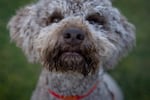
Nine of the more than 30 Joriad North American Truffle Dog Championship competitors pose for portraits in Eugene, Ore., on Feb. 6, 2026.
Eli Imadali / OPB
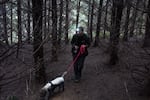
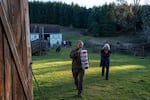
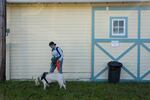
At the top of a winding road on the outskirts of Sherwood, Oregon, a small group is decked out in waterproof gear, carrying spades tucked in their belts, with dogs of all kinds getting ready to forage in the woods.
“Keep your dogs 10-15 feet apart … and have fun,” instructs truffle dog trainer Ava Chapman.
Chapman started out as a hobbyist hunting truffles with her own dog, but for the past few years has been training other dogs and their owners to find native Oregon truffles.
“It’s a hobby gone wild for me,” says Chapman. “I don’t advertise, I don’t have a website. People find me by word of mouth.”
In 2020, Chapman and her Yellow Retriever Joey won the Joriad North American Truffle Dog Championship with a whopping 77 truffles found in an hour in the Oregon woods. Nowadays she trains others, like Amber Heckman Pucci and her 5-year-old cattle dog mix Buddy.
“He’s about 17 different breeds because I did that DNA testing,” she laughs.
Pucci explained that Buddy had always been an athletic dog, but as he got older she was looking for lower impact activities than his usual frisbee games.
“Coincidentally, I went to “tree school” that the OSU Extension puts on and they had classes on truffle hunting and Buddy took an instant interest,” she said. “It’s about doing something with your dog, it’s a real connected activity and [being] in the woods? That’s the best!”
The pair were training under Chapman for this year’s Joriad, which took place Friday, Feb. 6, in Eugene. The competition is part of the Oregon Truffle Festival which for two decades has been trying to spread the word about the fragrant local fungi.
Preston Berkeley is led by Gracie, his Loggoto Romagnolo, as she sniffs for Oregon White Truffles in a thick grove of Douglas Firs during the finals of the Joriad North American Truffle Dog Championship in Eugene, Ore., on Feb. 6, 2026.
Eli Imadali / OPB
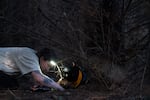
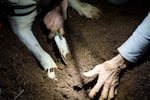
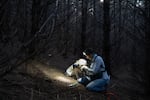

“There are hundreds of species of truffles in Oregon,” says Charles Lefevre. “You can go anywhere and find truffles, but there are only four that have known culinary potential.”
A lifelong forager with a Ph.D. in forest mycology, Lefevre owns New World Truffieres, a company that specializes in truffle cultivation. He explained that a truffle has to be fully mature and ripened like a fruit before it’s consumed.
“Think of it like a peach, you don’t want to eat it if it’s not ripe,” he said “The dog’s job is to choose those truffles that are ripe and leave the rest in the ground to continue to ripen.”
Lefevre co-founded the truffle festival with his wife Leslie Scott because they wanted to help elevate the profile of the Oregon truffle, which Lefevre thinks should be getting a lot more recognition. “Our experience was that the Oregon truffles were much better than their price and their reputation suggested,” he said.
Lafevre says Oregon truffles can sell for $650 to $750 a pound, while some Italian white truffles can cost anywhere from $3,000 to $8,000 a pound.

Master of ceremonies Bob Walker, left, and Charles Lefevre, world-renowned truffle expert and co-founder of the Oregon Truffle Festival, examine a truffle species with no culinary value found in the finals as the pair count and weigh truffle hauls to determine the winner. There was a tie for the first time ever this year, with two teams each collecting 15 truffles, so it came down to weight.
Eli Imadali / OPB

Oregon White Truffles found by dogs and their handlers fill containers as they are counted and weighed after the finals.
Eli Imadali / OPB
Part of the reason local truffles may have gotten a bad rap is because the alternative to using an animal to help sniff them out is something called raking. Foragers would use a rake to disturb the dirt and duff around trees to find truffles growing within the root systems.
The problem is that not only does raking tear up the forest floor, it collects both ripe and unripe truffles.
“So by just introducing truffle dogs, we could dramatically elevate the quality of the truffles on the market and, ultimately, their reputation,” said Lefevre.
And while it used to be that pigs were used to hunt truffles, that has largely fallen out of favor, and in Italy the practice has been banned since 1985.
“The reason they stopped harvesting with pigs in Europe is because they couldn’t pull the female sows off the truffles fast enough,” said Scott.
That’s because truffles produce an aroma that closely mimics the pheromones of a male pig, making sows the perfect hunters. But they like truffles a little too much and often eat the fungi before harvest can happen.
Lefevre and Scott created this competition to start building excitement around truffle dogs because to find the highest quality truffles, they needed to build a labor force.
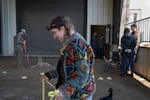
From left, handlers and their dogs Brian Norman and Lazlo, Jessie Barnes and Daisy, and Preston Berkeley and Gracie warm up before competing in the first round at the Lane County Fairgrounds Livestock Arena in Eugene, Ore., on Feb. 6, 2026. Norman and Lazlo later won the competition after collecting 99.2 grams of truffles in the finals.
Eli Imadali / OPB
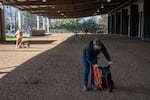
The competition starts early in the morning in a dirt-filled arena in Eugene. In the first round, dogs compete three at a time, frantically trying to sniff out the pungent aroma of an Oregon white truffle in rows of dirt-filled boxes.
From the stands, it’s quiet until a call of “truffle” from a competitor rings out in the arena. After more than 30 dogs compete in two rounds of indoor trials, the top five dogs get unleashed on the real thing.
The group will get just one hour to hunt on a nearby truffle patch about 30 minutes out of town and the team with the most truffles at the end wins.
All the competitors in the Joriad are amateurs, and a lot of them are here to have fun rather than go for a career in truffle hunting. Many competitors remain hobbyists because the work is physically demanding, and environmental factors make each harvest inconsistent.
This year’s Joriad winner Brian Norman said he has no interest in going pro.
“I’m in wine, so [truffle hunting] comes with the food and bev and gastronomy,” he said. “We give them to friends and restaurants and it’s really a great tool to start a conversation about food, about wine and to understand the land here.”
This year, for the first time ever, there was a tie — two different teams each found 15 truffles. So, it came down to the weight of the haul: one tipped the scales at 68.1 grams, while Norman and his dog Lazlo’s spoils were slightly heavier at 99.2 grams.
Leslie Scott and Charles Lefevre acknowledge that it’s an uphill battle to get more dogs and people into the industry full-time, but they hope that with competitions like the Joriad, interest will grow.
“When you’re creating culture, it takes a while,” said Scott. “You can train, but the appreciation and the understanding of why it’s so important takes time.”

Jessie Barnes kisses and holds Daisy, her terrier mix, after the finals in Eugene, Ore., on Feb. 6, 2026. The pair won second place in the competition, collecting 68.1 grams of Oregon White Truffles.
Eli Imadali / OPB