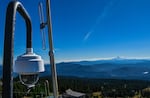
FILE - A camera with the OHAZ system looks out across a wooded stretch of Oregon.
The Oregon Hazards Lab At The University Of Oregon
Almost half of the University of Oregon’s network of cameras to monitor wildfires is at risk of being discontinued, according to an administrator.
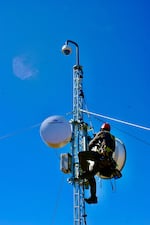
FILE - A technician works on an OHAZ camera attached to a communications tower at Jackass Butte in Oregon.
The Oregon Hazards Lab At The University Of Oregon
The Oregon Hazards Lab’s network of cameras operates 24-7 and covers some of the most remote, rugged, and inaccessible areas of the state.
It’s helped spot smoke plumes and track wildfires in real time. In 2025 alone, the OHAZ system logged more than 11,000 smoke detections.
OHAZ director Leland O’Driscoll told KLCC that the university got involved in 2018, adding 70 cameras to the regional network along with roughly 100 previously installed by the Oregon Department of Forestry and a few utilities.
“The cameras are in place to detect fire and smoke as early as possible,” said O’Driscoll. He added that their cameras are also viewable by the public.
“And information is key when folks are deciding what to do if they’re not getting alerts or not understanding the communications coming out of the emergency management space,” he said.
Advocates of the OHAZ system say that with less than optimal snowpack this winter, dry conditions will make for a potentially volatile wildfire season, making detection efforts vital in responding to blazes.
O’Driscoll said that unless Oregon lawmakers act, funding constraints will cause 33 of their cameras to go offline.
“The cameras in the system allow for alerting that goes directly to fire response agencies,” he said. “And that really maximizes the potential to suppress those fires before they burn out of control and have huge costs associated with that.”
The operational cost of each camera is $25,000 a year, while base costs for purchasing and maintaining each one range from $15,000 to $100,000, depending on whether a camera is placed in existing infrastructure (like a communication tower) or if that has to be planned, developed, and built as well before installation.
O’Driscoll and partners from the Oregon Department of Forestry and Link Oregon made their case Friday morning before the legislature’s Joint Committee on Information Management and Technology.
They hope to receive funding to keep the OHAZ system operating through FY 2027.
Levi Hopkins, deputy chief of policy and planning for ODF’s protection division, told lawmakers that a Memorandum of Understanding exists between his agency and the UO.
He says a statewide level approach for a camera system makes sense in terms of improved communications and sharing joint funding opportunities.
“In short, the MOU strengthens and completes the statewide detection system, and allows all partners and vendors to work cooperatively for the benefits of Oregonians,” he said.
Hopkins added that this system keeps small fires from growing into huge ones, which saves lives and millions of dollars in property damage. His remarks come just over five years after what’s considered Oregon’s worst wildfire season in state history: More than 1 million acres and 4,000 buildings were destroyed in 2020, with 11 casualties.
Jackie Wirz, executive director of Link Oregon, also spoke. She explained how data transmission across the state benefited education and research, including 2,500 miles of “lightning fast” fiber optic connectivity that is part of OHAZ’s fire and seismic detection network.
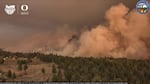
FILE - An OHAZ camera still of the Flat Fire on Aug. 23, 2025.
The Oregon Hazards Lab At The University Of Oregon
“It is peace of mind knowing that there is monitoring going on to ensure that if something does happen, OHAZ has the technology and Link Oregon has the speed to turn data into insight, into actions, that ensure the safety of our communities,” said Wirz, on how people can access OHAZ cameras to stay on top of potential hazards.
During his testimony, O’Driscoll said between $2 million and $4 million would be ideal for addressing their budgetary shortfall, maintaining OHAZ camera operations, and potentially expanding their network to help improve monitoring.
“Our fingers are crossed there will be a positive legislative outcome in this short session,” said O’Driscoll. “Then we can guarantee our sites are up and running. Without that, we’ll have to effectively shut off our cameras just at the wrong time.”
Brian Bull is a reporter with KLCC.
This story comes to you from the Northwest News Network, a collaboration between public media organizations in Oregon and Washington.
It is part of OPB’s broader effort to ensure that everyone in our region has access to quality journalism that informs, entertains and enriches their lives. To learn more, visit our journalism partnerships page.