

Washington Gov. Bob Ferguson during a press conference in Vancouver, Wash., March 17, 2026, discussing the rising cost of the Interstate Bridge.
Erik Neumann / OPB
The cost of the project to replace the Interstate Bridge between Washington and Oregon is going up again.
According to new official estimates released Tuesday morning, the price will increase approximately 140% from a 2022 estimate of $6 billion to a new target of $14.4 billion.
While dramatic, the new cost of the decadeslong megaproject is not surprising. A combination of project delays, rising materials and labor costs, and tariffs led to predictions and warnings from project administrators that the price would increase significantly. Other large infrastructure projects around the U.S. have faced similar price jumps in recent years.
Related: What to know about the Interstate Bridge's rising price tag
Washington Gov. Bob Ferguson joined with local lawmakers, labor leaders and transit officials on Tuesday morning to say he and Oregon Gov. Tina Kotek are committed to moving forward with the core elements of the bridge with the funding that’s available.
“I’m here today with key project partners to make it clear that we are all committed to moving forward with a core set of projects to replace our bridge with a modern fixed-span structure including light rail,” Ferguson said.
Those core projects include replacing the two existing bridge spans, connecting them to Interstate 5 and extending light rail from North Portland to downtown Vancouver.
That series of projects will cost $7.65 billion, Ferguson said, adding that the IBR currently has $5.5 billion available in state and federal funding and is pursuing another $1 billion from the Federal Transit Administration.
The remaining parts of the full five-mile corridor will be completed in phases as funding becomes available, he said.
Construction on the overall project, including the bridge and corresponding interchange overhauls in both Oregon and Washington, could last up to 15 years, according to officials. The new cost estimate actually ranges from $13.5 billion to $15.2 billion. The previous estimate ranged from $5 billion to $7.5 billion.
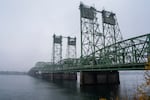
The Interstate-5 bridge in Vancouver, Wash., on Thursday, Dec. 4, 2025.
Saskia Hatvany / OPB
The Interstate Bridge Replacement Program, or IBR for short, grew out of the previous proposal known as the Columbia River Crossing, which fell apart in 2013.
The biggest concern about the current 109-year-old structure is that it would not be able to withstand a major earthquake. The bridge’s narrow size creates a bottleneck on I-5, delaying traffic and sometimes stopping it altogether when the bridge lift is raised to allow ships to pass below on the Columbia River. It also lacks dedicated lanes for mass transit and provides limited space for bicycles and pedestrians.
“This is the most important infrastructure project the state is going to do in the next several years,” said Washington state Rep. Jake Fey, D-Tacoma, co-chair of the state’s Joint Transportation Committee.
In recent years, the IBR has blown past deadlines, even as officials have notched sizable grants from state and federal partners. So far both Washington and Oregon have pledged $1 billion each for the project.
In the past, IBR staff have pointed out that other bridge projects across the country have faced similar cost increases in the past decade. In one nearby example, the estimated cost of the Hood River-White Salmon Bridge increased 119% between 2022 and 2024.
Transportation planners have tried to reduce the price of the IBR in recent months. In January, the U.S. Coast Guard approved a continuous fixed-span design for the bridge. That approval will lower the cost by as much as $1.7 billion, compared to the alternative of a bridge with a lift to accommodate vessels passing underneath on the Columbia river.
Related: Coast Guard OKs less-costly Oregon-to-Washington Interstate Bridge proposal
Part of that agreement included a settlement where the IBR will pay four marine companies that operate farther east on the river $140 million to mitigate potential business impacts with a lower bridge.
The program is planning to find a contractor in 2027 when they will finalize the bridge design. Construction is expected to begin in 2028.
“I’m not interested in looking backwards, OK?” Ferguson said. “We’re building this damn bridge. That’s happening.”
