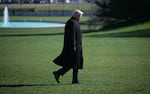
President Trump walks to the Oval Office at the White House in Washington, D.C., as he returns from Dover Air Force Base in Delaware after attending a dignified transfer solemn event on Wednesday.
Oliver Contreras
Iran attacked the world's biggest liquefied natural gas complex in Qatar, targeted a gas field and facility in the United Arab Emirates, fired missiles and launched drones on a Saudi Arabian oil refinery and on two Kuwaiti gas units on Thursday, following Israel's bombing of Iran's South Pars gas field a day earlier.
The attacks marked a major escalation as the war with Iran approached its third week. The strikes sent shockwaves across the global energy market, which was already reeling from the consequences of Iran's chokehold on the Strait of Hormuz, a key conduit of the world's oil supply.
Brent crude oil, the international standard, was above $110 a barrel in Thursday morning trading, an increase of over 50% since the start of the war on Feb. 28.
President Trump said on social media the U.S. "knew nothing" about the Israeli attack on Iran's South Pars gas field, but he threatened Iran that the U.S. would blow up the gas field.
The Iranian attacks drew condemnation from the three Gulf countries, calling it a dangerous escalation.
Here are further updates from the conflict.
To jump to a specific coverage topic, click on the links below:
Qatar | U.S.-Japan summit | Gulf nations | Trump on Israel striking Iran gas
Qatar says its gas facilities suffered extensive damage
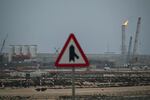
This photo shows QatarEnergy's operating facilities in Ras Laffan Industrial City on March 2. Qatar suspended liquefied natural gas production on March 2, causing a massive leap in prices, after Iranian strikes hit Gulf energy facilities in a new escalation of the Middle East war.
Getty Images
QatarEnergy said Thursday its Ras Laffan gas-to-liquid facility suffered extensive damage from the Iranian strikes a day earlier.
Authorities said several of Qatar's liquefied natural gas facilities came under missile attack again early Thursday, setting them ablaze and causing further damage.
Qatar, one of the world's biggest producers of liquefied natural gas, has had to halt all gas production due to Iranian counterattacks in the war, disrupting global supplies and the production of fertilizer already.
Qatar expelled Iranian military attaches in response to the Iranian attacks. In a statement issued on Wednesday, Qatar condemned Iran's attack on its assets as "a dangerous escalation, a flagrant violation of state sovereignty, and a direct threat to its national security and regional stability."
Japan's prime minister to visit the White House under shadow of Iran war

Japanese Prime Minister Sanae Takaichi and President Trump speak to troops aboard the USS George Washington at Fleet Activities Yokosuka on Oct. 28, 2025, in Yokosuka, Japan.
Andrew Harnik
Japanese Prime Minister Sanae Takaichi will be the first U.S. ally to visit the White House since President Trump asked for help in sending ships to patrol the Strait of Hormuz.
While Trump has since said the United States doesn't need help, Takaichi is likely to come under pressure Thursday to both please the U.S., Japan's only treaty ally, while working within tough legal and political constraints.
Takaichi has said Japan has no plans to dispatch warships to the Middle East, but she also hasn't explicitly turned down Trump's request.
She told lawmakers on Wednesday, ahead of the meeting with President Trump, that she "will clearly explain what we can do and cannot do based on the Japanese law."
Japan's unique legal system determines what the country can and cannot do when it comes to international disputes. Its constitution renounces the right to wage war as a means of settling such disputes.
In 2015, Japan passed security legislation reinterpreting the constitution and allowing it to deploy the military for collective self-defense in case of an attack on Japan or an ally, which could result in a "survival-threatening situation."
Takaichi has carefully declined to make any judgment on the legality of the U.S.-Israeli attack on Iran. Any judgment that the attack was preemptive or unprovoked could undermine the logic of deploying Japan's military, known as the Self-Defense Forces (SDF).
— Anthony Kuhn
Gas infrastructure targeted in the UAE, Saudi Arabia and Kuwait
Authorities in the United Arab Emirates said the country's Habshan gas facility and Bab field came under attack from Iran overnight. Authorities said the missiles against those sites were intercepted, but due to falling debris, the gas facilities have been shut down.
In its condemnation of the attacks, UAE's Foreign Ministry said it "reserved its full right to take all necessary measures to protect its sovereignty and national security, and to safeguard its national interests."
Kuwait News Agency also reported drone attacks, confirmed by Kuwait Petroleum Corp., on two units in Mina Al-Ahmadi and Mina Abdullah refineries, among the largest in the Middle East, on Thursday morning.
The Saudi Defense Ministry reported Thursday that a drone crashed in the Samref oil refinery, one of the leading in the region, in the country's east. Authorities said they were assessing the damage.
"What little trust there was has completely been shattered, has been shattered on multiple levels," Saudi Foreign Minister Faisal bin Farhan said on Thursday.
The strikes on gas and oil facilities in the Gulf countries followed Israel's attack on Iran's South Pars gas field on Wednesday. Qatar said Israel's attack targeted the Iranian side of the underwater gas field that the two countries share.
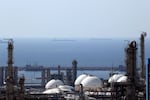
A picture shows a general view of the phase 17-18 of the South Pars gas field facilities in the southern Iranian port town of Assaluyeh on the shore of the Gulf on Nov. 19, 2015.
Atta Kenare
Prior to the Iranian attack on the Gulf countries, Qatar's officials condemned Israel's strike against Iranian gas fields as "a dangerous and irresponsible step."
"Targeting energy infrastructure constitutes a threat to global energy security, as well as to the peoples of the region and its environment," Majed Al-Ansari, Qatar's Foreign Ministry spokesman, said on X.
Trump: U.S. "knew nothing about" Israel's strike on Iran's gas field
President Trump said late Wednesday that Israel acted alone when it struck the gas field in Iran. In a Truth Social post, he wrote:
"Israel, out of anger for what has taken place in the Middle East, has violently lashed out at a major facility known as the South Pars Gas Field in Iran. A relatively small section of the whole has been hit. The United States knew nothing about this particular attack, and the country of Qatar was in no way, shape, or form, involved with it, nor did it have any idea that it was going to happen."
Trump said that Israel would not attack Iran's South Pars facilities again. But he threatened Iran to halt its attacks on Qatar's gas infrastructure or face severe U.S. strikes on South Pars.
"The United States of America, with or without the help or consent of Israel, will massively blow up the entire South Pars Gas Field at an amount and strength and power that Iran has never seen or witnessed before," Trump wrote on Truth Social.
Anthony Kuhn contributed to this report from Seoul, Aya Batrawy from Dubai, United Arab Emirates, and Tina Kraja from Washington, D.C.