
Earlier this month, Dr. Mark Thomas treated a patient who suffered a devastating accident while smoking fentanyl.
The patient fell asleep, caught themselves on fire, and was brought to the Oregon Burn Center at Legacy Emanuel Medical Center in Portland, where Thomas is a surgeon.
They didn’t survive.
In the span of just a week and a half, Thomas performed surgery on two other people who burned themselves badly while smoking illicit drugs.
The patients often have an unusual pattern of injury: burns that cover a limited part of their body, but extend deep into the muscle, tendon and bone. Thomas often has to perform multiple reconstructive surgeries, or amputate a person’s limb.
“They’re passing out with that butane lighter on their legs, in their lap, in their hands,” he said. “It’s leading to these devastating injuries.”
Troubled by what he was seeing, Thomas reached out to Dr. Honora Englander, director of the addiction care team at OHSU. This month, Englander, Thomas and several colleagues published a paper that is the first to measure the risk of burns among people smoking opioids, stimulants and cannabis.
They found compelling evidence it’s been an underappreciated public health problem.
Related: Addiction experts raise alarm about cannabis use among Oregon’s youth
Using insurance claims data from the state’s Medicaid program, they showed that over half of people treated for burns in hospitals and emergency rooms in Oregon between 2016 and 2024 used smokable drugs other than tobacco.
The data showed that burn rates for people smoking opioids or stimulants was four times higher than it was for people who did not smoke illicit drugs.
While their data is limited to Oregon, it has clear national implications.

A person holds pieces of fentanyl in Los Angeles, Thursday, Aug. 18, 2022.
Jae C. Hong / AP
A shift from injection to smoking
The United States is in the midst of a sea change in the way that people are using opioids, with smoking gaining popularity.
Experts believe the shift started on the West Coast and has spread across the country. In one measure of its prevalence, a study from the Centers for Disease Control and Prevention looking back at data from 2022 found that smoking had overtaken injection as the leading route of drug use involved in overdose deaths in the U.S.
It’s a shift that comes with obvious public health benefits, and has been welcomed by many in harm reduction circles. Smoking is less likely than injection to transmit diseases like HIV and hepatitis C, or to cause abscesses or heart valve infections.
George Karandinos is a physician anthropologist at Massachusetts General Hospital, the teaching hospital in Harvard Medical School, who has looked closely at the phenomenon.
An influential paper he published last year found that the risk of death was lower for people in opioid treatment who reported smoking, compared to those who reported injecting.
However, Karandinos said every method of drug use comes with its own specific risks. The Oregon study was the first he’d seen quantifying the problem of burns, and it convinced him that people who care for drug users need to start talking about the issue.
“I think it’s really, really critical work and should become a part of harm reduction practice,” he said. “It’s only going to become more important.”
The research also leaves some questions open. The decade they looked at included the rise of fentanyl on the West Coast and the national shift toward smoking opioids. Despite that increase, the rates of burns remained relatively stable over time.
“We have more work to do to understand why that didn’t show up in the Medicaid data,” Englander said.
Related: Oregon lawmakers begin ‘urgent’ effort to address the state’s addiction crisis
One reason could be the limits of their dataset. It includes burns of varying degrees of severity, not just the deep burns that Thomas believes have become dramatically more common among fentanyl users in recent years.
The researchers also couldn’t tell from the data they were studying whether patients were smoking, injecting or ingesting drugs.
It’s possible, Karandinos said, that before the current fentanyl wave, people were already smoking other drugs like heroin and methamphetamine at a high rate in Oregon, making the risk of burns relatively stable over time.
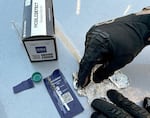
Portland Police officers use a fentanyl test kit during an arrest for drug possession in downtown Portland, Sept. 10, 2024.
Conrad Wilson / OPB
‘Continuous flame’ feature causing tragic burns
The researchers found the likeliest cause for the severe burns Thomas is seeing more often is the use of butane torches — a type of kitchen or camping tool that’s bigger than a standard lighter.
The Oregon researchers interviewed 19 people who smoked fentanyl and methamphetamine for the study, and they all said the torches are popular because they’re easier to use in the wind and can vaporize drugs for a “crisper, cleaner hit.”
Often those torches have a flame lock: a switch that keeps the flame on continuously, leaving the users’ hands free. Many of the participants said they’d used the lock while smoking, and said these burns can happen if a person passes out with the torch lock on.
Thomas and Englander believe the locking mechanism is particularly dangerous for people smoking fentanyl, a powerful sedative and pain reliever. A participant in the study reported watching a friend remain asleep while a torch burned through his hand.
“The potency of fentanyl overwhelms your system. If you don’t have control of that healing source, you’re going to get severely injured,” Thomas said.
Related: Only 1 in 5 people with opioid addiction get the medications to treat it, study finds
Thomas fears for the patients he treats. He believes that recovering from a major burn will make it harder for them to find a path out of addiction. Burns are permanent injuries that can create mobility issues and chronic pain, as well as differences in a person’s appearance.
“It leads to physical and mental trauma for the patient, no matter who they are,” Thomas said.
Some do find recovery. Like one of Thomas’s patients, a young man who needed to have his leg amputated. Thomas said the young man has been clean for two years, and recently got his first job and first apartment.
Englander says her message to her patients will be that the softer flame of a lighter is safer than a butane torch.
“The torches with the locks are really risky,” she said.
The widespread availability of torches with a locking function, Englander said, is something policymakers should consider changing.
