A historic strike at Oregon’s largest higher education institution has come to a close.
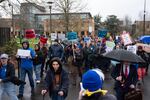
Portland Community College’s Federation of Faculty and Academic Professionals and Federation of Classified Employees union members chant as they march through the Portland Community College Cascade campus in Northeast Portland, Ore., while on strike on March 11, 2026.
Eli Imadali / OPB
Portland Community College and its faculty union, the Federation of Faculty and Academic Professionals, announced late Monday that their bargaining teams tentatively agreed to a new contract covering wages and other benefits.
In a post on their website headlined “When we fight we win!”, the union sounded triumphant following hours of mediation Monday after nearly a year of negotiations with administrators.
“The victory belongs to every single one of you!” the union’s online message said.
The faculty union agreed to the compensation increase of 2% in year one and 3% in year two — the same bump that administrators had presented in its “last best offer” shared Monday.
Payments to recover faculty’s lost wages during the strike was among the last remaining pieces of the deal. Union leaders said the back pay is especially important as teachers, who are not eligible for overtime, are now expected to complete nearly two weeks of missed work and prepare for the upcoming semester in just a handful of days. The back pay, called “one-time lump sum payments”, went up from the college’s final offer publicized earlier Monday.
Under the tentative agreement, full-time faculty members will receive $5,475 in lump payments, academic professionals will get $5,000 and part-time academic professionals and faculty will get $1,400.
In a statement announcing the agreement Monday night, PCC President Adrien Bennings called the end of the strike “an important step toward stability for PCC and the students we serve.”
But Bennings warned that the concessions made in the new faculty contract carry a cost.
“We are pleased to be moving forward and refocusing on our core mission of educating students and serving our community,” Bennings said. “At the same time, our hearts are heavy because we know that this agreement is so far outside of our budget that it will result in significant additional cuts in the future.”
FFAP members don’t have much time to celebrate — full-time faculty are expected to return to work Tuesday, with winter-term grades due by 8 PM Wednesday. Part-time faculty are expected to complete winter-term work and prepare for spring term this week.
Union members must still approve the deal in a ratification vote before teachers can go back to work. Voting is set to begin 8 AM Tuesday.
PCC’s staff union, the Federation of Classified Employees, agreed to a similar contract with the college last week.
These agreements come after the unions, which combined represent over 2,300 employees at PCC, commenced a nearly three-week work stoppage that ground classes and other college services to a halt.
The strike drew the attention of several local, state and federal politicians who urged college leaders to support PCC faculty and staff, including U.S. Sen. Jeff Merkley, D-Oregon, and Gov. Tina Kotek.
Both unions went on strike on March 11, after nearly a year of bargaining over salaries and benefits for the second half of separate four-year contracts.
The unions said they were fighting for a living wage that would keep up the rising cost of inflation. In a conversation with OPB’s Think Out Loud last week, FFAP’s President Ben Cushing said the cost of the faculty union’s wage package would be the lowest agreed to by the union in over a decade.
PCC officials had been saying they value their faculty and staff, but that the institution must be fiscally responsible amid increasing economic uncertainties. The college is projecting a $37 million budget over the next two years, largely driven by increasing personnel costs and flattening state support.
Bennings’ statement warning of looming budget cuts wasn’t the first such statement from college leaders. PCC’s bargaining website warned the new deals with the two unions will result in “significant additional cuts for the upcoming biennium.”
But union members have argued that the college does have money to spare for represented employees, pointing at administrators’ plans to deepen the college’s reserve funds from 9% to 12%.
The impact of the strike on PCC’s more than 30,000 students was serious. It began just before the winter term was coming to an end, lasted through spring break and pushed the start of spring term by a week.
Many students missed final exams and have not received final grades. The strike also jeopardized some students’ financial aid packages for the spring term and the immigration statuses of international students.
Despite these risks, many students had expressed their support for PCC faculty and staff, often joining them on the picket lines.
PCC announced last week that the spring term will start as previously scheduled, on March 30, but that the start date for the vast majority of classes at the college’s four campuses are delayed by a week. Administrators had been warning that if the strike had lasted much longer, spring term would have been additionally delayed and compromised.
This was the first-ever strike at a community college in Oregon, but it may not be the last this year.
Central Oregon Community College’s classified staff union announced last week that its members overwhelmingly authorized a strike. Picket lines could form at the Bend-based college as early as April 2.