Members of the Confederated Tribes of Warm Springs are mourning the death of Delvis Heath Sr., who served as the Warm Springs tribe’s leader and ambassador for more than four decades.
He died Sunday and will be buried at sunrise Wednesday. Heath was 87.
As chief, Heath played an important dual role: to uphold and remind members of his tribe of their traditional ways and values and to educate the outside world what it meant to be a sovereign nation.
And as a person, his friends and family members remembered him as a gifted storyteller, who loved riding horses, could hit his free throws on the basketball court, took up golf later in life and often broke out into a wide grin that could be contagious.
“I lost a good buddy,” said Louie Pitt Jr., the former director of government affairs and planning for the Confederated Tribes of Warm Springs. “A good friend. Great teacher, mentor, helped with all the tribes, not just Warm Springs … all the tribes of Oregon.”
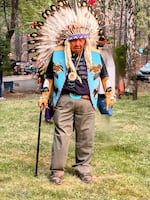
Warm Springs Chief Delvis Heath Sr. pictured at the Wasco County Fair and Rodeo in an undated photo.
Courtesy of Delson Suppah Sr. / Courtesy of Delson Suppah Sr.
Heath was instrumental in helping the outside world, including politicians in Salem, understand the Treaty of 1855 and what it meant to be a sovereign nation. The treaty created the Warm Springs reservation on a small portion of what had been the tribes’ 10-million acre territory. Oregon became a state three years later using that land.
In his early days as chief, Heath became friends with Republican Governor Vic Atiyeh and later Democratic Gov. Ted Kulongoski. On one trip to Salem in the 1990s, Heath told The Oregonian he was visiting the state Capitol for a straightforward reason to remind people, “We are a nation within a nation.”
Kulongoski remembered Heath on Tuesday as someone who wanted to make sure the state understood what it meant to be sovereign; that the tribes have their own government, judges, court systems and are independent of state government.
“He educated all of us,” Kulongoski said. “He educated me.”
Over the years, Kulongoski got to know Heath on a personal level. The chief threw a political fundraiser for Kulongoski at a Madras bowling alley decades ago with many tribal members. They had shirts made for people who showed up that read “I went bowling with Ted.”
“I thought I could bowl, that was a mistake I made,” Kulongoski said.
The former Democratic governor remembered one meeting on the Warm Springs reservation with the chiefs of Warm Springs, Paiute and Wascoes tribes where Heath spoke of his ancestors’ role of caring for the land and water that sustains life.
“He said, governor, you understand the sky and the rivers and the bear and the elk and the deer and the fish will always be here, we will always be here,” Kulongoski said. “I didn’t understand until I was driving home and realized that the ‘we’ did not include me.”
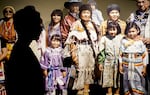
On March 18, 2023, Warm Springs Tribal Member Mason Frye stands silhouetted against images of those who attended the grand opening of the Museum at Warm Springs in March of 1993.
Emily Cureton Cook / OPB
Heath was also a driving force in the creation of the Museum at Warm Springs. Heath wanted the museum to be a place where younger tribal members could learn and understand the past. At the museum’s dedication, he helped lead the religious Washat service.
“We are still here,” Heath said. “And we are going to be here for many, many years. I want my people to know that.”
Delson Suppah, Sr., grew up with Heath, who was his cousin.
“A lot of our younger days were spent cattle riding and horse riding and taking care of them,” Suppah said of the animals. “And we went to boarding school and got exposed to basketball and he played basketball throughout his life.”
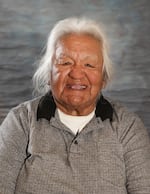
Delvis Heath Sr. was chief of the Warm Springs tribe for more than 40 years.
Courtesy of the Confederated Tribes of the Warm Springs
Later, Chief Heath ran horse stables at Kah-Nee-Ta Hot Springs Resort with his family. Heath’s brother, Martinez Heath, became a well-known jockey.
Suppah said his cousin, who started serving as chief in 1984, understood his role as chief. Heath’s father was also chief and died in 1969. But at the time, Heath said he wasn’t ready to take over and didn’t assume the leadership position until 15 years later, according to the tribe. Heath took over after Amos Simtustus Sr. died.
“He understood the traditional life of our people and that is the foundation of being the chief. To assure our traditional way of life is the best despite the encroachment of the immigrants who we are still trying to educate on how we are,” Suppah said.
And despite the sometimes serious nature of his position, Heath wasn’t afraid to goof around and had a sense of humor, Suppah said.
On Monday, Gov. Tina Kotek ordered flags at state public institutions to be flown at half-staff Tuesday and Wednesday in his honor.