Subscribe to OPB’s First Look to receive Northwest news in your inbox six days a week.
Good morning, Northwest.
The Trump administration has expanded an agricultural visa program known as H-2A — and slashed pay for those workers — to try to fill a farm labor shortage worsened by the president’s aggressive deportation campaign.
But as OPB’s Alejandro Figueroa reports, the move hasn’t yet taken hold in the Pacific Northwest. His story starts today’s newsletter.
Also this morning, allergies got you feeling that sneezy, itchy feeling? Spring allergy season is getting longer in Northwest cities, according to a new analysis.
Here’s your First Look at Thursday’s news.
—Bradley W. Parks

FILE - A farmworker (who chose not to provide his name) harvests cherries in Wasco County, Ore., July 2, 2025.
Morgan Barnaby / OPB
Trump administration push to bring more guest farmworkers is slow to take hold in Pacific Northwest
The Trump administration has made it cheaper and easier for farmers to bring temporary foreign farmworkers to the U.S.
But a push to expand the federal H-2A agricultural visa program might not solve a Pacific Northwest farm labor problem made worse by rigorous immigration enforcement campaigns — at least not right away.
So far in Oregon, there is no surge in visas.
And some advocates say these federal policy changes could also lower wages for local U.S. farmworkers, and possibly undercut them with a cheaper, temporary workforce. (Alejandro Figueroa)
📨 Are you enjoying First Look? Forward this email your friends.
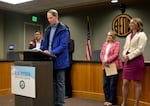
Sen. Ron Wyden, second from left, in blue, speaks at a press conference in Bend, Ore., Wednesday, April 1, 2026. Wyden and Central Oregon leaders say they're pushing back against the president's campaign to curtail vote-by-mail.
Jen Baires / OPB
3 things to know this morning
- Elected leaders in Central Oregon say they are worried the president’s false statements about the trustworthiness of vote-by-mail systems have already soured some voters ahead of the midterm elections. (Jen Baires)
- Yesterday, Portland city councilors unanimously advanced an ordinance that would raise the threshold for business license tax exemption for small businesses to $75,000 in sales this year and up to $100,000 in 2027. (Kyra Buckley)
- In a rare move, Oregon labor unions and advocacy groups are backing challengers to two sitting Democratic state lawmakers this year. (Dirk VanderHart)

People walk beneath the cherry blossoms on the University of Washington campus in Seattle. Northwest allergy season is getting longer, but it's mostly due to alder, birch and other trees, not so much cherry trees.
Headlines from around the Northwest
- Latest Oregon measles exposure site confirmed at Providence Portland (OPB staff)
- Why allergy season in the Northwest is nothing to sneeze at (Vaughan Jones, Patricia Murphy and Sami West)
- 2026 Newbery Medal winner Renée Watson returns to the Portland grade school where it all began (Geneva Chin)
- Drought emergency declared in Deschutes, Umatilla and Baker counties (Zac Ziegler)
- Popular campgrounds and recreation sites around Carmen-Smith Hydropower Project in Oregon will reopen this spring (Rachael McDonald)
- Ashland voters to decide on school levy renewal in May primary (Jane Vaughan)
Listen in on OPB’s daily conversation
“Think Out Loud” airs at noon and 8 p.m. weekdays on OPB Radio, opb.org and the OPB News app. Today’s planned topics (subject to change):
- Oregon secretary of state plans to challenge Trump executive order on mail-in voting
- As the West faces snow drought, ski resorts are scrambling
- Northern California condors suspected to be tending the region’s first egg in more than a century

FILE - Potatoes grown between solar panels in 2021. Another OSU research group is looking at whether potatoes could be grown on the moon.
Brandon Swanson / OPB
Potatoes on the moon? Oregon State University scientists show it could work
Picture it: You’ve traveled three days — nearly 250,000 miles.
You step off the space shuttle onto the powdery surface of the moon. You think to yourself, “Man, fries would hit hard right about now.”
Well, you could be in luck.
Researchers at Oregon State University have shown that potatoes can be grown in moon dirt, a substrate called “lunar regolith.”
But you have to add a little compost to get a decent harvest. (Jes Burns)
Subscribe to OPB’s First Look to receive Northwest news in your inbox six days a week.