Picture it: You’ve traveled three days — nearly 250,000 miles. You step off the space shuttle onto the powdery surface of the moon. You think to yourself, “Man, fries would hit hard right about now.”
Well, you could be in luck.
Researchers at Oregon State University have shown that potatoes can be grown in moon dirt, a substrate called “lunar regolith.” But you have to add a little compost to get a decent harvest.
The moon is covered in a fine rocky sediment created by millions of years’ worth of meteoroids hitting the surface. This regolith is completely sterile — no life, no microbiome, and very little nitrogen and carbon, all of which plants need to grow well.
Because actual moon-dirt is hard to get a hold of, the researchers used several Earth-made analogs that mimic the surface sediment from different lunar regions. Then they added different amounts of vermicompost, nutrient-rich organic matter made by worms.
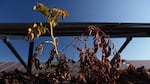
This file photo at an Oregon State University research farm shows potatoes being grown in the rows between solar panels in 2021. Now another OSU research group is looking at whether potatoes could be grown on the moon.
Brandon Swanson / OPB
Over the course of two experimental plantings, the OSU researchers grew Modoc variety potatoes in the different regolith/compost mixes, as well as in a native soil from Eastern Oregon for comparison.
The scientists found that while the potatoes did grow in pure lunar regolith, the plants were severely stunted. But with the addition of even 5% compost, the potatoes in some varieties of moon-dirt grew relatively well.
In addition, testing showed that the overall nutrition of the “moon-grown” plants were very similar to those grown terrestrially.
Of course, growing conditions on Earth are very different from the conditions plants would face on the moon. For example, there’s less gravity and more radiation, which could impact production.
Despite this, the research provides a promising indication that with the addition of a little compost, fresh French fries could be on the lunar menu in the future.
Now, if we could just engineer a FryDaddy to work in space...
The research is available in the online archive BioRxiv here. It is currently published as a preprint, meaning it has not yet been peer reviewed.
In these All Science Snapshots, “All Science. No Fiction.” creator Jes Burns features the most interesting, wondrous and hopeful science coming out of the Pacific Northwest.
Find full episodes of “All Science. No Fiction.” here.