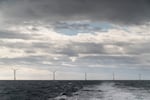
FILE - The five turbines of America's first offshore wind farm, owned by the Danish company, Orsted, are seen from a tour boat off the coast of Block Island, R.I., Oct. 17, 2022. Efforts to advance a floating offshore wind industry on the Oregon Coast have been challenged by opposition from coastal communities, tribes, the fishing industry and changing federal administrations.
David Goldman / AP
Oregonians have one more month to weigh in on the future of floating offshore wind energy in the state, including a path forward that would abandon the effort for now.
State officials extended the deadline to submit comments on the Oregon Offshore Wind Energy Roadmap from April 3 to April 27, before it goes to state lawmakers to inform energy policy proposals that could come up during the long legislative session in 2027.
Jeff Burright, who heads up the offshore wind energy work at the Oregon Department of Land Conservation and Development, said the extension is an effort to get more perspective from people who haven’t come to in-person or virtual meetings, and who also might have been bogged down earlier this year due to the legislative session.
The roadmap is part of a multi-year effort by state and federal officials and private companies to harness the power of ocean winds off the Oregon Coast to generate clean electricity. But the effort has been stymied by opposition from coastal communities, tribes, the fishing industry and changing federal administrations.
The roadmap outlines four paths forward:
- No offshore wind energy.
- Oregon develops a full-scale offshore wind energy industry.
- The state participates only economically in the offshore wind industry, such as parts manufacturing or research and development, but does not host projects.
- Oregon hosts a pilot offshore wind energy project to gain more experience before decisions to expand into a full-scale industry.
In 2021, the Oregon Legislature set a goal of powering 1 million homes with offshore wind by 2030, and former President Joe Biden set the goal of building up 15 gigawatts of offshore wind energy capacity along the coasts of the U.S. by 2035, with a total of 30 gigawatts deployed by 2030.
By 2024, the federal Bureau of Ocean Energy identified several sites off the coast of northern California and two sites off southern Oregon’s coast as having great potential for generating offshore wind energy. They included 61,200 acres off the coast of Coos Bay and nearly 134,000 acres off the coast of Brookings. The Coos Bay site is 30 miles from the coast, and the Brookings area is 20 miles away. Combined, they could potentially generate more than 3.1 gigawatts of renewable energy, enough to power 1 million households.
Informational meetings were held in coastal communities and federal officials prepared to auction off leases to wind energy companies to develop those sites.
“Starting in the middle of 2024, it looked like leasing was imminent, so there was a recognition that we needed to kind of sharpen our tools and figure out what standards we were actually going to hold for ourselves when we got to play at the federal permitting table, using the state’s authorities,” Burright said.
The state Legislature passed a bill directing the agency to plan for the state’s role with the roadmap.
“So we started down that path. And then, of course, everything changed,” he said.
By the fall of 2024, facing growing opposition from locals and calls to pause development from Oregon’s governor and congressional delegation, the ocean energy bureau called off its plans to auction off the sites, and potential developers pulled out. Then in July of 2025, as part of President Donald Trump’s overarching war against wind, the ocean energy agency rescinded all designated Wind Energy Areas identified for possible development on the U.S. Outer Continental Shelf, more than 3.5 million acres in all.
Emotions over the project were stirred in part, Burright said, because “the ocean is the commons. It’s something that we all have a part in owning. People generally, I think, all feel a connection to it. No matter where they live, people will visit the ocean, have some sense of connection and ownership over what it means to them.”
While Oregon decides on its ocean wind future, California is moving forward with its offshore projects, helped in part by a state energy department with the authority to buy the power itself and a grid run by the state, as opposed to the grid in the Northwest run almost entirely by the Bonneville Power Administration.
Burright said even though one of the paths in the roadmap is no offshore floating wind energy at all, he doesn’t think it would be the end of the story for Oregon’s efforts.
“They’re moving forward. We can learn from that,” he said of California’s plans. “And if we can identify — what does the path actually look like? What about for Oregon? That we can live with? And what are the things that we have to have in our pocket before we would ever say yes? Well, then, there’s at least a path that somebody could follow.”
Oregon Capital Chronicle is part of States Newsroom, a network of news bureaus supported by grants and a coalition of donors as a 501(c)(3) public charity. Oregon Capital Chronicle maintains editorial independence. Contact Editor Julia Shumway for questions: info@oregoncapitalchronicle.com. Follow Oregon Capital Chronicle on Facebook and Bluesky.
This republished story is part of OPB’s broader effort to ensure that everyone in our region has access to quality journalism that informs, entertains and enriches their lives. To learn more, visit opb.org/partnerships.