On Saturday, around 100 people gathered near Block 14 of Portland’s Lone Fir Cemetery to observe Qingming — a traditional Chinese festival honoring deceased ancestors at their tombs. Block 14 is a historic and largely unmarked burial site for early Chinese immigrants.
The event has been hosted since 2022 by the Lone Fir Cemetery Foundation, a nonprofit established more than a decade ago to raise funds for a memorial at Block 14 honoring those buried there.

People put flowers on the fence around Block 14, the historic burial site of early Chinese immigrants, at Lone Fir Cemetery in Portland, Ore., as part of an annual event observing Qingming festival on April 4, 2026.
Winston Szeto / OPB
This year’s event was different. In addition to marking the beginning of the memorial’s construction, it was the first time Multnomah County representatives read their apology at the cemetery for desecrating Block 14’s Chinese graves over five decades. County Chair Jessica Vega Pederson led the commissioners in delivering the acknowledgment.
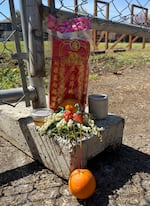
Qingming ritual offerings — including food, flowers and incense — are placed at the fence built around Block 14, the historic burial site of early Chinese immigrants, at Lone Fir Cemetery in Portland, Ore., on April 4, 2026.
Winston Szeto / OPB
Located in the cemetery’s southwest corner at Southeast Morrison Street and 20th Avenue, Block 14 was the burial ground for most of the more than 3,000 people of Chinese ancestry buried at Lone Fir Cemetery between the 1860s and the 1920s. This period was marked by widespread anti-Chinese racism, including laws that barred Chinese immigrants from entering the country and denied Chinese Americans the right to become U.S. citizens.
In the 1950s, when Multnomah County owned the cemetery, Block 14 was repurposed as a maintenance facility and parking lot. In 2004, when the county planned to sell the land for development, community members intervened, citing the likelihood that graves still remained.
Helen Ying is the vice president of the Chinese American Citizens Alliance, Portland Lodge, and the president of Lone Fir Cemetery Foundation. She advocated for the county’s apology for nearly 20 years before it was first delivered at a board of commissioners meeting last June.
Ying remembered how emotional and personal it felt to learn the full extent of this history.
“The county built a building on top of this burial ground, and it’s just unfathomable,” Ying said. “I don’t have ancestors buried there. However, my grandfather had experienced the kind of discrimination that the ancestors that are buried there would have encountered at the time.”
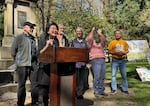
Helen Ying, president of Lone Fir Cemetery Foundation, speaks at the podium during the Qingming event the organization hosts at Lone Fir Cemetery in Portland, Ore., on April 4, 2026, with fellow board members (from left to right) Marcus Lee, John Laursen, Karin Hansen, Rachel Essig and David Dahl in the background.
Winston Szeto / OPB
According to the Metro regional government, which now owns the cemetery, many of the people buried at Block 14 — mostly men — were later exhumed and returned to China in accordance with cultural practices. However, some bodies, likely those of women and children, remain in unmarked graves at the site.
Marcus Lee, former chair of the history museum of the Oregon Chinese Consolidated Benevolent Association, said the organization once oversaw the disinterment of Chinese immigrants buried in the United States and arranged for their remains to be returned to their home villages in China.
Lee, also a board member of Lone Fir Cemetery Foundation, recalled that when Multnomah County planned to sell Block 14, CCBA helped uncover ledgers listing the names and origins of those buried there — records that had previously appeared in county documents in dehumanizing, anonymous terms.
“You would just see continuously page after page of ‘Chinaman.’ If it were a female, you’d see ‘China woman.’ You might see ‘China baby,’ which is pretty heartbreaking,” he said. “With the translation of the ledgers, that brings a greater reality to these individuals that have been forgotten.”
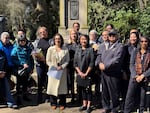
Helen Ying, center, stands next to Multnomah County Chair Jessica Vega Pederson in a family photo with the county's commissioners, Metro Acting President Duncan Hwang and members of the local Chinese American community, after Vega Pederson and commissioners have delivered an apology for the county's past wrongdoing on Block 14, at Lone Fir Cemetery in Portland, Ore., on April 4, 2026.
Winston Szeto / OPB
According to Metro, the translated information from these ledgers will be used to create “spirit tablets” — metal tablets inscribed with the names of those buried at Block 14. The tablets will form a tall circular screen around a central altar as part of the memorial, which has received more than $4 million in funding from a parks and nature bond approved by voters in 2019.
Acting President Duncan Hwang said Metro aims to complete the memorial by early 2027 and is working to stay on schedule and within budget. As the first Chinese American to serve on the Metro council, he said the memorial offers an opportunity to honor early Chinese immigrants who faced discrimination and to ensure their stories are recognized.
“Our stories actually do deserve to be told, and the public needs to understand that as well,” Hwang said.

Metro Acting President Duncan Hwang speaks at the Qingming event held at a central park area of Long Fir Cemetery in Portland, Ore., on April 4, 2026.
Winston Szeto / OPB
For CACA Vice President Helen Ying, raising public awareness about the history of anti-Chinese racism — especially among younger generations — is essential to preventing similar injustices in the future, particularly at a time when efforts around diversity and historical education are being challenged.
“This is not history for just the Chinese Americans [and] Asian Americans, and it is this United States history, and so everyone needs to know about it,” she said.