The U.S. Court of Appeals for the 9th Circuit heard from attorneys for the Trump administration Tuesday, who argued legal restrictions imposed on federal officers’ use of crowd control weapons during protests in Portland are unlawful.
Related: VIDEO: How Portland’s ICE protests took the national stage
The Justice Department asked the three-judge appeals panel to block two separate orders issued by two federal judges in Oregon that drastically limited when Homeland Security can use those weapons outside the Immigration and Customs Enforcement facility in the city’s South Waterfront neighborhood.
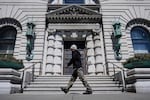
A man walks past the James R. Browning United States Courthouse building, a courthouse for the U.S. Court of Appeals for the Ninth Circuit, in San Francisco, Wednesday, Aug. 27, 2025. (AP Photo/Godofredo A. Vásquez)
Godofredo A. Vásquez / AP
“Chemical irritants are a critical, defensive law enforcement tool,” Brenna Scully, an attorney with the Justice Department’s civil division, argued Tuesday. “Limiting the government’s ability to use them based on the facts and circumstances facing officers irreparably harms the government.”
Tuesday’s arguments combined two legally different cases that had the same effect: drastic limitations on Homeland Security officers’ use of devices, including tear gas, pepper balls and flash bang grenades, directly outside the Portland ICE facility.
One of the lawsuits was brought by tenants at Grey’s Landing, an affordable apartment complex across the street from the ICE building, where residents say tear gas has seeped into their homes and harmed their health.

Gray’s Landing, an affordable housing apartment building, sits directly across the street from the U.S. Immigration and Customs Enforcement facility in Portland, Ore., as a few immigrant rights advocates and demonstrators stand outside the facility on March 16, 2026.
Eli Imadali / OPB
The other lawsuit was filed by protesters and independent journalists who argued their free speech rights were chilled after federal law enforcement officers targeted them with crowd control weapons.
In both cases, two federal district court judges granted preliminary injunctions limiting when officers can use those weapons to instances with specific and imminent threats of physical harm.
Kimberly Hutchinson, one of the attorneys representing protesters, pointed out to the appeals court that the lower court ruling found “defendants have an unwritten policy of using excessive force against nonviolent peaceful protestors at the Portland ICE building for the purpose of chilling the constitutional rights to free speech and the free press.”
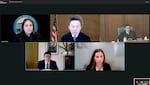
Attorneys for the Justice Department arguing before the U.S. Court of Appeals for the 9th Circuit on April 7, 2026. They argued that a court order limited federal officers' use of crowd control weapons at the Portland ICE building was too broad, and limited their ability to respond to protests.
Screenshot via the 9th Circuit Court of Appeals
At times, the three-judge panel appeared skeptical towards the Justice Department’s arguments — particularly those surrounding First Amendment protections for nonviolent protesters.
“We are talking about the First Amendment and one can allege injury based on First Amendment chill,” appeals court judge Eric C. Tung, who was appointed to the court by President Donald Trump last year, said to the government’s attorney. “You’ve got past incidences of purported targeting that have created this chill.”
Justice Department attorney Michael Shih responded, calling the protesters’ arguments weak.
“It’s not enough for plaintiffs simply to say, ‘Well, I allege that I’ve been chilled because I’m afraid that something bad might happen to me if I exercise my First Amendment right,’” Shih said.
Stephen Wirth, an attorney representing the tenants who live at the Gray’s Landing apartment complex, argued federal law enforcement knew the harm the chemical munition caused tenants and used them anyway.
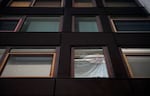
A window broken in a Gray’s Landing apartment as a result of a crowd control munition from the U.S. Immigration and Customs Enforcement facility which is across the street, in Portland, Ore., on Jan. 31, 2026. Federal officers used crowd control munitions, which included chemical and projectile munitions that evening.
Eli Imadali / OPB
He reiterated that the orders do not block the federal officers from using chemical munitions.
“These agencies do have tools they can use,” Wirth added. “Instead, what they’ve done on multiple occasions is attempt to create propaganda by saturating the area, videographing it and putting it up on their Instagram account. I think it’s inappropriate. The government has never denied that.”
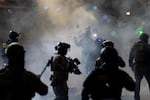
Federal officers deploy tear gas, flash-bangs and pepper balls on nonviolent protesters outside the U.S. Immigrations and Customs building in Portland, Ore., Oct. 18, 2025 in order to clear the driveway. About 500 people gathered outside the facility to continue protesting following the “No Kings 2.0” rally.
Eli Imadali / OPB
Appeals court judge Ana de Alba, who was nominated by President Joe Biden and confirmed to the court in 2023, turned to the Justice Department’s Scully, and asked her to respond to the assertion that “chemicals were being dispersed simply for purposes of political propaganda to be placed on social media feeds.”
“That answer is not in the record,” Scully replied, appearing to side-step directly answering de Alba’s question.

Attorneys representing the tenants and owners of the Gray's Landing apartments in Portland argue before the U.S. Court of Appeals for the 9th Circuit on April 7, 2026. They argued the repeated use of chemical munitions by federal officers at the nearby ICE building violated the bodily autonomy of tenants at the building.
Screenshot via the 9th Circuit Court of Appeals
The Justice Department’s Shih also addressed the use of force on protesters that was captured in numerous videos and testimony. Some captured nonviolent protesters being tear-gassed. Others showed officers spraying demonstrators who were passively resisting on the ICE building’s driveway at close range.
“There are many reasons why force might be excessive under the First Amendment that have nothing whatsoever to do with subjective intent to retaliate,” Shih said. “An officer might simply have been scared of a crowd.”
Appeals court judge Tung interrupted.
“Aren’t instances of excessive force — I mean, assuming they are in such instances — at least suggestive of retaliatory intent?” Tung asked. “It’s very difficult for plaintiffs to prove directly the state of mind of any particular officer. So they rely on circumstantial evidence. And if you have repeated instances of excessive force, isn’t that at least suggestive?”
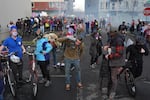
Protesters try to get tear gas out of their eyes and escape the area after federal agents deployed the chemical munition on a crowd of more than a thousand demonstrators, many of whom were with local unions and included elderly people and children, in the blocks surrounding the U.S. Immigration and Customs Enforcement facility on Jan. 31, 2026.
Eli Imadali / OPB
Shih acknowledged that it would be relevant to that determination, but instead suggested officers may also be responding to alleged crimes that justify force.
“Those are also relevant facts that would go to whether the force used was excessive,” he said.
Appeals court judge Kenneth Kiyul Lee, who was appointed to the court by Trump in 2019, said he reviewed video evidence from the Portland protests ahead of the hearing. He noted that the vast majority of the videos show “unrest or trespassing.”
“There are a couple of videos where it seems like a couple of the people are not necessarily trespassing or causing trouble, and one person is sprayed in the face and another person is knocked down,” Lee said. “What do we do with those videos?”
Appeals court judge de Alba later said she too watched them.
“I found them to be quite disturbing, not all of them, of course, but a big majority of it,” de Alba said. “I just don’t know how we’re justifying this.”
Shih responded to both judges by saying he could not speak to the actions of any particular officer.
“The point is the district court can’t simply assert with a broad brush,” he said.
In regard to any investigations DHS has into uses of force at the Portland ICE building, Shih told the court the same information several other Justice Department attorneys have stated during previous hearings in different cases:
“DHS has a few pending investigations into activities at the Portland ICE facility,” he said. “I’m afraid I don’t have any more information about that.”
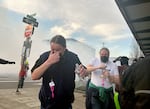
Tear gas used on protesters and children protesting at the Portland ICE building, after thousands gather downtown for ‘Labor Against ICE’ rally in Portland, Jan. 31, 2026.
Joni Auden Land / OPB