The federal Bureau of Reclamation has announced this year’s water allocation for farmers who rely on Upper Klamath Lake, setting it at 221,000 acre-feet — just over half of what growers typically need.
An acre-foot is enough water to cover one acre to a depth of one foot. Roughly two acre-feet equals the volume of an Olympic-sized swimming pool.
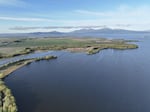
Aerial shot of Agency Lake, Upper Klamath Lake, May 19, 2024.
Todd Sonflieth / OPB
Snowpack levels are a key factor. In the Klamath Basin, snowpack is about 4% of average for this time of year — the lowest level since 2015, during a previous drought.
The bureau is limiting water use from Upper Klamath Lake to meet federal requirements. Court orders and agreements with local tribes require the agency to maintain lake levels to protect endangered sucker fish and release water downstream to support salmon in the Klamath River.
Last year, farmers received enough water to meet their needs for the first time in six years. A drought that began in 2020 sharply reduced irrigation supplies, including a complete cutoff in 2021, prompting a standoff by some growers.
“It’s much less than what we want to hear, although realistically not less than what we expected at this time,” said Elizabeth Nielsen, executive director of the Klamath Water Users Association, which represents farmers in the basin.
The association also criticized the existing regulations for allocating water in the Klamath Project.
“Right now, our drought problem is made worse by an ESA (Endangered Species Act) regulatory framework that was hurriedly adopted at the end of 2024,” said Scott Seus, president of the group’s board.
The group said it hopes a federal reconsultation process will result in changes to the framework before next year’s allocation decisions.
The bureau said the allocation is an initial estimate and could increase later in the year depending on conservation efforts and water conditions.
The agency also announced $19.1 million in drought resilience funding. Some of that money will go toward paying farmers to keep their land idle, with about 40,000 acres expected to be affected this year.
Roman Battaglia is a reporter with the Jefferson Public Radio newsroom. This story comes to you from the Northwest News Network, a collaboration between public media organizations in Oregon and Washington.
It is part of OPB’s broader effort to ensure that everyone in our region has access to quality journalism that informs, entertains and enriches their lives. To learn more, visit our journalism partnerships page.