After a historic spike in immigration enforcement in the Pacific Northwest last fall, newly released data corroborates that enforcement fell sharply in late winter.
Between Jan. 1, 2026, and the second week of March, roughly 890 people total have been arrested by immigration enforcement.
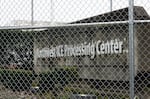
U.S. Immigration and Customs Enforcement has detained immigrants in custody at the Northwest ICE Processing Center in Tacoma since the facility's opening in 2004.
Stephani Gordon / OPB
But one thing has remained static: people with no criminal convictions continue to be apprehended.
The findings come from the latest batch of data published by the Deportation Data Project, a collaboration between multiple universities that obtain arrest data from the U.S. Department of Homeland Security through public records requests and lawsuits.
This latest release details immigration enforcement trends through March 11.

OPB filtered the data to focus solely on data relevant to U.S. Immigration and Customs Enforcement’s Seattle field office, which oversees operations in Oregon, Washington, and Alaska.
According to the data, roughly 260 people were apprehended by immigration officers in February – a steep decline from the 546 people picked up in January. October, November, and December saw more than 850 apprehensions each month as part of “Operation Black Rose.”
Related: After Trump called Portland ‘war-ravaged,’ ICE apprehensions near the city spiked 600%
Data from March is still incomplete. There is no data yet after the second week.
Still, the new numbers suggest that individuals with no criminal records continue to be targeted in high numbers.
Homeland Security categorizes people apprehended in three buckets: people with criminal convictions, people who have been criminally charged but not convicted, and “other immigration violators.”
That last group often encompasses people with no criminal records, and who only have immigration related charges like illegal entry.
Apprehensions of people with no criminal records spiked during the fall 2025 operation, with agents picking up more than 400 people in each of October, November, and December.
January saw fewer apprehensions, with 322 people with no criminal records picked up.
Whitney Phelps, an immigration attorney with the CLEAR Clinic, a nonprofit legal organization in Portland, said opponents of the Trump administration’s aggressive deportation agenda should be cautious despite the recent decline.
“There’s really nothing to prevent things from going back to what we saw in the fall,” Phelps said.
About the data analysis
OPB filtered data from the March 30 release of new data by the Deportation Data Project.
The data shows tens of thousands of rows signifying an individual’s apprehension by immigration enforcement.
The data includes information about the dates a person was arrested, where the arrest occurred, their criminal history, and other factors.
OPB then filtered the dataset by the data’s “area of responsibility” value – which lists the name of the Homeland Security field office that conducted the arrest – to focus solely on the Seattle Area of Responsibility.
That field office is responsible for all of Alaska, Oregon, and Washington.
The data was used to create another table that filtered the number of arrests under the Seattle Area of Responsibility by two factors: the month and year the arrest occurred, and the listed criminality of those arrests.