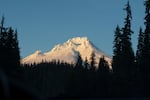
Mount Hood and Mount Hood National Forest on Dec. 12, 2025.
Saskia Hatvany / OPB
Before issuing sweeping protections on more than 30% of U.S. Forest Service-managed lands in 2001, federal officials spent more than a year holding 600 meetings across Western states and received more than 1.6 million public comments.
But federal officials have not held a single public meeting since they announced in August an effort to terminate the 2001 Roadless Rule, which prohibits road construction, logging and mining on roughly 60 million acres of public land, including about 2 million acres of forests in Oregon. Forest Service officials did not respond to questions from the Capital Chronicle Thursday morning.
Instead, U.S. Rep. Andrea Salinas — a Democrat representing Oregon’s Willamette Valley and ranking member of the House Agriculture Committee’s forestry subcommittee — and several conservation groups led by the Oregon chapter of the Sierra Club are taking up the mantle.
Salinas and the Sierra Club hosted a public meeting Wednesday at the Ecotrust building in Portland, where roughly 60 audience members could give verbal comments or submit written ones. It was one of three public meetings on the Roadless Rule they scheduled this month, including a Monday meeting in Bend with roughly 150 attendees, according to organizers, and another scheduled for April 14 in Eugene.
Related: What the reorganization of the U.S. Forest Service will mean for the Pacific Northwest
The U.S. Department of Agriculture has so far opened a single three-week comment period since its leader, Brooke Rollins, proposed terminating the rule in August. Salinas told the audience a second comment period would open soon. The first public comment period brought in more than 600,000 comments, most of which expressed opposition to any rollback of the Roadless Rule.
“Our next opportunity for public comment will open any day now, and I will again use this opportunity to demand this administration change course,” Salinas said.
Last summer, she introduced the Roadless Area Conservation Act to enshrine the rule in federal law, but it does not yet have enough support to pass. In the House, 78 of her colleagues have signed on as co-sponsors, including Oregon Democratic Reps. Suzanne Bonamici, Janelle Bynum and Maxine Dexter, as have 25 U.S. Senators. The state’s two other representatives, Democrat Val Hoyle and Republican Cliff Bentz, have not signed on as sponsors.
What roadlessness protects
Roadless areas in Oregon include Iron Mountain in the Willamette National Forest, Joseph Canyon in Wallowa County, Tumalo Mountain in central Oregon and Lookout Mountain in the Ochoco National Forest.
Jared Kennedy, who works for the Greater Hells Canyon Council in Enterprise, said at Wednesday’s meeting there are already 26,000 miles of roads across Forest Service lands in eastern Oregon, southeast Washington and north-central Idaho.
“That’s more than enough miles of road to circle the Earth and then still drive to Portland from Enterprise and back,” he said.
Some attendees had worked on passing the Roadless Rule and spoke at public meetings the Forest Service held in 1999 and 2000. Among them was Kristin Faulkner, who said issues that spurred the rule in the first place have only gotten worse, as climate change, declining snowpacks and biodiversity loss accelerate drought, floods and wildfire.
“Here we are 26 years later, or six presidential terms later, or a generation later, to again defend why we desperately need the Roadless Rule to remain fully intact more than ever before,” she said.
She and others argued that intact forests have far-reaching benefits, including keeping water clean for fish and humans. Nearly 90% of people in the West are served by public drinking water systems that rely on water from national forest and grasslands. Commenters also discussed the massive amounts of carbon forests take-in and store, and that would otherwise enter the atmosphere as gas, further increasing global temperatures and climate change.
The largest roadless area in the U.S., the Tongass National Forest in Alaska, holds 44% of all the carbon stored by the United States’ national forests and is home to some of the last old-growth stands in the country.
Related: US Forest Service to close Portland headquarters, research station, open Salem office
A firefighter at the meeting discussed his concerns with more roads in forests given 85% of wildland fires are caused by humans, and 90% of those start within a half mile of roads, according to Forest Service data. Others discussed the already low funding and growing backlog of maintenance needs on existing roads in national forests.
Jordan Latter, a manager at Bark, a conservation watchdog group dedicated to protecting the Mt. Hood National Forest, cited a recent Pew Charitable Trusts report showing a $6.4 billion road maintenance backlog within the National Forest system. He added that the roads in Mt. Hood alone need $72 million of investment to be brought up to standard.
“And what is in the president’s fiscal year 2027 budget proposal? $73 million for road maintenance — for the entire National Forest system,” he said.
Oregon Capital Chronicle is part of States Newsroom, a network of news bureaus supported by grants and a coalition of donors as a 501(c)(3) public charity. Oregon Capital Chronicle maintains editorial independence. Contact Editor Julia Shumway for questions: info@oregoncapitalchronicle.com. Follow Oregon Capital Chronicle on Facebook and Bluesky.
This republished story is part of OPB’s broader effort to ensure that everyone in our region has access to quality journalism that informs, entertains and enriches their lives. To learn more, visit opb.org/partnerships.