
Out and about in Oregon, you will see pets. It may be an adventure cat on a paddle board or llamas at the airport.
If you’re in Bend on the Fourth of July, thousands of pets take over the streets for the city’s largest annual parade that’s been a tradition for over a century.

Talyn Elliott snaps a selfie with his camel Hilde in Grant County in this undated photo.
Courtesy Talyn Elliott
In John Day, you may see Hilde the camel and her newborn Cora.
With a plethora of pets in Oregon, the state gets called pet-friendly all the time, topping lists like how the best dog parks are here, how Bend has the country’s highest demand for pet sitters and how the state has the strongest animal protection laws.
The Oregon Legislature even adopted a resolution in 2023 to make shelter dogs and cats the official state pet.
How did the state develop such an affinity for animals? Looking beyond recent headlines, Oregon’s history of pet companionship sheds some light.
Paw prints of the past
Oregon is currently home to 4 million people — and many, many pets. An estimated 92% of adults in Oregon have owned a pet in their lifetimes.
There’s a particularly long tail of dog ownership in the Pacific Northwest.
The Coast Salish people bred and kept woolly dogs, a breed unique to the Pacific Northwest. Meriwether Lewis’ canine companion Seaman joined the full trip of the Corps of Discovery. And from diary entries, we know there were dogs who traveled with settlers on the Oregon Trail.
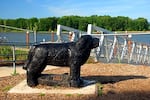
A statue of Seaman the dog, who traveled to Oregon on the Corps of Discovery expedition, along the Columbia River in St. Helens, Ore., as pictured in May 2009.
Gary Halvorson / Oregon State Archives
Oregon became a state in 1859. Less than a decade later, one of the oldest organizations of its kind in the country got its start.
Founded in late 1868, the Oregon Humane Society is only two years younger than the American Society for the Prevention of Cruelty to Animals (ASPCA). But it’s nearly 10 years older than the American Humane Society.
Today, the main OHS campus in Portland includes adoption services, a shelter hospital, a community hospital and a behavior training and rescue center. Since 2022, OHS also has a campus in Salem.
“Just seeing them wag their tails is amazing. The little things that make me so happy,” said Tanya Roberts, director of training and behavior at OHS.
When animals come to OHS, “they have no idea how to be pets,” said Roberts. “They exist in their only world that they’ve ever known, and that’s usually a barren world where there’s not enough food, there’s not any socialization. There’s not a lot of enrichment. All the things we take for granted with our pets.”

Tanya Roberts, director of training and behavior at Oregon Humane Society, reaches down to greet a dog at the campus in Portland, Ore., Feb. 11, 2026.
Cameron Nielsen / OPB
The Oregon Humane Society is the oldest and largest organization dedicated to pet welfare in the state, but it has a large partner network in Oregon and beyond.
In total, Oregon has easily over 100 animal rescue oriented organizations, including many run entirely by volunteers.
Along with historic dedication to pet shelter and adoption, Oregon also has a long legacy of veterinary care.
In 1889, the Oregon Legislature created the Oregon Domestic Animal Commission and the role of state veterinarian. Fourteen years later, the Oregon Veterinary Medical Examining Board was established.
Related: Mobile veterinary team helps Indigenous communities reduce overpopulation of stray dogs and cats
According to a study of 2020 census data, Oregon has the eighth most employed veterinarians per 100,000 people, the best ranking of Western states.
From a pet’s first check-up to when it’s time to say goodbye, veterinarians and others in Oregon come together to better the lives of animals.
The countless caretakers
In February, OPB traveled the Willamette Valley and Eastern Oregon to meet a number of animal advocates.
The mobile veterinarian
On a sunny late winter morning, Dr. Haley Beamon of Northwest Mobile Vet drove to an appointment at a home farm in Clackamas County with goats and chickens — some of her favorite animals to treat.
Dr. Beamon sees clients across species across our region.
“Goodness, on a given day, I would say we travel maybe 200 miles round trip,” said Dr. Beamon. “I can help mama goat give birth and then, you know, say goodbye to somebody’s 18-year-old kitty cat.”
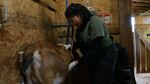
Dr. Haley Beamon performs an exam on a goat at a home farm in Clackamas County, Ore., on Feb. 6, 2026.
Cameron Nielsen / OPB
In addition to helping pets, Dr. Beamon feels fulfilled in her work for another reason: representation.
“Being a Black woman in this profession is super important,” she said. “Personally speaking, I didn’t see my first Black veterinarian until I was like 18 years old.”
“It brings me joy to see kids like, ‘oh my goodness, that’s a veterinarian, she’s a Black woman. I can do this. I can do this when I grow up.’”
Related: From giant pandas to black rhinos, Oregon Zoo veterinarian shares his remarkable journey
The Facebook group founder
In Grant County, there are about 7,000 people and one stop light.
Kim Essex saw a need for more support for pets in the county and greater Eastern Oregon. So in 2012, she created the now 40,000-member Eastern Oregon Pet Lovers Facebook group.
Essex was inspired when she saw a post about a lost black lab named Oso, and felt inclined to help — she went on to assist in finding him.
“With no experience with Facebook whatsoever, I just sat down one day and said, ‘I’m just gonna start a pet group’ because I can look out for the animals’ welfare and make sure that they find good families, make sure they have their vaccines,” said Essex. “And it just grew to be bigger than I could ever have imagined it would be.”
Essex coordinates the group entirely in her free time — her full-time job is unrelated to animal welfare — and says she puts in “probably three to four hours a day, and sometimes late into the night.”

Kim Essex, founder of the Eastern Oregon Pet Lovers Facebook group, sits at her dining room table with her laptop in her Grant County home on Feb. 26, 2026.
Cameron Nielsen / OPB
Essex shared with OPB stories of neglect cases she’s seen over her 14 years leading Eastern Oregon Pet Lovers, but also lit up talking about successes, such as many happy endings reuniting lost pets with their families — the reason that spurred the group in the first place.
Eastern Oregon Pet Lovers has provided near-instant help locating missing animals, including pets displaced in car crashes and wildfires.
Through the group, Essex and her partners have connected thousands of people and pets seeking assistance with resources for care like spay and neuter. Essex also uses the group to uplift small rescues like Hope4Paws: Grant County, Pendleton Paws, Best Friends of Baker and Fuzz Ball Rescue.
“The community spirit of Eastern Oregon and all of Oregon is amazing. They will step up and help in any way they can,” said Essex.
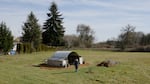
At Friend to Fern on Sauvie Island, Ore., Pippa Stasiuk walks to her business' pet composting bins on Feb. 4, 2026.
Cameron Nielsen / OPB
The end-of-life entrepreneur
The last act of animal welfare is death care.
After pets die, most are cremated. A first-of-its-kind business in the Portland metro area offers a different option for saying goodbye.
Natural organic reduction is the decomposition of a body when microbes and organic material, like manure, convert the remains into compost – a.k.a. human composting.
Washington was the first state to legalize human composting in 2019. Oregon followed in 2021.

Friend to Fern founder Pippa Stasiuk looks down at one of her business' pet composting bins on Sauvie Island, Feb. 4, 2026.
Cameron Nielsen / OPB
Pippa Stasiuk owns and operates Friend to Fern, which provides pet composting on Sauvie Island.
“When I went into this, I came at it from the environmental angle. Because that was what most resonated with me as a way to make a difference,” said Stasiuk.
“What I’ve learned is that this is a sacred space of grief, and I think I’ve learned a lot about the bond between animals and their owners. And the depth of grief that the loss of a pet brings.”
Related: How a Portland nonprofit has helped grieving pet owners for decades

A Friend to Fern pet compost bag, Feb. 4, 2026.
Cameron Nielsen / OPB
Companions in cinema
While most Oregonians are pet guardians and advocates, the state’s outdoors are a big reason why it’s considered so pet-friendly, from the fully publicly accessible coastline to trails galore.
Oregon’s landscapes are cinematic quality.
In fact, the rugged terrain of Eastern Oregon inspired not one but two Disney movies for sets with pets.
The 1993 film “Homeward Bound: The Incredible Journey,” arguably the most famous movie about lost pets, was filmed in the Wallowas — not the Sierra Nevadas like the script says.
And in the credits, the Oregon Humane Society is named as an organization who oversaw the treatment of animals in the movie.
While lesser known, a 1972 movie shot in and around John Day featured a unique pet: a lion named Major.
“Napoleon and Samantha” stars young Johnny Whitaker and Jodie Foster as the title characters. After the death of his grandfather, Napoleon decides to leave home with Major and Samantha joins.
On screen and in present day Oregon, pets are a large part of the state’s identity.
Across species and years, pets have been by most Oregonians’ sides. And we have been by theirs.

This story was written and reported by Meagan Cuthill and edited by Arya Surowidjojo. The short documentary was filmed and edited by Cameron Nielsen with additional cinematography by Brandon Swanson. Illustration by Jenny Davanh.