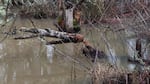
This March 13, 2026 photo show one of many trees in the pond along Mulkey Creek that have been gnawed by beavers. The animals eat the cambium, a layer of soft inner bark.
Zac Ziegler/KLCC
The Bald Hill multi-use path draws a lot of people, be they hikers, runners, cyclists or those out walking their dog.
“This path is probably one of the most popular ones, I would say, in the Corvallis area, for all sorts of people to come out and recreate,” said Kendra Callahan of Greenbelt Land Trust, a land conservation nonprofit.
But dogs aren’t the only four-legged animals who frequent the area.
Old residents have returned in recent years. Beavers built a dam on Mulkey Creek near where it crosses under the paved path.
That led to frequent flooding and closures of a trail that offers people of a variety of abilities the chance to get outside and enjoy Bald Hill Natural Area.
When people began looking for a solution to the problem, a variety of groups ranging from governmental entities like the National Oceanic and Atmospheric Administration and the City of Corvallis, to nonprofits like Marys River Watershed Council and Greenbelt, decided to work together on a solution.
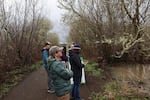
In this March 13, 2026 photo, Greenbelt Land Trust's Kendra Callahan (foreground center) looks at the beaver pond along the Bald Hill Multi-Use Path along with others representing groups that worked on the notch exclusion fence.
Zac Ziegler/KLCC
What they settled on is a relatively simple fix that’s been used elsewhere in the country, but, to the group’s knowledge, is a first in Oregon: It’s called a notch exclusion fence.
“Essentially what you do is you make a notch in the beaver dam to drain some of the water, keep the path dry, but leave enough water in the pond,” said Greenbelt’s Matt Benotsch.
Then, they built a box around it using material like chain link fencing, the gridding of which needs to be a certain size.
“Big enough to allow fish passage, small enough that a beaver can’t get in there to repair the notch,” said Benotsch.
Allowing the dam to drain to a certain level means the path stays clear much of the time while allowing beavers access to an area they once called home in much larger numbers.
“Before there was any settlement and trapping of beavers in this area, every mile you would have found a beaver,” said Callahan. “They were just super critical. They’re a keystone species for keeping healthy river systems intact.”
They also created wetlands that allow water to seep into the ground, raising the water table and creating habitat that is valuable as conditions get drier and warmer.
“[Water entering the soil] creates things like fire breaks, as well as much cooler temperatures for the water, because just like if you go into a cave, it’s cooler,” said Nina with the Marys River Watershed Council. “And so when it reenters the flow downstream somewhere, it’s cooler than it would be if it was just sitting in the sun.”
That cooler water is good for salmon in area waterways.
Beavers are often only visible at dawn and dusk, so daytime visitors will likely not see the animals creating this new habitat. But they will see other animals that utilize the slowed water, such as ducks and salamanders.
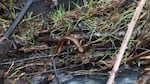
A salamander sits on the edge of a beaver dam on Mulkey Creek near Corvallis on March 13, 2026.
Zac Ziegler/KLCC
And this particular location allows a wider variety of people who would normally not be able to head into more rugged terrain to see what beavers do in the environment.
“People with limited mobility, especially those in wheelchairs or those who can’t walk very far, can now come up close and see the beavers for themselves, as opposed to having to hike or maybe not even see them at all,” said Jenna Leichner with Corvallis Parks and Recreation. “So this is honestly a wonderful gift.”
Among those who get that chance are Krista Anderson and Jen Felin, who walked by the dam with four small children.
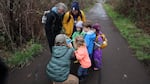
Kendra Callahan teaches a group of children who were walking on Bald Hill Multi-Use Path about beavers.
Zac Ziegler/KLCC
The children played around an A-frame sign as they listened to Callahan’s lesson on beavers, describing their flat tails, second set of lips and iron-enriched orange teeth.
For Dominici and others, the moment is an example of what it means to find a way to allow beavers and humans to coexist in an accessible place.
“We can show people right here, four feet away, this is what beavers are doing on any property,” she said.
It shows how a keystone species that shaped the area is still around and capable of benefitting a variety of life, including humans.
Zac Ziegler is a reporter with KLCC. This story comes to you from the Northwest News Network, a collaboration between public media organizations in Oregon and Washington.
It is part of OPB’s broader effort to ensure that everyone in our region has access to quality journalism that informs, entertains and enriches their lives. To learn more, visit our journalism partnerships page.