Illustration of a hand metaphorically placing a bet on a mobile prediction market. Assets courtesy of Canva.
Teo Popescu / KUOW
Washington is joining the queue of states bringing legal action against Kalshi, a popular prediction market. The platform allows users to wager money on everything from sports games, to politics, to pop culture — and even military actions.
Prediction markets, including PredictIt, Kalshi and PolyMarket, pay dividends based on the outcome of real-world events. Anyone can buy a share in the markets and will either gain or lose money based on the outcome they pick. Companies who run these markets say their model deals in event contracts, similar to the stock market. Washington’s attorney general says otherwise.
“Under longstanding, well-established, and unambiguous Washington state law, Kalshi’s gambling operation is illegal,” the attorney general’s office wrote in a complaint filed in King County Superior Court.
Kalshi did not respond to KUOW’s request for comment on the lawsuit.
Washington’s complaint asks federal judges to stop Kalshi from operating in the state. It also demands that Kalshi repay money lost by Washingtonians on the platform.
Washington’s lawsuit comes on the heels of other legal showdowns. Arizona brought criminal charges against Kalshi last month, and Nevada is embroiled in a court fight as it attempts to force the company to abide by state gambling regulations.
How we got here
Sports gambling was outlawed in the United States in 1992, when Congress passed the Professional and Amateur Sports Protection Act (PASPA).
New Jersey sued over the ban in 2010, and in 2018, the act was overturned by the U.S. Supreme Court. That ruling handed regulatory control over sports betting to states.
Today, 40 states allow sports gambling in some form and the industry rakes in roughly $1 billion each month. Washington passed a state law in 2020 allowing betting at tribal casinos, but online gambling is banned in the state. Most other states, including Oregon, allow online sports gambling on digital platforms like DraftKings and FanDuel.
Online access is one of the largest risk factors for problem gambling, one reason the Washington State Legislature banned gambling online in 2006.
Luke Burbank, co-host of the podcast “Too Beautiful to Live” and a life-long Seattle sports fan, lives in Kalama, Washington, near the border with Oregon.
“I live in a place where I can’t just open up my phone on a Sunday morning and put some bets down on my Seahawks players,” he said. But Burbank said that changes when he is at his girlfriend’s house in Portland.
“I absolutely put some bets on my phone,” he said. “So, it’s totally driven by my access to doing it.”
As online sports gambling grew in popularity, a new kind of company appeared on the scene: prediction markets.
Ongoing legal battle
Washington Attorney General Nick Brown argues that Kalshi meets the state definition of illegal gambling. The term is defined in Washington state law as “staking or risking something of value upon the outcome of a contest of chance or a future contingent event.”
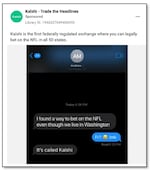
A social media post sponsored by Kalshi and included in Washington state's legal complaint against the company. The complaint alleges that Kalshi advertised itself as a way to circumvent Washington's ban on online gambling.
Courtesy of the state of Washington
Chris Louis, a professor at Boston University’s School of Public Health who studies sports gambling, said the line between gambling on a sports game and putting money in a prediction market is a thin one.
“To me, there’s no difference between what they’re doing in the stock market versus what they’re doing in Kalshi and PolyMarket and some of these other [prediction markets], and what’s being done with sports betting,” he said. “It’s all risking your money on an outcome that you don’t know the answer to.”
But when it comes to the law, the nuance between futures trading and gambling is clear. In a case brought by New Jersey last year, Kalshi argued that prediction markets do not fall under a state’s jurisdiction. Instead, the company pointed to the Commodity Futures Trading Commission (CFTC), the federal agency that oversees derivative markets. Kalshi and other prediction markets have licenses from the CFTC to trade in event contracts.
A panel of judges ruled 2-1 in favor of Kalshi in that suit, and the CFTC recently sued Arizona, Connecticut and Illinois over legal action in those states against prediction markets.
“The CFTC will continue to safeguard its exclusive regulatory authority over these markets and defend market participants against overzealous state regulators,” CFTC Chairman Michael Selig said in a press release.
A ruling in Washington state’s case is likely some months away. In the meantime, Kalshi remains available and legal for betting on everything from when traffic on the Strait of Hormuz will return to normal to who will win Survivor Season 50.
Clare McGrane and Teo Popescu are reporters with KUOW. This story comes to you from the Northwest News Network, a collaboration between public media organizations in Oregon and Washington.
It is part of OPB’s broader effort to ensure that everyone in our region has access to quality journalism that informs, entertains and enriches their lives. To learn more, visit our journalism partnerships page.
Note: If you or someone you know may have a gambling problem, services are available by calling the problem gambling helpline at 1-877-695-4648 in Oregon and 1-800-547-6133 in Washington.