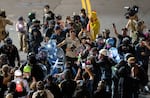
FILE - Masked-up federal agents confront the protesters outside the U.S. Immigration and Customs Enforcement facility in Portland, Ore., on Sept. 28, 2025.
Kristyna Wentz-Graff / OPB
Newly released court documents detail federal officers’ first-hand accounts of protest activity and what led them to use force outside the Immigration and Customs Enforcement building in Portland over the summer and fall.
The redacted accounts are part of records released Thursday by the U.S. Justice Department after a coalition of news organizations, including Oregon Public Broadcasting, filed a motion to unseal court documents from the federal government related to President Trump’s attempt to deploy the National Guard in Portland last year.
Between June and September, Homeland Security officers in Portland used crowd control weapons on more than a dozen occasions while responding to protests near the ICE facility, OPB found when reviewing the documents. The records consist largely of incident reports from the Federal Protective Service, one of the lead Department of Homeland Security agencies stationed at the facility.
Intermittent demonstrations outside the ICE facility have continued since June. In recent months, uses of force by federal officers has been the subject of two separate lawsuits that both resulted in judges issuing injunctions limiting officers’ use of munitions. Both cases are currently before the U.S. Court of Appeals for the 9th Circuit.
The documents contain the most detailed insights yet into the mindsets of the federal officers deployed at the frequent protests. A federal judge, who reviewed the sealed accounts, found the protests were largely peaceful and did not require military intervention. A federal judge also found that Homeland Security officers had an unwritten policy to use excessive force on nonviolent protesters to chill constitutional rights.
Related: Portland immigration operation spanned months, included 100 ICE agents
The incident reports largely focus on shouting and “snarling” protesters who kicked, bit and threw rocks.
“I detected and observed a large rock coming at a high rate of speed towards me,” one federal officer wrote in an incident report from July. “I was then struck by the rock and sustained an injury to my left shin.”
Other reports describe protesters throwing fireworks or glass bottles at federal officers. One officer reported firing pepperballs at a protester who kicked a “burning CS gas canister” at the officer.
“I shouted for him to ‘Stop!’ and fired multiple 2-3 round bursts at his body,” the officer wrote in an incident report. “I observed my balls impacting his stomach and back as he moved, and he retreated back into the crowd.”
The incident reports note at least one effort by federal officers to deescalate a situation with protesters by returning inside the Portland ICE facility. Other documents describe arrests by federal officers, including a person who was arrested after shooting two fireworks that exploded against the ICE building. At one point, an FPS inspector “deployed pepper spray to move two subjects away from officers.” While the protesters weren’t hit by the spray, “most of the officers felt the effects of its use.”
OPB joined with The Oregonian, The Associated Press and a coalition of news organizations in ongoing litigation over the sealed documents.
Related: Federal officers’ tear gas tactics in Portland head to appeals court
They represent only a small portion of all the records connected to the Trump administration’s efforts to deploy the military to American cities. While detailing numerous confrontations between protesters and federal officers, the reports also show that in the week before Trump called the National Guard into the city, federal officers reported a number of peaceful protests.
Trump announced on Sept. 27 he was attempting to send the military to Portland. That same day, his administration launched an unprecedented immigration enforcement campaign, “Operation Black Rose,” that resulted in more than 1,100 arrests from across the region.
The City of Portland along with the states of Oregon and California successfully sued to block the National Guard troop deployment.
After a three-day trial in late October, U.S. District Court Judge Karin Immergut concluded, “the President did not have a lawful basis to federalize the National Guard.”
Immergut, who Trump appointed to the federal bench during his first term, noted in her 106-page ruling there was some violence, but “the protests outside the Portland ICE facility have been predominately peaceful, with only isolated and sporadic instances of relatively low-level violence, largely between protesters and counter-protesters.”
Trump announced in December that he would abandon his efforts to deploy the National Guard after the U.S. Supreme Court ruled against the administration in a similar case in Illinois. Speaking to reporters in early January, he said they may return to Portland “at the appropriate time.”
At the same time, federal officers still assigned to the ICE facility have come under scrutiny for excessive force and widespread use of crowd control weapons as protests have continued in 2026. Two federal judges in Oregon drastically curbed officers’ use of those munitions before a federal appeals court stepped in. The Ninth Circuit paused those orders as it considers their legality. The court’s decision is pending.
OPB’s Troy Brynelson and Michelle Wiley contributed to this report.