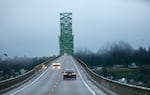
FILE - The Astoria-Megler Bridge, southbound towards Astoria, Ore., on Aug. 11, 2024. The bridge carries Highway 101 across the Oregon-Washington border.
Anna Lueck / OPB
If you’ve ever driven to the Oregon Coast, you’ve likely been on Highway 101. The scenic roadway was officially designated a federal highway 100 years ago, in 1926. The highway changed how people across the state accessed the coast, bringing new opportunities for industry and tourism from Astoria to Brookings.
The Oregon Historical Society is celebrating the highway’s 100th anniversary with an exhibit that runs through Oct. 11. Megan Lallier-Barron, curator of exhibitions for OHS, joins us to share more about the history of Highway 101.
Note: The following transcript was transcribed digitally and validated for accuracy, readability and formatting by an OPB volunteer.
Dave Miller: This is Think Out Loud on OPB. I’m Dave Miller. If you’ve ever driven along the Oregon coast, you’ve likely been on Highway 101. The scenic roadway was officially designated a federal highway 100 years ago. It changed how people across the state accessed the coast, bringing new opportunities for industry and tourism from Astoria down to Brookings. The Oregon Historical Society is celebrating the highway’s 100th anniversary with an exhibit that’s open now. It runs through October 11. Megan Lallier-Barron put the exhibit together. She is a curator at OHS and she joins us now. It’s great to have you on Think Out Loud.
Megan Lallier-Barron: Thank you for having me.
Miller: How did people navigate along or near or around the coastline before Highway 101?
Lallier-Barron: Well, certainly there were Native communities who lived on the coast who developed a series of trail networks along the coast, and then as you have non-native migrants coming to the Oregon coast to live, a lot of those early Native routes are adapted for roadways. So there were a number of roads divided by sections of the coast that were developed at very different times.
Miller: So it was not possible, though, to traverse the entire coast?
Lallier-Barron: I think you could theoretically do that, but it would take a lot of time and a lot of energy to do so.
Miller: And a lot of zigging and zagging, I imagine.
Lallier-Barron: Absolutely.
Miller: When did the idea to build a coastal highway first come about?
Lallier-Barron: It first came about in 1917. Ben Jones, who was a member of the Oregon legislature for Lincoln County, suggested a military highway. This was during World War I, so the idea that the coast could be potentially affected by that war spurred the need for a military highway on the coast.
Miller: What is a military highway?
Lallier-Barron: It’s a federal designation – I should also mention it didn’t become a military highway. But it’s a designation that essentially means a road needs to be constructed in a particular way so it could withstand the weight and traffic of military personnel and equipment.
Miller: Big convoys.
Lallier-Barron: Absolutely.
Miller: Which actually does sound a lot more like the interstate system that developed with a lot of money during the Cold War, later. But let’s stick with the earlier parts of the 20th century. How big a challenge was it, engineering-wise, to build Highway 101?
Lallier-Barron: Very challenging. I think the original idea to design the Coast Highway was for both industry but also tourism. So they wanted to construct a highway that could get people from point A to point B but also have a beautiful drive.
If you look at a map of the Coast Highway, it hugs the Oregon coast pretty tightly. So in order to do that they required, in some places, boring through hundreds of feet of rock to build tunnels. There are a number of bridges that span the Coast Highway that required a lot of engineering to figure out, so it was pretty technically challenging.
Miller: It is fascinating though, that from the beginning it was designed with both tourism, meaning some kind of aesthetics or driver appreciation, along with more industrial benefits in mind, because I can imagine that those, in some ways, might go against each other. It certainly would add to cost and complexity.
Lallier-Barron: Yeah, and the highway did end up being rerouted several times throughout its history to accommodate both of those things. Some of the early roads might have a beautiful curve that is quite steep, so taking traffic and safety in mind, those get gently widened over time.
Miller: Where did the funding come from for this?
Lallier-Barron: That’s a great question. That’s sort of complex. In 1919, the Oregon voters voted for a $2.5 million bond measure to fund the highway, hoping that the federal government would match those funds. They don’t at that time, but later on the federal government did provide funds, especially when it became a federal highway, or Highway 101, as we know it now. So it’s a combination of state funding. Oregon introduced its first gas tax to help pay for Highway 101, about one cent per gallon, to help do that. So it’s kind of a combination.
Miller: Were you working on this as a curator in the exact time that Oregon lawmakers and Oregonians were debating the future of transportation funding in recent years?
Lallier-Barron: Yeah, I suppose it did sort of map onto that. I hadn’t really thought about it.
Miller: Was it always meant to connect the California and Washington portions of Highway 101? I mean, how much was this an Oregon idea, as opposed to, hey, let’s have a West Coast-wide highway system?
Lallier-Barron: I think when it becomes a federal highway, the intention was to connect to California and Washington, but both the states of California and Washington were creating highways at the same time as Oregon, and I don’t think that there was an intention to connect them all.
Miller: But eventually, at a certain point when it became federal, then it was obvious, let’s make this go the entire length of the West Coast. You mentioned bridges, but my understanding is that at first this was not a continuous highway. There were a bunch of ferries. How did it work?
Lallier-Barron: Correct. If you wanted to travel the Coast Highway all the way from Astoria to Brookings, you would be met with a variety of different ferries. Initially they were locally owned and operated, but in 1927 the Highway Division took over ownership of those ferries, which would create a lot of additional traffic and travel times. So you would have had to wait for a ferry to carry you over a number of different waterways and estuaries.
Miller: And then one man, Conde McCullough, played an outsized role in responding to that – getting rid of the ferries and putting in tons of bridges. Who is Conde McCullough?
Lallier-Barron: Conde McCullough was the state bridge engineer at the time. He’s originally from Iowa but came out to Oregon in the ‘teens, I believe, and he was really responsible for a number of bridge projects across the state. A lot of iconic bridges that we think of in Oregon were designed by Conde McCullough, but most of the major bridges along the Coast Highway were designed by him.
Miller: What have you been able to learn about him that you really enjoyed in the course of this research?
Lallier-Barron: I really appreciated that McCullough wanted to create bridges that were both economical but also were beautiful. He really incorporated a lot of classical and gothic architectural features into his bridges, and he really thought about how they would fit within the landscape of a highway. I think a lot of us think of bridges as being functional, but he really thought of them as being artistic.
Miller: So he is an engineer, a designer, but obviously the work that spanned many years was done by a bunch of laborers. How much were you able to learn about them, the people who actually constructed these bridges and these roadways?
Lallier-Barron: Well, I think I originally thought that the Highway Department had a source of labor that they used throughout the highway, but that wasn’t the case. There were a lot of separate contracting companies that built portions of the highway.
I also learned that there is a portion just north of Florence – the Cape Arch area – they had a company town that they used to keep two different construction companies. One that bore a hole through Devil’s Elbow to make the Cape Creek tunnel, and one construction company to build the viaduct that is right outside of the tunnel. But because it was so remote and the highway didn’t really exist, they built a company town for them to live and work there.
Miller: They would live there, sleep there, and then go and dig and go back to the company town.
Lallier-Barron: Yeah, and their families lived there as well. They had a schoolhouse, a company store, everything you needed.
Miller: Let’s turn to the effects of Highway 101. First of all, for existing communities. How did the highway affect communities that had already sprung up in various parts of the coast?
Lallier-Barron: I think it made it a lot easier for coastal communities to travel between one another. We think that going from Astoria to Seaside is not a very long drive, but a lot of communities before Highway 101 was built, you would have to go back out into the valley and then come back to the coast in order to travel. So it made it a lot easier for already existing communities to travel within one another.
Miller: What about new towns? I mean, how, how did Highway 101 change or shape what came afterward?
Lallier-Barron: There are a number of communities that either already existed in some capacity, or were relatively new that looked at the highway and really shaped themselves around Highway 101. I’m thinking of the community of Lincoln City, which originally was a number of from five to seven small communities that incorporated in 1965 along Highway 101. There are also communities like Depoe Bay or Yachats, where if you look at the map of the community, you can see how it forms around the highway.
Miller: Were those developments and those changes essentially predicted and planned by the folks who decades earlier had said let’s make Highway 101, or was it a surprise?
Lallier-Barron: I think it’s probably a little bit of both, and it really depends on the community. There are some communities, Depoe Bay, for example, the way that the land for the town was originally acquired, I think it did lend for some planning around Highway 101. But there are some communities that have grown and shifted over time because the highway exists.
Miller: What did all this mean for tourism in particular?
Lallier-Barron: I think it meant a lot for tourism. There were some communities along the coast that benefited from tourism before Highway 101, but I think since the highway has been built, it’s really lent itself, for a lot of communities, to increase their tourism. Also, when the highway was built, there was a conscious effort to add to the beauty of that area. So there are a lot of state parks and waysides that were consciously built along Highway 101 at the same time to lend itself to that tourism.
Miller: There’s a great picture of, I guess it’s car camping, that’s what you’d call it now. Maybe they even called it that then. Is that the kind of thing that would have sprung up after Highway 101 or become more common?
Lallier-Barron: I think that there were certainly people who were doing camping, or very early automotive camping. I’ve seen some very old photos of Model Ts camping on the Oregon coast before Highway 101, but this certainly made it easier to get to the coast, and more opportunity for campgrounds to exist.
Miller: We were talking earlier about all those bridges that Conde McCullough designed and that were built as part of this. What kind of state are those bridges in right now?
Lallier-Barron: I think it really depends on the bridge. There is the Alsea Bay Bridge, the only bridge along Highway 101 that Conde McCullough designed, that has been replaced. It was replaced in 1991 with the idea that the new bridge is reminiscent of the old one. But I know that there have been a number of bridge projects, repairs that have happened along the Coast Highway, but I think they’re in fairly good shape. I’m not 100%.
Miller: They’re not young.
Lallier-Barron: They’re not young.
Miller: But hopefully they’re in OK shape. Has looking into the past of Highway 101 made you think at all about its possible futures?
Lallier-Barron: Yeah, I think the design of the highway is unique, and as a traveler, I love being able to see the coast as I’m driving Highway 101. I am a little wary of the potential for landslides, erosion, how the coast itself might change over time and how that might impact the road, so it will be interesting to see 100 years from now, what the road will look like.
Miller: What do you most hope visitors will take away from this exhibit?
Lallier-Barron: I really want to have visitors come away with the idea that roads are foundational and ordinary, but each of them have a pretty unique history. So having people explore more about an area that they might know pretty well at this point, but looking at it in a different light.
Miller: Megan Lallier-Barron, thanks very much.
Lallier-Barron: Thank you.
Miller: Megan Lallier-Barron is the curator of exhibitions at the Oregon Historical Society.
“Think Out Loud®” broadcasts live at noon every day and rebroadcasts at 8 p.m.
If you’d like to comment on any of the topics in this show or suggest a topic of your own, please get in touch with us on Facebook, send an email to thinkoutloud@opb.org, or you can leave a voicemail for us at 503-293-1983.