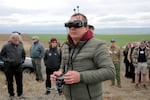
Valerii Stadnyk, demonstrates how a drone can be made to fly autonomously without a GPS signal at a drone symposium in Pendleton, Ore., on April 23 2026.
Kristian Foden-Vencil / OPB
On a chilly Thursday morning, scores of drone manufacturers, investors and military officials gather on the rolling hills of the Pendleton drone range for a demonstration.
“Hey everyone. I’m really motivated to keep things brief,” says Yuri Kurat, bundled against the wind as he prepares his drones.
Kurat is the founder of Ocko Navigation, which makes a black box that can strap onto a drone, enabling the drone to navigate without GPS.
“Electronic warfare is a huge problem,” he explains to the crowd. An enemy can jam the GPS signal in a specific area, leaving a drone to either wander off target or drop out of the sky.
“About half of all drones flying in Ukraine today do not make it to their destination because of electronic warfare,” Kurat says.
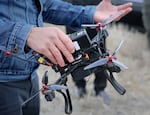
Yuri Kurat with Ocko Navigation demonstrates how his product can make a drone navigate without GPS.
Kristian Foden-Vencil / OPB
His drone hangs in the air in one spot, fighting the wind, then moves to another spot, all without needing a GPS signal. The demonstration shows potential buyers how his $1,300 product can make a drone autonomous.
Drone development is moving fast nowadays as manufacturers learn from Ukraine’s resistance to the Russian invasion. Kurat’s research and development department is in Ukraine, where drone production has expanded exponentially in recent years.
Pendleton — or “Dronetown, USA,” as some have dubbed it — is not looking to test the technology under a high-pressure situation like Ukraine’s.
But after years of being a hot spot for drone testing, officials say it’s time to attract some drone manufacturing and the jobs that come with it.
“There’s a window of opportunity that if we don’t act quickly the state will miss,” says Pendleton’s economic development director Steve Chrisman. “Manufacturing is the holy grail that the state would like to see.”
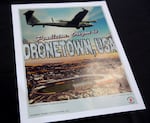
A flyer at the drone symposium in Pendleton shows the city is being dubbed 'Dronetown, USA.'
Kristian Foden-Vencil / OPB
Pendleton: Dronetown USA
The Cascade Chapter of the Association for Uncrewed Vehicle Systems held a two-day symposium in Pendleton in April to showcase new drone activity.
“For this industry, it’s a land grab moment,” said Joseph Wyno, the president of the Oregon Unmanned Aircraft System Accelerator. “The question is: Do we scale this opportunity here in Oregon? Or does it scale somewhere else?”
In a Pendleton conference room, above the historic Hamley Western Store, scores of drone manufacturers, Silicon Valley investors and Oregon venture capitalists listened as startups like Kurat’s Ocko Navigation pitched their ideas.
There were startups there that use drones to spray herbicides on crops, fly medications to hospitals, and pick up blocks to build homes.
One company at the symposium, American Tenet, builds a variety of inexpensive decoy drones. They can be used to flood war zones, forcing an enemy combatant to gamble on which drones to shoot down and which to allow through.

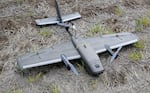
The Silent Arrow, a glider that can dropped out of a plane to deliver supplies, is on display among other types of drones at the symposium.
Kristian Foden-Vencil / OPB


But not all drone scenarios are as terrifying.
Farzad Rahbar is the co-founder of Fly X Technologies in California. His company has developed a way to allow drones to land on power lines and charge their batteries.
“What this enables is that drones can achieve unlimited flight range using the existing infrastructure and basically fly as long as necessary,” Rahbar said.
He was at the Pendleton symposium to raise $6 million and turn his pilot project into a business. His future customer base might include railways or power utilities, which need to regularly check thousands of miles of wires.
Fly X builds its prototype drones in California, despite having offices in Bend, Oregon, and in Bellevue, Washington. Within a couple of years, they’ll need to manufacture at scale, said Rahbar, and that could happen in Oregon.
“It’s closeness to California and, as I said, all the incentives,” Rahbar said. “Actually, Oregon is having higher weight than California and Washington in my mind.”
Rahbar and his partners have yet to make a decision. But he said Oregon’s lower costs compared to the rest of the West Coast are attractive.
Welcoming the industry to Pendleton
Some drone manufacturing is already happening in Pendleton.
Sigma Design’s main offices are in Camas, Washington. But salesman Joby Easton said they opened a Pendleton office a few years ago to serve the growing drone sector.
“The Pendleton Sigma facility was designed to be rapid support for companies that are out here testing and developing their drones,” Easton said.
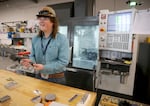
Keenan Spencer, pictured in Pendleton at an April 2026 symposium, operates a computerized lathe for for Sigma Designs.
Kristian Foden-Vencil / OPB
So, if a company is testing a new drone in Pendleton and something breaks, Sigma will quickly design and build a new piece on a computer-controlled lathe to get the drone back up and flying again.
Easton thinks that as more drone companies come to Oregon to test their machines, they will consider manufacturing here.
“I think it absolutely can grow,” said Easton. “But there are just so many little incremental steps that take place where manufacturing has to get support to allow that to happen.”
Specifically, he said, Oregon needs a direct supply of educated workers coming out of universities and trade schools.
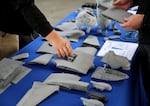
Drone parts are on display at the event in Pendleton.
Kristian Foden-Vencil / OPB
Capturing the momentum
Back on the rolling hills of the Pendleton range, Yuri Kurat’s drone landed and he was quickly surrounded by people who wanted to know: How does it work? How far can it fly? And will it attach to any kind of drone?
Like Fly X’s unlimited flight range project, Kurat’s technology is in a prototype phase. But he’s already struck a deal with a Portland company called Cascade Systems Technology to start building at scale this summer.
“I think because of the friendly regulation and infrastructure that Oregon has, this is a great spot,” Kurat said.
Neither military officers nor Silicon Valley investors would talk to OPB about what specific technologies they were looking for.
But they did ask some telling questions at the symposium. For example: Drone propellers are known to break and often need quickly replacing; could new 3D printing technology print propellers in the field?
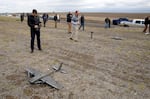
A drone demonstration at Pendleton's UAS test range.
Kristian Foden-Vencil / OPB
While Pendleton and its test range have put the town ahead of the pack in terms of drone activity, Oregon as whole has a relatively healthy drone sector. It supports over 1,000 jobs and generates about $840 million a year, according to Wyno, the president of the Oregon UAS Accelerator.
He thinks that if Pendleton and Oregon get their drone strategy right, that could be more like 12,000 well-paid jobs and $4 billion a year by 2032.
But to get there, economic experts like Chrisman said Oregon needs to be open to manufacturing, not just in Pendleton, but up and down the Interstate 5 and Interstate 84 corridors.
Those are the areas with the supply companies and infrastructure necessary to capture the momentum of the drone sector, as well as the people to work in the industry.
“We’re dealing with a lot of new and emerging technology,” Chrisman said. “And that isn’t as clean and simple to grasp from an economic impact standpoint as a food processing plant or a data center.
“This is a little more nebulous, but I also think it’s just got an unbelievable upside.”