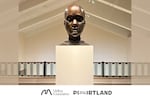
Todd McGrain's bust of York, an enslaved member of the Lewis and Clark expedition on view at Portland Art Museum.
Literary Arts Staff / OPB
The City of Portland is engaged in a national dialogue about public art, history, monuments, and memorials. With support from the Mellon Foundation, the Portland Monuments Project is a multi-year project with the goal of deciding on the future of seven monuments that were damaged, toppled, or removed following demonstrations in Portland in 2020-2021. Portland Monuments Project aims to foster public dialogue to reimagine and transform the purpose of monuments and memorials in Portland.
This episode is part two of a three-part series – previously planned to be two parts, but we decided to expand it as we had more stories to tell – as part of the Portland Monuments Project. This episode explores the city’s present; episode one looked to the past, and the next and final episode will look to the future.
Literary Arts is involved in this project because storytelling is at the heart of our mission, and monuments tell a story about who we were, who we are, what we value, and who we aspire to be. They tell stories about different communities and the stories they tell are dynamic, in so much as our community is changing, time is passing and the context for these fixed objects changes around them.
In this episode we’re tracing the path of a monument that went from a guerilla artwork, to a museum piece, and will soon be a monument again. We’ll travel from the top of Mount Tabor to the mouth of the Columbia River to learn more about the monument and its subject. We’ll talk to art curators, historians, and some nice people enjoying an afternoon in the park.
Our guide for today’s episode is Archive Project editor and producer, Matthew Workman.