Environmental groups have successfully stopped a series of logging projects in coastal Southern Oregon after scoring a win in federal court.
On Thursday, a U.S. District Court judge ruled the U.S. Bureau of Land Management broke environmental laws when it approved a plan to log about 2,400 acres of forests near Yoncalla in Douglas County.
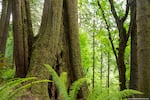
A forest slated for logging under the Bureau of Land Management's Blue and Gold project in Southern Oregon. A federal judge ruled the project broke environmental laws and ignored evidence of old growth trees.
David Herasimtschuk | Photo courtesy of Oregon Wild
The ruling came a few days after environmental groups requested a restraining order on logging in this area.
The court ordered BLM to throw out the entirety of the logging plan it called the Blue and Gold project. If the bureau wants to log this area in the future, it will need to come up with a new plan — and it will have to study these forests more closely to assure the public that it won’t kill large, ancient trees.
“We’re all just breathing a deep sigh of relief that — for now, at least — these ancient forests are going to remain standing, providing vital habitat for imperiled species and clean drinking water,” said John Persell, senior staff attorney for Oregon Wild.
Oregon Wild, Cascadia Wildlands, Crag Law Center and Umpqua Watersheds brought the lawsuit against BLM.
Timber industry representatives and local county politicians have long argued that federal law requires extensive logging in this region — namely in forests once owned by the Oregon and California Railroad company. The American Forest Resource Council, a timber association, intervened in this lawsuit to make similar arguments.
“We are disappointed by the court’s decision and are currently assessing next steps,” spokesperson Nick Smith said in a statement.
Smith added that Blue and Gold project sufficiently protected old growth trees.
“It was carefully designed by professional public lands managers to support rural Oregon jobs, timber supplies, and county revenues while incorporating strong safeguards for water quality, wildlife habitat, and forest health,” Smith said.
The ruling marks a win for environmental groups as they contend with the Trump administration’s push to ramp up logging and mining on public lands. Since taking office, President Donald Trump has chipped away at decades-old environmental laws that have long protected old forests — and the animals that need them to survive.
Plans to log the Blue and Gold area predates Trump’s second term, however, and were finalized under the Biden administration.
In 2024, an Oregon Public Broadcasting and ProPublica investigation found massive, old trees in the Blue and Gold logging area. The bureau’s policies prohibit logging trees greater than 40 inches in diameter or older than 175 years old. OPB and ProPublica found trees measuring over 80 inches. A former BLM wildlife surveyor estimated some of the trees were hundreds of years old.
The court found similar proof of old growth trees in these forests. In his ruling, District Court Judge Mustafa Kasubhai determined that “significant evidence” proved the existence of protected old growth trees throughout the logging area that “contradicts BLM’s simplistic representations.”
Complex, multilayered forests and ancient trees are critical to many struggling plant and animal species. In coastal Oregon, mature and old growth forests are especially important to spotted owls, which are teetering on the brink of extinction, and marbled murrelets. These struggling bird species need broken treetops, mossy branches and standing dead trees for nesting, roosting and foraging.
Like OPB and ProPublica reported in their investigation, Kasubhai found that BLM relied on contradictory data measuring forest age and complexity. BLM also appeared to obscure information that could have changed the outlook of its logging plans. BLM initially withheld data about marbled murrelet and spotted owl habitat from the court, arguing this information was protected. Kasubhai rejected the agency’s argument.