
Note: This story contains photos that might be disturbing to some readers.
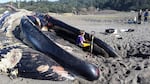
More than a decade ago, the body of a 70-foot blue whale washed ashore near Gold Beach, Oregon.
It’s not uncommon for a gray whale to turn up on Oregon’s beaches. But a blue whale is different. They live primarily in the deep ocean and when they die, their bodies tend to sink.
So, when this 100-ton blue whale appeared near Gold Beach in 2015, leaders at Oregon State University’s Marine Mammal Institute took it as an opportunity to turn loss into learning.
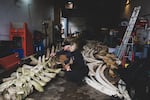
An undated provided photo showing Frank Hadfield of Dinosaur Valley Studios, left, and Lisa Ballance of OSU's Marine Mammal Institute examining the skeleton of a blue whale. The whale washed ashore in 2015. Oregonians will be able to watch the 5,500-pound skeleton come to life via webcams at beav.es/bones.
Courtesy of Ellie Lafferty/Oregon State Univerisity
“It’s going to stop people dead in their tracks,” said Lisa Ballance, the director of the Marine Mammal Institute. She attributes her career, in part, to seeing a blue whale skeleton in a museum when she was young.
After 10 years of work, it’s being installed at OSU’s Hatfield Marine Science Institute for students and visitors alike.
“All of their thoughts are going to leave their mind and they’re just going to be stunned,” Ballance said. “They’re going to be inspired and they’re going to feel in awe of what’s in front of them.”
The skeleton will be one of only a handful of blue whale skeletons available for public viewing in North America, and the only one between Vancouver, British Columbia, and San Francisco Bay Area.

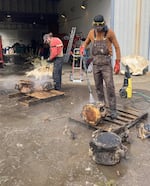
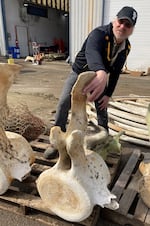
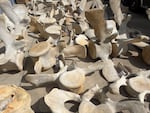
An undated provided photo showing Jason Van Kleef, left and, Kynan Perry of Dinosaur Valley Studios cleaning pieces of a blue whale skeleton. The whale washed ashore in 2015 and will be displayed in Newport, Ore.
Courtesy of Oregon State University
Cleaning giant bones
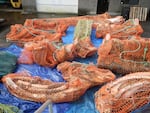
But processing a whale for display is no easy task. Step one was to strip the carcass of flesh. It had to be cut up, bundled into huge nets and submerged in Yaquina Bay. After three years, marine invertebrates and seawater had done their work and cleaned the bones.
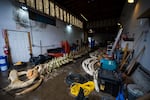
But shortly after they were brought up in 2019, the pandemic hit and the former director of the MMI, Bruce Mate, retired. Restoration efforts effectively ground to a halt. For four years, the bones lay all but forgotten at a Yaquina Bay warehouse.
Ballance said the school was struggling with how to clean so many bones, where to clean them, and how to move such big bones. In the end, she decided to bring in a private company.
“We could not do this project justice,” she said. “And if we were to do it at all, I wanted to do it right.”
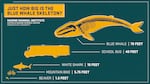
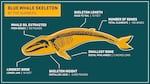
A provided graphic showing the scale of Oregon State University's blue whale skeleton. The whale washed ashore in 2015 and will be displayed in Newport, Ore.
Courtesy of Oregon State University
Dinosaur Valley Studios, a Canadian company that specializes in reconstructing large skeletons, recharged preservation efforts.
“The biggest challenge of this project has been the sheer size of the bones,” said Frank Hadfield, the director of Dinosaur Valley Studios.
“But the reward is seeing the largest creature that ever lived come together as a skeleton.”
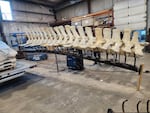
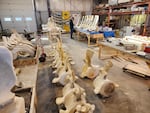
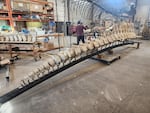
A five-person team has spent three years cleaning, restoring and preserving the bones, the largest being an 18-foot lower jaw bone. The team then created a steel frame to display the whale in natural motion.
“We wanted to convey a living animal in a dynamic environment, rather than a static display,” Hadfield said. “We hope visitors are inspired by the wonder of the natural world through this piece.”
The team removed an estimated 175 pounds of whale oil from the bones. They also used 3D printing technology to repair portions of the skeleton damaged either by injury or by surf action following its death.
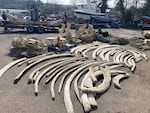
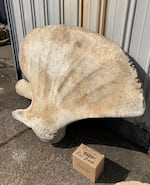
An undated provided photo showing rib bones from a blue whale skeleton. The whale washed ashore in 2015 and will be displayed in Newport, Ore. Bones were collected under authority of the NOAA Marine Mammal Health and Stranding Response Program Permit No. 18786 and transferred to OSU's Permit No. 23092 for curation and education.
Courtesy of Oregon State University
A necropsy found the whale appeared underweight and had not been eating well. It also showed blunt force injuries consistent with a possible ship strike, and domoic acid, a naturally occurring biotoxin caused by algal blooms.
The skeleton display is not just for looks. Research will continue. The bones will hang in a cradle so they can be brought down and inspected.
Hadfield said there are scars on the bones that could be investigated. It appears the whale might have had scoliosis, a curbed spine and two fused ribs.
“There are a number of really curious things that probably will get more research here,” Hadfield said.
Ballance agreed, “This whale skeleton represents another remarkable educational opportunity for our students and researchers as well as visitors to the Oregon Coast.

Cradle for a 70-foot blue whale skeleton outside the Hatfield Marine Science Institute, Newport, Ore., May 15, 2026.
Kristian Foden-Vencil / OPB
“Researchers at the Marine Mammal Institute are working every day to advance knowledge of these extraordinary animals, the environments they live in and the threats they face.”
Oregonians will be able to watch the 5,500-pound skeleton come to life via webcams at beav.es/bones.