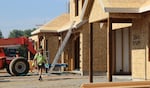
FILE: New houses under construction in Bend, Oregon, Oct. 10, 2022.
Joni Land / OPB
The housing crisis is worse than ever, and it’s one that many elected representatives and nonprofits have been working on for some time. Last month Gov. Kotek signed a package of housing related bills into law. They allow cities to expand their urban growth boundaries, protect existing affordable housing and provide financing to encourage the construction of new housing. Estimates put the need for new homes at 29,500 a year to keep up with population growth and the demand for housing.
Constructing new housing for middle income families is at the heart of the Oregon Community Foundation’s announcement of its $100 million “Building Hope Fund.” OCF says it’s a kind of down payment to spur even more investment from other sources to create a fund that will make affordable loans to developers so they can build middle income housing. OCF’s goal is 10,000 new homes built all around Oregon in the next 10 years.
Lisa Mensah is the President and CEO of the Foundation. She joins us to explain how she sees the loan program working and how it fits into their extensive and longstanding granting program for housing and other community needs throughout the state.
Editor’s note: Oregon Community Foundation is one of OPB’s financial supporters. We cover them as we do any other organization.
Note: The following transcript was transcribed digitally and validated for accuracy, readability and formatting by an OPB volunteer.
Dave Miller: This is Think Out Loud on OPB. I’m Dave Miller. Ten thousand new housing units in 10 years – that is the goal of the Oregon Community Foundation that they just announced. They are investing $100 million into the “Building Hope Fund.” They hope to grow the fund to make loans that spur the construction of new homes specifically for middle income earners. Lisa Mensah is the President and CEO of the Foundation. She joins us now. It’s great to have you on Think Out Loud.
Lisa Mensah: Great to be here, Dave. Thank you.
Miller: I should note before we start that the Oregon Community Foundation is one of OPB’s financial supporters, and we cover them as we do any other organization. Before we get to the big recent announcement, this new fund, can you just remind us what the Oregon Community Foundation has already been doing in terms of housing in Oregon?
Mensah: The Oregon Community Foundation is really our state’s resource for giving. We pool all our donors together and we give to lots of causes, and housing is one of the major ones. We think it’s been about $100 million that have gone out in grants and some loans over the past decades, and that’s largely in the affordable space. We’re known for projects like Project Turnkey, where the state turned to our foundation in the middle of a pandemic and wildfire, and we took $125 million of state money and deployed that to convert shelter…
Miller: … to find unused motels, for example.
Mensah: Exactly, all over the state. [That] made a 30% difference in beds. So we’ve been in that field, we’re staying in that field. We’re still in affordable housing. We’ve been making loans. We have something called the Oregon Impact Fund, which we are keeping. So housing is a cornerstone of stability and economic vitality, and grant makers typically get involved at the toughest part of that affordable housing shelter. And we’re proud of that work, but we think we need to do more.
Miller: What you’re doing now is, if you think about this as a ladder with just mansions at the top and shelters at the bottom, you’re focusing on the middle. What’s your definition of middle housing?
Mensah: Well, for us, the middle is what’s been missing. And this is middle, both in incomes for people who will eventually hold mortgages or rental, and it’s middle for the stock that’s missing. So I’m going to answer that in two ways. For the stock, the actual housing stock, these are smaller homes. They used to be called starter homes, 1,400 square feet, something that back in the day, 40 years ago, was 40% of our nation’s housing stock. Now since the status zeros, it’s about 9% nationally. We think, anecdotally, in Oregon a tiny amount is being built. So it’s just not being built.
Miller: Meaning, out of, I don’t know, 100 homes being built in any given year, fewer than 10 of them…
Mensah: Fewer than 10 of them.
Miller: … would be called a starter home in the past. Do people still use that phrase?
Mensah: I think there’s been so little of it, there’s kind of no need to because people can’t get started. That’s been the challenge. So that’s one aspect of middle.
Miller: The first time that I heard about middle housing that I remembered – and the missing middle, that exact phrase – was from, I think, then-candidate Tina Kotek. [She said] we’re going to spur, we’re gonna make up for this loss, this gap in middle housing. It’s missing right now. So there has been a political focus on this for years. Why hasn’t it worked?
Mensah: There’s a lot of challenges in building for this. When it’s expensive to build, builders typically build for what they can get paid off and what a bank will lend to. So the system is not geared to produce this kind of housing. It’s often where you need subsidy, but the subsidy that most governments have been able to deploy – state, federal – has been down at the bottom. So it’s been a while since we’ve been able to really produce in this, and costs have changed. Costs changed after the pandemic.
I got to run one of the largest housing divisions of the federal government in rural areas, the Rural Housing Service at the Department of Agriculture…
Miller: This is during the Obama administration.
Mensah: Yeah, it was in the Obama administration, and I was so proud of what federal dollars can do. It is building a lot of that middle, but not a lot of that has happened in our state. And there’s a hunger for that. Also, we’ve got a country that depends on homeownership. So, a lot of the hopelessness, which politicians speak to, has been about getting on that ladder. Where do you ever get started? And it’s particularly acute for younger families, younger folks starting out, and I think that’s why people have been looking at how do we crack this code?
Miller: Are you talking about subsidized housing or market rate housing at the lower end of the market?
Mensah: Well, that’s a great question because we’re a philanthropy, so in a way we are bringing some subsidy to the equation. We’re out there trying to raise grants, and we will do lower interest loans.
Miller: For the builders.
Mensah: For the builders.
Miller: Can you give us a ballpark sense … Let’s say I’m a builder and I want to build a 1,400 square foot home – that’s the size you mentioned earlier – and I have the site laid out. Everything is ready and maybe I want to build 10 of them. I go to a bank and say, “Hey, can I get some money? This is going to be great. There are people who need to buy these homes.” What kind of a loan am I likely to get?
Mensah: First of all, you’re going to have to have great collateral, and you’re going to have to be a really experienced builder, even to get into the bank store. But most banks will loan you about 60% of the value of your project. They might not have helped you either do your pre-development dollars – all that architecture work – and they might not have helped you acquire the land. So as a builder, you’ve got a pre-development challenge, an acquisition challenge, and then you’ve got to go build. Most banks, if they will fund you, [will loan you] about 60%. So where are you going to get the other 40%? You would admit that some of that is coming from you, maybe 15% is you. But it’s that slice that’s been missing that’s been holding you back. How do you get [it]?
People talk about, how do we layer in the capital? And this is where I think philanthropy can push. What we want to do, in combination with others, is come in and provide some of that capital that’s been missing. And in fact, make it so affordable that the deal actually can be constructed and that our builder doesn’t have to borrow from the local car dealership at 18%. He can borrow from the Building Hope Fund, or she can borrow from the Building Hope Fund.
Miller: Do you think that this is a risky loan on the part of the Oregon Community Foundation? I guess I’m wondering what you know that the banks don’t? You were a former commercial banker yourself. I mean, is it just that banks are greedy, or are they savvy and saying, “we don’t think it’s smart to make a bigger loan because we’re not sure they’re actually going to be able to pay it off?”
Mensah: Yeah, there are two things that I think are going on. First, the bank has other options. So you can be a good lender and fund a lot of builders who are building for a higher market that will absolutely sell, and that’s a better loan. You don’t have to fund the Dave Builder project for these 10 homes. You’ve got other options. You don’t have to be greedy. You have a market to play in.
There is risk, but what we think we are going to provide is we anticipate being in the same deal with banks, so we can bring down the cost of this loan. So it’s better for all players. [It’s] better for the banker; they’re going to get repaid. We think we’ll be repaid. So it’s a layer of finance that’s been missing in Oregon and a simplicity for our builders.
When you think about it, we’ve got 36 counties, some very rural areas that just haven’t seen capital available at this level. So we are excited to kind of unstick a lot of deals. What we hope is that our 10,000 homes that you mentioned at the beginning, that’ll spur a lot of other market development, and we will show that it is possible to sell these homes quickly. And that’s also what banks need. A wise bank wants to see comparable things being financed so that they know the repayment makes sense. We think we can be a prod to that.
Miller: You’ve said that the $100 million is, in a sense of the initial investment, a down payment. How much bigger do you want this fund to get?
Mensah: Well, I’d never give you a top because I’m in the philanthropy business. [Laughter]
Miller: Let me put it this way, how much bigger does it need to get if you’re going to actually build 10,000 units over the next decade?
Mensah: We hope that there’ll be double the funds that will commit to this, and we hope that it’s a mix of funds. Some people will come in as lenders with us. Some will come in as grant makers. We need, actually, grant funds to support those riskier loans and to be able to experience some losses and keep going.
Miller: Oh, and the difference there being, there’s no expectation of getting the money back at 4% or 5%. This is money that’s given in a purely philanthropic way to spur this. Then that’s some piece of this.
Mensah: There’s a piece of it. We think it’s a layer in this. So, in every good loan fund – I used to run the Association of Community Development Financial Institutions – loans that push the market, [whoever doing it] will keep 10% to 20% of, we call it net assets or some equity, that can be at risk. And we hope to raise grant funds for that. So part of our goal with $100 million of investment capital is we want to add some grant funds, and we want some loan funds to come in and build with us.
So, I don’t have a top, but I hope to double this and get better. And I hope people will see this as a chance for Oregon to tackle some tough problems. There are other ones in the market, but we want to start building hope with this builder challenge.
Miller: Have you already gotten any bites since you made this announcement? I mean, because you’ve said, hey, we want other people to join us. That was a little while ago, it’s only been a couple days. But have you gotten any calls yet?
Mensah: Nobody that we’re ready for announcing, but no, no checkbooks yet. No public announcements. But this is one of the reasons I’m glad I’m talking to you now, because we wanted to come out and say we’re ready to do the down payment. We feel this is where other funds would make a difference, and we think there’s a role for philanthropy. This is really, to me, a powerful way of being an impact investor. That’s a big field. It’s grown in the last 30 years. Not every impact investment is this deep, many places rural, taking on tough challenges that [have] kind of been with us for decades, like housing, and we think this is an opportunity.
Miller: Is this basic model something that the state government is already doing, or is there something different about what a foundation can do?
Mensah: I think states and municipalities have identified this layer – you mentioned it before, the middle-income layer. And there are things states can do. What is fun about being a private actor is we’ve got a lot of flexibility. We don’t have to have one program, one size fits all. We’ve been talking to builders in Reedsport, Coos Bay, Ashland, La Grande [and] Portland. So we can be flexible with both what the builders are building, sites will look different, deals will come together differently. That’s a beauty of a private actor.
Miller: As opposed to saying, “We have these rules, and it has to be ‘X %’ of median income.”
Mensah: Exactly. We can be a little more flexible on this, which we think is appropriate. We want to be a prod to everything else.
Miller: The flexibility, I imagine … it sounds like it’s great to have, but it also maybe gives you the challenge of then figuring out what your actual lane is and also how you will decide which lenders to actually…
Mensah: … part of, yeah.
Miller: So how are you going to decide, yes, this project is worthy of this money and this one, sorry, it’s not?
Mensah: That’s the fun of doing this with an Oregon Community Foundation. That is our business. We are all the time, we never have enough philanthropic resources. That is kind of the sadness of being in a foundation…
Miller: Even with $5 billion.
Mensah: Absolutely. There’s always a need to assess, to discern, to say no to some things. So that’s the business we know. That is the lane we know. And I think after 53 years of operating this foundation, we’ve got a lot of track record in understanding our communities. We are already fanned out across the eight regions of our state. And I think we will build a powerful portfolio that will demonstrate we took on a challenge that Oregon was facing in 2026, and we made a meaningful difference in the decade that we brought our partners to bear to this challenge.
Miller: How will you know that this is working?
Mensah: The fun part about something like housing is you can see it, you can count it. You can see it.
Miller: And we can see it, too.
Mensah: There will be families getting keys. There will be builders celebrating. There will be ribbons to cut. There’ll be lots of credit to go around. I think we’re also a foundation who can track, evaluate and research. So this is, again, something we’re pretty good at, saying where we got to. And in something very tangible like this, I think we’ll know. I think the more difficult thing to say is, will we really push our impact investing platform?
Miller: What do you mean by that?
Mensah: I mean, will others really come in? Will other foundations join us, not only in our state, but outside of our state? Will we have attracted some capital that’s been missing? We don’t have big banks headquartered here. So, will we attract some folks who maybe have flown over Oregon, not looked at our state? I think we’ll count the houses, we’ll count the joy of building hope family by family. But I think the proposition here is also who comes in to help us, and I hope we get some happy surprises here.
Miller: The name of this fund, again, it’s the Building Hope Fund. Broadly, what gives you hope for Oregon right now?
Mensah: Well, I’m an Oregon girl who came back, and everything in me sees, again, the beauty of this state, the power of its potential. And I feel like the challenge, having lived in much bigger, denser places, this is a manageable challenge. I get hopeful that the 10 homes you said, those 10 homes I feel are buildable. And when they get on the ground, I feel like that’s going to make a meaningful difference. There will be people who will say, “my kids can stay in the town they love,” and there will be employers who will say, “my folks can work here.” And that just gives me so much hope. I feel like there is a solution here that’s right at hand and we can do it.
Miller: Lisa Mensah, it’s great to meet you. Thanks very much.
Mensah: Thank you.
Miller: Lisa Mensah is president and CEO of the Oregon Community Foundation. She joined us to talk about the launch of the Building Hope Fund intended to spur the construction of 10,000 new housing units in Oregon over the next 10 years.
“Think Out Loud®” broadcasts live at noon every day and rebroadcasts at 8 p.m.
If you’d like to comment on any of the topics in this show or suggest a topic of your own, please get in touch with us on Facebook, send an email to thinkoutloud@opb.org, or you can leave a voicemail for us at 503-293-1983.