
FILE - A provided photo from September 2025 shows unidentified soldiers in a trench in Ukraine pointing out how a fishing net protects them against a drone-carrying explosives.
Courtesy of Ground Squirrel Ventures
Kurt Cochran has moored his 85-foot fishing trawler, New Life, to the docks in Newport.
His nets are fine. The boat is fine. But getting the various electronics on board to talk to each other is proving difficult.
“We’ve got a lot of electronics down on our nets,” Cochran explained.
Nets on a boat this size cost about $80,000. For a larger vessel, they can be a quarter of a million dollars. And they bristle with electronics.
“We have catch indicators. We have a trawl sonar that shows the fish going in,” Cochran said. “We have a live-feed video camera that shows everything in real time. And then we have lights and other things.”
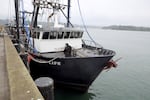
Kurt Cochran's fishing vessel New Life, docked in Newport, Ore., on May 14, 2026.
Kristian Foden-Vencil / OPB
But high-tech devices don’t stop fishing nets from getting old and brittle. And old nets are a problem. They’re made of synthetic fibers like nylon and polyester, so they don’t biodegrade well.
But now a nonprofit called Net Your Problem is collecting them from fishing towns across the country to send to Ukraine to protect against drone attacks.
Over time, the sun breaks down a net’s synthetic fibers and its shape gets stretched from towing the equivalent of 150 tons at a time.
“When a net gets stretched out of shape, it quits fishing,” said Cochran.
Basically, the round flat opening of a new net gets warped, so it’s only trawling a fraction of the area it was designed to cover. So after about 10 years, commercial fishing nets are thrown away. Often they just get left in a field to be covered by weeds.
“If you know someone with a smaller boat, you might cannibalize it,” Cochran said. “Or if you have a friend that says, ‘Hey, I need something to keep my chickens in their coop.’”

Captain Kurt Cochran aboard his boat, New Life, in Newport, Ore., on May 14, 2026.
Kristian Foden-Vencil / OPB
Old nets are used for everything from making batting cages for kids to decorative garden trellises. But eventually, they generally end up in the landfill.
It’s a problem that caught the imagination of Nicole Baker in Alaska. She’s setting up a non-profit called Net Your Problem to find uses for old nets. Essentially, she collects them in more than 40 different fishing towns across the country, from Washington to Oregon and California as well as the East Coast and New England. Then she sends them to a factory in Denmark for recycling.
“Once the plastic netting is sorted by type, you can shred it and melt it. And you get these little beads of plastic that can be used to make new plastic items,” said Baker.
Those items include clothing, shoes and carpet tiles.
But the war in Ukraine changed her focus. Brutal videos show drones from both sides, flying through the doors or broken windows of damaged buildings near the front, in search of soldiers to attack.
Combatants quickly learned that laying a net over a door opening, a broken window or a trench can effectively stop an attacking drone. Bigger nets are used to hang between streetlights to protect people using the road underneath.
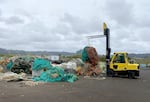
FILE - In this supplied photo, old commercial fishing nets from Newport, Ore., are loaded into a container on April 22, 2026. The nets are sent to Ukraine and used as impromptu drone protection.
Courtesy of Net Your Problem
Brian Shaw with Boston-based private equity firm Ground Squirrel Ventures says they had reached out to Baker to see whether she’d be willing to send nets to Ukraine instead.
“And she was receptive.”
Baker changed gears immediately.
“We sent our first load from our warehouse in New Bedford, Massachusetts, in December of 2025.”
She visited Newport, Oregon, in April and fishermen watched as old nets were squeezed into a shipping container using a forklift and what can only be described as a massive metal plunger.
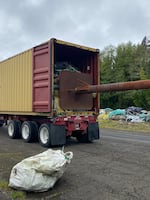
Dock workers needed a ram to shove old fishing nets into a container for transport to Ukraine on April 22, 2026, in this provided photo.
Courtesy: Net Your Problem / OPB
“I absolutely could not have imagined that this is where we would be sending these. And what they would be used for in their second life,” said Baker.
When the war stops, she said, hopefully the netting can be recollected and recycled.
The executive director of the Port of Newport, Paula Miranda, said using old fishing nets for drone protection is a clever idea.
“We love this at the port, to have those old disposable nets being used for such a beneficial use.”
Back on the docks, Capt. Cochran is getting ready to go shrimping. He says he hasn’t seen the harrowing videos of Ukraine drone attacks. But he’s glad his old nets can help.
“It’s a good thing to help save lives and make people safer.”
Shaw, with Ground Squirrel Ventures, said they just sent their third container full of nets to Ukraine and hope to send more in the future. He’s learning that different nets get put to different uses. Even small nets.
“Gill nets, with tiny plastic filaments, work well because the filaments are so small, operators can’t see them and the drones get tangled.”
Russia launched a full-scale invasion of Ukraine in February 2022. The ongoing war is the deadliest conflict on European soil since the end of World War II.

In this supplied picture, Nicole Baker and Don Moon load up old fishing nets bound for Ukraine in Newport, Ore., April 22, 2026.
Kristian Foden-Vencil