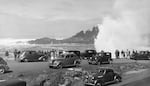
A provided photo from the Oregon Historical Society shows the Spouting Horn at Depoe Bay, Ore., in August 1939. Oregon's Highway 101, which turns 100 this year, brought new opportunities for industry and tourism to coastal communities. (OHS Research Library, OrHi 57495)
Provided by the Oregon Historical Society
If your Memorial Day weekend plans include visiting the Oregon Coast, you might drive along Highway 101 to get there. The iconic roadway is celebrating a milestone this year: the 100th anniversary of its designation as a federal highway.
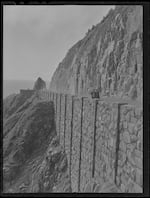
A photo from the Oregon Historical Society shows Highway 101 at Neahkahnie Mountain (OHS Research Library, Org. Lot 1284). The steep, rocky, remote terrain of the coast presented significant challenges while constructing the highway.
Provided by the Oregon Historical Society
The Oregon Historical Society is celebrating the highway’s centennial with an exhibit that runs through Oct. 11.
The idea for a coast highway came about in 1917, during World War I. It was originally envisioned as a military highway, though it never received that designation.
Still, the road changed the way Oregonians accessed the coast, bringing new opportunities for industry and tourism to communities from Astoria to Brookings.
“They wanted to construct a highway that could get people from point A to point B, but also have sort of a beautiful drive,” said Megan Lallier-Barron, curator of exhibitions at OHS.
Oregon implemented the nation’s first gas tax in 1919 to help pay for the construction of the highway. At the time, the tax was one cent per gallon.
The steep, remote terrain presented significant construction challenges, with laborers boring through hundreds of miles of rock to create tunnels. Initially, there were no bridges linking different sections of the road.
“You would have had to wait for a ferry to carry you over a number of different waterways and estuaries,” Lallier-Barron said. “[It] would create a lot of additional traffic and travel time.”
Renowned architect Conde McCullough would later design several of the bridges along Highway 101, including the Yaquina Bay Bridge in Newport, the Alsea Bay Bridge in Waldport and the McCullough Memorial Bridge near Coos Bay.
The highway not only created new communities as laborers set up camps during construction, but also helped connect existing towns along the coast.

A photo provided by the Oregon Historical Society shows part of the Highway 101 exhibit that runs through Oct. 11. The highway received federal designation 100 years ago, in 1926.
Courtesy Evan Kierstead
“It made it a lot easier for coastal communities to travel between one another,” Lallier-Barron said. “We think of maybe going from Astoria to Seaside as not a very long drive, but … before Highway 101 was built, you’d have to go back out into the valley and then come back to the coast.”
The opening of the Astoria-Megler Bridge in 1966 is generally recognized as the completion of Highway 101. The bridge provided the final link in the highway’s stretch from California to Washington.
Lallier-Barron said she hopes visitors leave with a new appreciation for the seemingly mundane parts of everyday life.
“Roads are pretty foundational and ordinary, but each of them have a pretty unique history,” she said. “So having people explore more about an area that they might know pretty well at this point, but looking at it in a different light.”
OHS curator Megan Lallier-Barron spoke with “Think Out Loud” host Dave Miller. Listen to the full conversation here: