From left Oregon City Mayor Denyse McGriff, Confederated Tribes of Grand Ronde Tribal Council Chairwoman Cheryle Kennedy and Oregon Gov. Tina Kotek talk with one another at the ground breaking of tumwata village in Oregon City Thursday May 28, 2026.
Holly Bartholomew / OPB
The Confederated Tribes of the Grand Ronde took a significant step Thursday in their decadeslong journey of returning to Willamette Falls.
The tribe broke ground on the infrastructure needed to launch the first phase of tumwata village — a mixed-use development on the 23-acre site of the former Blue Heron Paper Company mill perched atop the falls in Oregon City.
“Today we start rebuilding. Today we lay the foundation of tumwata village and start the process of bringing our people back to the falls,” Grand Ronde Tribal Council Chair Cheryle Kennedy said at Thursday’s ground breaking, surrounded by state, regional and local officials.
For centuries the 40-foot falls on the Willamette were a sacred place for Indigenous people from across the Northwest to gather, trade and fish. When white settlers arrived and industrialized the area, they largely cut off public access to one of the country’s largest waterfalls. Today, the falls still sit nestled between enormous shuttered paper mills on opposite sides of the river.

Confederated Tribes of Grand Ronde tribal members drum at the ground breaking of tumwata village in Oregon City on May 28, 2026.
Holly Bartholomew / OPB
While regional tribes, including the Grand Ronde, have long hoped to restore access to the falls, those hopes began to take shape in 2011 with the closure of the Blue Heron mill and later the formation of the Willamette Falls Legacy Project. Project partners envisioned a riverwalk to the falls from the mill site.
Frustrated with a lack of progress, the Grand Ronde withdrew from the project in 2022, three years after their purchase of the Blue Heron site.
For the past several years, the Grand Ronde have worked on their own public access project at the Blue Heron property and in 2022 named the site tumwata village, referencing a Native name for the falls.
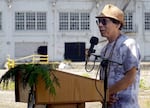
Confederated Tribes of Grand Ronde tribal member Greg Archuleta speaks about tribal history at the ground breaking of tumwata village in Oregon City on May 28, 2026.
Holly Bartholomew / OPB
While the Grand Ronde have made progress at the site in recent years — demolishing about half the existing mill buildings on the property — Thursday’s groundbreaking represented a shift toward the positive steps the tribes are now taking to create tumwata.
“This work is for the generations to come,” the Grand Ronde’s Project Manager Ryan Webb said.
Moving forward, Webb explained the project team will begin building out roads for the tumwata site. A main road will come off Highway 99E and run parallel to the river before connecting with Main Street. Webb expects construction of the road to take 12 to 15 months.

Confederated Tribes of Grand Ronde tribal council members, along with Gov. Tina Kotek and Oregon City Mayor Denyse McGriff break ground on tumwata village in Oregon City on Thursday, May 28, 2026.
Holly Bartholomew / OPB
From there, the Grand Ronde will begin constructing the first block of tumwata village, which will include two buildings: a multi-use space with retail, office and event space and an apartment building. Construction of the buildings is still likely a year or two out.
Once that phase is complete, the project team will continue working its way south through the property, building out more roads and buildings.
In all, the Grand Ronde plan the village to have retail and office space, housing, cultural spaces, gathering spots, restaurants and a riverwalk to the falls.
“This is about healing and this is about restoration,” Gov. Tina Kotek said at the ground breaking. “Restoration is at the heart of tumwata village. The Confederated Tribes of the Grand Ronde are healing the land.”
Industrial heritage
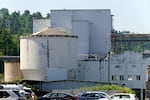
The Blue Heron Paper Company, pictured here on May 28, 2026, closed in 2011. The Confederated Tribes of Grand Ronde purchased the property in 2019.
Holly Bartholomew / OPB
Beyond the cultural significance for Indigenous people across the region, Willamette Falls played a significant role in Oregon’s industrial development in the latter half of the 19th century and early 20th century. In 1873, the Willamette Falls Canal and Locks Company completed the locks on the West Linn side of the falls, which allowed boats to travel safely up and down the river, connecting Portland and the Columbia River with the lower Willamette Valley. A decade and a half later, the Willamette Falls Electric Company, which later became Portland General Electric, developed the country’s first long-distance transmission line, sending power from the falls 14 miles north to Portland.
At the same time, the falls became a hub for the paper industry. The Oregon City Paper Manufacturing Company opened in 1866 on the east side of the river and the Willamette Pulp and Paper Company began operating on the west side in 1889. Though it changed ownership and names several times, the Oregon City mill operated until the closure of Blue Heron in 2011. The mill on the West Linn side also changed names and ownership several times before finally shuttering, likely for good, as the Willamette Falls Paper Company in 2025.
With the decline of the paper industry in recent decades, some community members came to see the old mills as brownfield sites rather than the economic engines they once were.
The Grand Ronde’s village, along with plans for another tribal-led project on the opposite side of the falls, promise a significant shift from that industrial heritage toward a closer connection between the falls and the public.
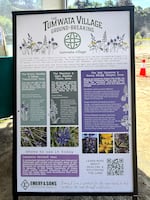
A sign displays information about native plants at the ground breaking of tumwata village in Oregon City May 28, 2026.
Holly Bartholomew / OPB
The Grand Ronde see it as a homecoming.
At the podium on Thursday, Kennedy recalled her great-grandfather. He was chief of the Clackamas tribe and one of the signatories of the Willamette Valley treaty of 1855 that saw the removal of Indigenous people from their ancestral lands. Kennedy said he was watching down over the groundbreaking.
“I know our ancestors are here and watching and their hearts are full as they encourage us to move forward.”
Correction: An earlier version of this story incorrectly summarized when the Willamette Falls Trust was formed. OPB regrets the error.