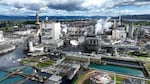
Aerial views of the Nippon Dynawave Packaging Co. in Longview, Wash., showing the scene of a major chemical tank implosion at a Southwest Washington paper mill, May 26, 2026.
Brandon Swanson / OPB
This week’s chemical blast that killed at least eight workers at Longview’s Nippon Dynawave Packaging Co. highlights the potential dangers in the timber and paper manufacturing industries.
Early Tuesday morning, a 900,000-gallon chemical tank failed at the Longview mill, releasing tens of thousands of gallons of a caustic chemical known as white liquor. The chemical solution breaks down wood chips into pulp — a key step in mass producing paper and cardboard products.
The subsequent blast killed at least eight workers. Three more are presumed dead and expected to be recovered. The force of the blast and chemical leak also injured multiple others.
“We work in a highly hazardous atmosphere, in a highly hazardous industry,” Brian Wood, director of support services for Nippon Dynawave, told reporters Thursday.
The Nippon plant is mostly closed as officials investigate what went wrong, although a limited number of staff is continuing to run some critical infrastructure.
“We’ve made arrangements to pay people who are not working today because of this incident,” Wood said, “and will continue to do so.”
The industries involved in the range of economic activities from cutting timber to manufacturing paper have shed jobs in recent decades, yet this sector continues to have some of the deadliest occupations. The disaster in Longview highlights the dangerous chemicals used in paper making. In 2024, 13 people were killed while working at their paper manufacturing job, according to the U.S. Bureau of Labor and Statistics.
Across the country jobs in the sector have plummeted. In the last quarter century, BLS figures show paper manufacturing employment fell by 230,000 jobs to sit around 355,000 across the country. Industry researchers estimate as many as 45 mills closed last year.
However some communities still rely heavily on paper mills for jobs. The Longview mill, purchased by the Japanese company Nippon from Weyerhaeuser in 2016 for $285 million, employs about 1,000 people, according to the Washington Department of Ecology. That makes it a major employer in the heavily industrial Longview-Kelso area along the Columbia River where about 115,000 people call home.
U.S. Rep. Marie Gluesenkamp Perez, who represents Longview, told reporters on Wednesday that an investigation is needed, but shouldn’t act as the “last straw for a viable mill.”
“Folks here have watched mill after mill close across this state, always wondering if their mill is next,” she said. The Southwest Washington Democrat called for a plan to address failures “so we can have safe jobs, come home to our families at night, and rebuild public trust.”
Areas historically powered by the timber industry have had to adapt quickly to changing technology, regulations and political circumstances, according to Steven Beda, an associate professor of history at University of Oregon who specializes in the timber industry.
“When you look at the peak harvest rates in the ‘60s and then you see them now, this industry looks like a shell of its former self,” Beda said. “But I always encourage people not to simply characterize this as a dead and dying industry.”
Beda said the industry has stabilized, and those working in it have adapted to the new reality of smaller harvests and fewer workers.
“This is an industry people are really passionate about,” he said. “This is an industry that remains important to the Pacific Northwest, and people I have spoken with in these communities still take a lot of pride in the fact that they are an economic backbone of this region and that they are doing important work.”
Beda acknowledges that it’s also dangerous work dealing with heavy equipment and unpredictable chemicals, as the tragic blast in Longview this week shows.
“No one should have to deal with this,” Beda said, “but I do feel safe in saying that the people of Longview will find a way forward — because they always have.”
Longview was established as a company town serving the wood products industry over a century ago, Beda said. Ownership of the land and various industrial plants has changed. Mills have opened and closed. But throughout all of it Longview residents have shown the resilience rural timber communities are known for, he said.
“They’ve often found a way to continue to maintain an industry, and maintain their community,” Beda said. “And not necessarily thrive economically, but certainly thrive socially and culturally, and continue to build strong communities.”