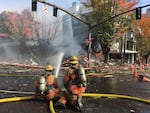
FILE - Firefighters direct a hose toward a building at the corner of Northwest 23rd Avenue and Glisan Street after a gas explosion and fire on Oct. 19, 2016.
Amelia Templeton / OPB
A decade ago, a building in Portland’s Nob Hill neighborhood exploded in a gas leak and was consumed by a fire soon after. That building was home to Portland Bagelworks and the eyewear shop Fetch, as well as Art Work Rebels Tattoo Studio, which was located in the building for seven years. Artist Jeff P, who now co-owns Tattoo Smile, was an artist at the shop when this happened. After the dust settled and rubble was sorted, much of the shop was lost, including memories, personal belongings and much of the hand-drawn art and flash that many artists like Jeff created.
But for Jeff, some of his work survived as digital scans and phone camera photos he captured as he documented his own work. Now, Jeff has released a book marking the anniversary of the explosion. “Everything That Burned” is a collection of scans and photos of his art and the shop after the fire. Jeff joins us to share more on his memories of the shop and his new book.
Note: The following transcript was transcribed digitally and validated for accuracy, readability and formatting by an OPB volunteer.
Dave Miller: This is Think Out Loud on OPB. I’m Dave Miller. A decade ago, a commercial building blew up in Portland’s Knob Hill neighborhood. It was home to a bagel shop, an eyewear company, and the Art Work Rebels Tattoo studio. Jeff P was one of the tattoo artists who worked there. He lost hundreds of sheets of hand painted art, at least he lost the originals. He had digital scans and iPhone photos of some of his work. You can now see those photos in a book that’s been released to commemorate the 10th anniversary of the explosion. It’s called “Everything That Burned.” Jeff P joins us now to talk about it. It’s great to have you on the show.
Jeff P: Thanks for having me. Happy to be here.
Miller: How did you get into tattooing?
Jeff: I was going to film school at NYU at the time and kind of feeling like that wasn’t actually what I wanted to be doing with my days, and I drew a tattoo for a friend that asked, and that seemed like maybe a good way to make a living, drawing pictures.
Miller: In that case, you drew the tattoo and then the friend took it to a tattoo artist and then put it on their skin.
Jeff: That’s right.
Miller: But then you went from that to actually doing it yourself?
Jeff: Yeah, I started looking into what that might look like and started telling people that’s what I wanted to do. And a friend happened to know a couple of tattoo artists, or a friend of a friend knew a couple, and got me in touch, and it worked out. Got my foot in the door and figured out the rest from there.
Miller: What can you tell us about Art Work Rebels, the studio where you worked?
Jeff: Art Work Rebels, it’s an existing name. It was owned by Jason Kundell, who had been a big name in tattooing, well before I even started. It was a graffiti crew before that, and he happened to be moving to Portland the same time I did, at the end of 2009. Some mutual friends put us in touch and ended up working at that shop, helping them build out the shop. And just that name – Art Work Rebels and Jason Kundell – that opens a lot of doors, and that provided a lot more opportunities for me.
Miller: What was the vibe of the shop?
Jeff: It was all about hard work and taking it seriously. It was really supportive. Jason is an incredibly hard worker. He sets a really high bar and he also provides the support to improve with regular critiques of our drawings and tattoos. He was very good at helping with drawings, explaining why you were doing things certain ways, why certain things didn’t work.
Miller: What do you remember about the last time you were in that shop?
Jeff: It was the night before the explosion. I actually finished a painting, it’s the first painting in the book. It was painted the night before, I finished it, put it in a drawer, and the next morning it blew up.
Miller: You weren’t there, right, this was the morning of October 19, 2016?
Jeff: That’s correct. Our shop manager, Jen, was in the shop that morning cleaning up. We had some aquariums with fish and snakes and lizards and stuff, and she thought it was just kind of funky from the aquarium, so she was cleaning up, airing the shop out. At a certain point when she was cleaning up, she started getting a headache and thought maybe it was gas.
And so she went down where there was some construction being done on the sidewalk, some excavating, and she asked them, she was like, “I think it smells like gas up there.”
And they’re like, “Well, we hit a gas line, so if it smells like gas, we should get out of there.” I guess people hit gas lines all the time when they’re working on things. It’s typically not a big issue. The gas company comes out, the fire department makes sure it’s not combustible or explosive, and that’s what they were doing when the building exploded. They didn’t know until Jen mentioned that it was backing up into the building. I guess that’s abnormal.
So my understanding is, I feel like Jen should get a lot of credit for this, when she came down and said that it smelled like gas up there, that’s when they started evacuating people from those businesses. And we got a text from Jen that morning saying, “There’s a gas leak at the shop. Fire department’s got to clear it before we can go in, so don’t come in yet. I’ll let you know when we can go in. Shouldn’t be long.”
And then 20 minutes later I think it was three rapid explosions that just leveled that building.
Miller: That shook a big area. It was such a big explosion and made the national evening news, and amazingly, because people were cleared out just in time, nobody was killed. The book that you ended up making has photographs and scans of what’s known as flash art. What is flash art?
Jeff: Flash art, I think the name flash originally comes from the carnival world, to catch people’s attention. Within tattooing flash art, if you ever walk into a tattoo shop and you see the sheets of designs on the wall, that’s flash. It’s just a kind of ready-to-go tattoo designs.
Miller: As opposed to someone saying, “I want a tattoo of a walrus eating an ice cream cone on a unicycle.” That has to be done in the moment.
Jeff: Correct. Yes, it’ll be a custom tattoo. A flash is ready to go. You pick it and we stick it on you.
Miller: How much flash art did you have just in a filing cabinet at the studio?
Jeff: I had close to 100 sheets of flash and similar flash-style paintings, probably about 100 sheets altogether. Some of them were hanging on the walls in the shop and some of them were in a drawer. I think that one of the harder things for me was processing the explosion afterwards.
Because there was asbestos in either the flooring or the ceiling, that site was shut down and a lot of those sheets were in this heavy steel flat file, and they would have been damaged, burned, waterlogged, ripped, whatever. But I feel like anything that I could have gotten out of there, it would have been amazing to have, whatever condition it was in. So that was, I think, the hardest thing to let go of.
Miller: So you weren’t able to get anything in the end?
Jeff: The only thing we really got out of there was a big, probably an eight-foot tall hand painted blade sign on the corner of the building that our friend Ken Davis had painted for us and that we saw on the news later that night. We saw a fireman kind of lifting it out of the rubble and walking off screen with it, and we ran back to the site and argued with the fire marshal for a bit to get our hands on that. And that hung in the shop that Jason eventually opened downtown.
Miller: Is there something that you miss most about what you lost?
Jeff: Well, I think it’s a little, what’s the word, hard to put your hands on. I mean, tattooing is a big world and trying to carve out a spot for yourself can be difficult, especially these days there’s so many tattooers. And there are a lot of tattooers that tattoo in the style that I do. And that flash, for me, was how I was defining myself in tattooing. I was spending a lot of time painting. I really love it as much as I love tattooing.
I think it was just losing that, it was losing those objects that I put time into, but it was losing something more than that. And I don’t know exactly what it is, but it took me a while, and still, I’ve never gotten quite back to the same pace of painting flash. I still paint flash regularly, but I think losing that was losing something of myself, you know, not just like the books that I also lost.
Miller: Right. I mentioned that you had some sort of professional scans of some of this hand-painted work, and then at a certain point, it was just taking pictures with your phone. What changed?
Jeff: I felt like I was being a little too precious about…
Miller: …serious documentation?
Jeff: Yes. It just felt like, it’s just flash. I’m just painting it. It’s supposed to hang on the wall and people come and pick something out. I don’t know, it just felt like at a certain point, why am I shipping these off to be professionally scanned, shipping them back, it just seemed excessive.
So at a certain point, I just started finding a good spot in the shop under a light, shooting an iPhone photo of it and tucking that away. But after the explosion that really helped processing and moving on, being able to still have those. I missed those original sheets, but the images were very valuable to me.
Miller: You made a few copies, as I understand it, of a book for yourself, a year after the fire with these scans, professional scans, and then some iPhone photos. Why did you want to make it more widely available now?
Jeff: Oh, I think the reason I didn’t do it originally, there were kind of two reasons. One was those sheets were still new for me, you know, I had just painted those. I hadn’t tattooed a lot of those things. So I didn’t want to put them out in the world and let everyone start tattooing them.
Miller: Is that a thing? I mean, do people just copy flash that’s out there? I mean, this is your work, your IP, but people can just..
Jeff: Yeah, I mean, it depends who you talk to. Some people are pretty protective of it, especially if it’s just hanging in their shop, they don’t want you taking photos and taking them to other places. But people sell sets of flash, books of flash, and I think if you’re putting it out there like that, you should be expecting that people are going to use it.
Miller: And on somebody else’s skin.
Jeff: Personally I think that’s the point. Like, if I’m putting out a book of flash, it’s for you guys to make use of whether you’re redrawing or tattooing.
Miller: Has that happened since you published this new book?
Jeff: Yeah, the day after we put it out, a friend of mine, Dean, who was at the convention in Portland where we released the book, bought the book on Thursday, and on Friday did a tattoo out of it, just had a design that he was looking for. It was an old design by a tattooer named Pinky Yun, who, again, a lot of flash just gets passed along through the years and people do their version of it and then someone does their version of that and it’s really fun.
Miller: What’s it been like to revisit that time and that serious loss a decade later?
Jeff: It was a little more emotional than I was expecting it to be. I felt like I had processed everything and moved on. And I had, but going back and really looking at that flash again in a way that I hadn’t looked at it really. And looking for some news photos to use for our book release to put up, to give it some context if people didn’t know the full story, seeing the photos, it just makes it more real again. You realize, that was really crazy. It’s crazy to remember at the time, thinking, it’s a really strange feeling to look at a pile of rubble and recognize things in it, you know, seeing…
Miller: Your things in it.
Jeff: Yeah, your things. Just things that you would see every day, you know, like, just as silly as, a jar of peanut butter. I was like, “I know that jar of peanut butter,” you know?
Miller: Has that changed your approach to, not just the art you’re making in the world, but your physical stuff in the world?
Jeff: I don’t know. I mean, on one hand, maybe I wasn’t being overly precious by scanning the things, but I think there’s also a point where you learn to let go of certain things. I think really more than that, the explosion taught me a lot about community.
We had a really successful GoFundMe after that, and to feel a part of a community, to be on the receiving end of that, you learn what that means more than when you’re giving. That was really emotional for me at the time and continues to be. And the reaction that I’ve gotten to this book, which has been more than I ever would have hoped, that’s been another surge of that feeling in that community.
Miller: Jeff P, thanks very much.
Jeff: Thank you for having me.
Miller: Jeff P is a co-owner of Tattoo Smile in Southeast Portland. His new book is called, “Everything That Burned.” It’s made up of art, his art that was lost in an explosion at his old tattoo shop 10 years ago.
“Think Out Loud®” broadcasts live at noon every day and rebroadcasts at 8 p.m.
If you’d like to comment on any of the topics in this show or suggest a topic of your own, please get in touch with us on Facebook, send an email to thinkoutloud@opb.org, or you can leave a voicemail for us at 503-293-1983.