FILE - Portland police speak with two people in a tent during the forced removal of an encampment of unhoused people in the central eastside of Portland, Ore., on Jan. 28, 2026.
Eli Imadali / OPB
After years of consistent increases, the country saw its homeless population decline by 3% in early 2025. But that pattern wasn’t replicated in Oregon.
According to a report released Friday by the U.S. Department of Housing and Urban Development, roughly 27,200 people experienced homelessness in Oregon in January 2025, a 19% increase from the previous year. That’s the second largest increase by any state in the U.S., trailing only North Carolina, which was forced to open thousands of emergency shelter beds in late 2024 in response to Hurricane Helene.
The data point — now more than a year old — isn’t a perfect snapshot of Oregon’s homelessness crisis, due to the unique way Oregon cities and counties collect data. Some argue the high count simply demonstrates that the state is doing a better job at collecting data than others.
Either way, the numbers underscore the seriousness of Oregon’s intractable crisis, at a time when homelessness is the focal point of politicians across the state.
Nearly four years after homelessness took center stage in the gubernatorial race, it’s likely to be a key issue again on this November’s ballot.
“We have helped thousands of people move from the streets into shelter, from shelter into homes, and prevented thousands more from experiencing homelessness in the first place,” Gov. Tina Kotek, who has made homelessness and housing her top priority, said in a statement. “But we must maintain the momentum and strengthen our focus on the intersection of homelessness, mental health, and addiction.”

FILE - A woman carries her belongings to Portland’s Salvation Army Female Emergency Shelter, or SAFES, in Portland, Sept. 23, 2025.
Kristyna Wentz-Graff / OPB
Multnomah County’s data
Counties are required to share data on their homeless population with the federal government biennially in order to receive funding for programs that address homelessness. That data comes from a “point-in-time” count, where volunteers individually tally the number of people experiencing homelessness on a single January evening. This number has long been considered a very rough population estimate.
That point-in-time count is the main number that most counties nationwide share with HUD, which is reflected in the report. But some areas, including Multnomah County, have begun giving the feds a more expansive data set.
In 2022, Multnomah County began including more detailed information, such as administrative data on how many people were staying at a shelter that night, or the number of people on a waiting list for permanent housing who say they’re unhoused. That means the January 2025 data reflected in the federal report is a combination of both point-in-time numbers and other data.
“We are doing it differently than most other places in the country, with a focus on accuracy, transparency and integrity,” said Jillian Schoene, director of the joint city-county homeless response system. “All that is to say — comparing our numbers to other jurisdictions that only count people on one night of the year would not be an apples to apples comparison.”
Multnomah County reported 10,500 people experiencing homelessness in January 2025 — a 43% increase from the previous January. For comparison, Lane County reported a 14% increase during that time. Polk County saw a 22% increase.
Marisa Zapata, director of the Homelessness Research & Action Collaborative at Portland State University, has overseen the regional point-in-time count for years. She said that Oregon’s ranking in the HUD data shouldn’t come as a surprise.
“The point is not to use the data to make comparisons,” said Zapata. “The point is to have the best data. The decisions Multnomah County made were to produce the most robust data we can.”
Central Oregon’s data
In other areas of Oregon, local leaders say the HUD data doesn’t tell the whole story.
Eliza Wilson, the chair of the Homeless Leadership Coalition in Central Oregon and the executive director of RootedHomes, an affordable housing developer based in Bend, said the recently released federal data isn’t an accurate depiction of what’s happening on the ground today.
In 2024, during the window of time reflected in the federal data, she said there was a lot of money being spent on outreach and relationship building with the region’s unhoused population. The broadening of services meant the state was able to more accurately count people who were homeless, which led to a reported 17% increase in the region’s homeless population between 2024 and 2025.
But more recent data, from a January 2026 point-in-time count, shows a sharp decline, about 20%, in her region’s homeless population, she said.
“It’s taken some time to get people housed, to build resources in communities that maybe didn’t have them before,” she said. “So we believe that’s why you’re seeing a decrease in 2026 because it really takes time to stabilize the numbers.”

FILE - Rena, a person experiencing homelessness in Bend, sits in front of her tent with her dog, Scooby in a photo from 2022
Joni Land / OPB
Wilson said there has been a real push to open new shelters and expand shelter bed capacity in Bend, Redmond, Prineville and Madras.
One area that remains a sticking point is the number of children experiencing unsheltered homelessness; the most recent federal data showed a 62% increase throughout the state.
Wilson said that could still be tied to having more resources available to count them.
“It is well-known that it is more difficult to get an accurate picture of the number of youth experiencing homelessness just because it looks different,” she said. “They’re not the most visible population that experiences homelessness and often are in school or working or staying, you know, on various couches during the day when the count is usually conducted.”
While Central Oregon saw a decrease in its homeless population this year, Multnomah County continued to see a surge. The most recent update from the county, from March 2026, reports 18,500 homeless residents. Per the county’s own data, that’s a 29% increase from January 2025.
Political impact
The HUD report comes as homelessness remains a central policy issue for Oregon’s elected officials.
In Portland, Mayor Keith Wilson has made ending unsheltered homelessness a top priority, despite budget cuts threatening to shutter hundreds of shelter beds in the metro area. Wilson has also challenged Multnomah County’s homeless data, arguing that the rising number of homeless individuals doesn’t match anecdotal evidence he’s seen on Portland streets.
Wilson had been in office less than a month when the data reflected in the HUD report was collected. In a statement to OPB, Wilson said the data was an imprecise snapshot of the city’s homelessness crisis.
“It does not reflect the full scale of need in West Coast cities like ours, and it’s important to acknowledge that federal resources have not kept pace with the severity of the crisis,” Wilson said. “Cities and counties are being asked to shoulder responsibilities that far exceed the funding and tools provided by our federal partners.”
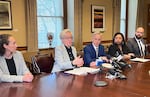
FILE - (Left to right) Portland City Councilor Elana Pirtle-Guiney listens as Gov. Tina Kotek and Portland Mayor Keith Wilson speak at a press conference on housing construction in Portland City Hall, March 6, 2025. Portland City Councilors Candace Avalos and Jamie Dunphy also attended.
Alex Zielinski / OPB
In the 17 months since the federal data was collected, the Trump administration has attempted to scale back programs and funding meant to address homelessness. Last year, HUD threatened to withhold roughly $25 million meant to help move people experiencing homelessness in Multnomah County into permanent housing. That funding was restored through a legal challenge, but it doesn’t prevent the federal government from making similar cuts in the future.
Homelessness remains the city’s top issue. Recent polling commissioned by The Oregonian/OregonLive found that 33% of 600 Portland voters ranked homelessness as the city’s “most important problem.”
When Gov. Kotek was first elected to office, she declared a “homelessness state of emergency” in the state and she has since re-upped that emergency declaration several times. Her office argued those efforts pushed the state to improve data collection and reporting to provide a clearer picture of homelessness statewide.
Since entering office in 2023, she points to sheltering 5,539 previously unhoused Oregonians and ensuring more than 25,900 people avoided eviction. The governor’s team pointed to success in Central Oregon and noted the rate of unsheltered homelessness for families with children has also declined.
The governor has mentioned many times that it took years for the state to get into the current homeless and housing crises and it will take time to fix.
“I think Oregonians understand that these are not things we’re going to solve overnight,” she said in a recent press conference.
But the reduction in unsheltered homelessness, she said, is because of state investment.
Kotek is facing re-election this year and housing and homelessness will be a focal point of the debates between her and Republican Sen. Christine Drazan. The federal data is simply more proof that the state is heading in the wrong direction, Drazan said.
“We’ve got to cut off access to fentanyl and support programs that help people get clean and stay clean,” Drazan said in a statement. “Tina isn’t fixing this problem. She’s making it worse.”
Clarification: The original version of this story compared Multnomah County’s homelessness data in March 2026 to numbers it submitted to the federal government in January 2025.
County officials told OPB after the story published that the federal government has a different definition of homelessness, and therefore the numbers the county submits to the federal government are different than their own data. The story has been updated to reflect that change.