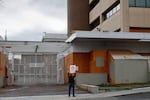
FILE - A protester pictured outside the South Portland Immigration and Customs Enforcement (ICE) building in February, 2026.
John Rudoff for OPB
The owner of Portland’s U.S. Immigration and Customs Enforcement building successfully lobbied the county court to block the city from ruling on a land use violation against his property, a ruling that could have imposed steep fines against him.
The order, approved by a Multnomah County Circuit Court late last month, came nearly two weeks before a city hearings officer had planned to rule on whether a 2025 land use complaint against the South Portland ICE building was justified.
The attorneys representing property owner Stuart Lindquist have claimed that the city is biased against their client because he chose to lease to ICE. The building has become a focal point for protests against the federal government’s immigration policies. The attorneys declined OPB’s request to comment on the issue.
Portland City Attorney Robert Taylor said his office is working to lift the court-approved pause — or “stay” — on the ruling.
“We believe strongly that that stay was improperly obtained, and we have objected,” Taylor told city councilors Wednesday morning.
In court filings, city attorneys characterize the legal delay as “professional ineptitude” and argue it wastes city resources and erodes public trust.
The land use appeal
The May 22 circuit court decision is just the latest turn in months of back-and-forth between Lindquist’s attorneys and city permitting staff. Land use hearings are not typically high drama, but the ICE building debate has flipped that script, with the typically dry bureaucratic hearings being punctuated by heated accusations of bias and political retaliation by Lindquist’s representatives.
The city first issued a land use violation in September, as the ICE building became a regular gathering spot for protests against the Trump administration.
The violation centered on two issues. The city found that Lindquist breached a stipulation of a 2011 property agreement with the city that prohibits ICE from holding detainees in the building overnight or for more than 12 hours. Public records obtained by the city found that ICE broke this rule at least 25 times between Oct. 1, 2024 and July 27, 2025.
The city also determined that the owner’s decision to cover first floor windows with plywood after protests began last year violated city building code.
Related: Portland says ICE violated agreement with city 25 times by holding detainees too long
Lindquist’s attorneys appealed both rulings in a two-day hearing, beginning on May 5, before Portland Chief Hearings Officer Charles Koutras, who operates in a quasi-judicial role to review any alleged city code violations.
They argued that the records showing detainees had been held for long periods of time were imprecise, but they did not offer any evidence to disprove the claim. They also say that their client had no choice but to board up the windows, due to the threats of damage to the building posed by anti-ICE protesters, threats that Lindquist’s attorneys allege Portland police failed to address.
“The city has stripped respondent of effective police protection and cannot prosecute respondent for protective measures in the absence of policing,” said Wendie Kellington, one of Lindquists’ attorneys, at the hearing.
Kellington also accused the city of using its land use policies to penalize Lindquist for his choice in tenant.
“The city may still not retaliate against a property owner because of the perceived message conveyed by that owner’s association with ICE,” said Kellington. “Which is what we have going on here.”
Attorneys with the city denied these accusations. At the May hearing, Senior Deputy City Attorney Beth Woodard said the city’s permitting staff had treated the case like any standard land use violation.
In this process, Woodard noted, Lindquist was given the opportunity to correct the violations and avoid any penalties — in this case, a monthly fine of $934 — and chose not to.
“We will work with any owner, including this owner, to ensure that the owner regains and maintains compliance,” she said. “Claims of bias, differential treatment, and differential enforcement are not supported by evidence.”
Hearing officer Koutras was expected to release a ruling on this issue on June 3.
The legal pause
Instead of waiting for the decision to drop, attorneys representing Lindquist went straight to the court to keep it from being released.
In this case, the attorneys pointed out that Koutras sped up the appeals hearing process because of security concerns. The city zoning decision has attracted attention from anti-ICE protesters, who have frequently held demonstrations outside city buildings and in City Hall to demand a swifter ruling. Attorneys say Koutras’ decision to expedite the appeals process “lacked neutrality.”
They asked Multnomah County Circuit Court Judge Judith Matarazzo to pause the ruling and consider a request to appoint a different hearings officer to the case. She agreed, issuing a stay on May 22.
In response, city attorney Woodard called the move unprofessional, and a type of “textbook gamesmanship” to undermine a democratic process. She asked Matarazzo to allow Koutras to release his ruling.
The court scheduled an August 14 hearing to discuss the issue.
Editor’s note: This story was updated with the new court hearing date, which was released post publication.