Portland’s largest electric utility announced Wednesday it plans to increase rates by 29% for large load users like data centers. Meanwhile, the utility’s residential and commercial customers will see a slight decrease in their rates.
Portland General Electric is making these changes as it begins implementing a landmark law that requires these large electricity customers to pay more.
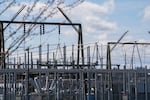
FILE - A Portland General Electric substation in Sherwood, Ore., on March 17, 2026.
Saskia Hatvany / OPB
“This is a pretty big deal because now this gives PGE new tools to be able to make sure that as data centers ... as a class [are] growing, that they are paying for that growth,” PGE spokesperson Drew Hanson said.
The POWER Act, passed by Oregon lawmakers last year, created a new rate class that requires data centers, cryptocurrency and other large industrial energy users to pay for their share of electricity usage. It kicks in for projects that use more than 20 megawatts, or 20 million watts of power. That’s the equivalent of what a large industrial user like a paper mill uses in energy.
According to Oregon Citizens’ Utility Board, a watchdog utility group, residential customers were paying more than twice as much per kilowatt-hour as data centers.
PGE says at least 16 data centers will be impacted by this change.
Other rate changes will include a 1.3% decrease for residential customers and a 2.2% decrease for commercial customers.
The Oregon Public Utility Commission, which regulates utilities and approves rate changes, will review the changes.
If approved, the new rates go in effect June 10.
As more data centers access electricity through PGE, they will pay for the associated growth costs, as opposed to other customers, Hanson said.
Over time, Hanson said it will “even out and lessen the pressure on all other customer groups.”
Related: Hillsboro residents push back on ‘data center explosion’
Oregon CUB Executive Director Bob Jenks said this marks a big win for Oregon households.
“The significant increase in data center rates confirms our belief that data centers were not paying for the costs incurred to serve them. With the new rate structure, we should see a slowdown in the significant increases to home PGE bills,” he said.
The increase is coming at a time when Oregon is seeing a growing number of data centers coming online. According to Data Center Map, an online database that collects information through data center operators and manual sourcing, Oregon has 125 data center facilities.
Data centers take up a lot of energy, with specifics varying depending on the type of service they provide — from cloud services to powering artificial intelligence.
So far, residential and business ratepayers have shared the costs of bringing data centers online, which have driven up utility rates.
In April, PGE increased residential rates by 5%, adding $8 more to a typical monthly bill. Rates from every major state-regulated utility in Oregon have increased, with some rising by more than 50% since 2020.
Related: How the Pacific Northwest's dream of green energy fell apart
PGE’s chief customer officer, John McFarland, said the POWER Act will support responsible growth while keeping customer affordability front and center.
“As energy demand from large-energy users grows, this approach helps ensure the costs of new infrastructure are paid by the customers driving that growth, protecting residential and small business customers while continuing to support economic development across our region,” McFarland said in a statement.
But Oregon CUB’s Jenks said he still thinks residential customers are still being overcharged.
“The commission didn’t address all costs in this realignment, so there is more adjustment yet to come, as the commission ordered these issues to be addressed in future cases,” he said. “For example, local electrical poles and wires fall very heavily on residential customers, and we believe these costs should be spread more evenly.”