
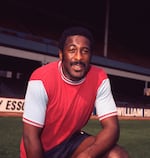
This provided photo shows Clyde Best during his time as a striker for West Ham United. Best later went on to play for the Portland Timbers, helping to establish professional soccer in the U.S.
Courtesy of The Clyde Best Story
Clyde Best became one of England’s first Black soccer superstars when he played for West Ham United from 1968 to 1976. Best scored 58 goals in his 218 appearances as a striker for West Ham. He later went on to play for the Portland Timbers from 1977 to 1981, helping build the foundation for professional soccer in the U.S.
The documentary “Transforming the Beautiful Game: The Clyde Best Story” showcases Best’s life and career, including the racism he had to contend with on and off the pitch. The film will play at the Aladdin Theater on June 4 and 5, followed by a Q&A with Best and other interviewees in the film.
Clyde Best joins us for a conversation ahead of those screenings.
Note: The following transcript was transcribed digitally and validated for accuracy, readability and formatting by an OPB volunteer.
Dave Miller: This is Think Out Loud on OPB. I’m Dave Miller. Clyde Best became one of England’s first Black soccer superstars when he played for West Ham United in the 1960s and ‘70s. He scored 58 goals as a striker. And then he moved to the United States. From 1977 to 1981, he played for the Portland Timbers, who were at the time a part of the North American Soccer League. He is credited with being part of the team that helped turn Portland into what it’s known as today: Soccer City USA. Best is featured in a documentary that’s screening tonight and tomorrow night at Portland’s Aladdin Theater. It’s called “Transforming the Beautiful Game: The Clyde Best Story.” And Clyde Best joins me now. It’s great to have you on Think Out Loud.
Clyde Best: It’s a pleasure to be here.
Miller: I want to start with an excerpt from the movie. We’re going to hear the voices of six Black English footballers spanning from the 1970s to the early 2000s, all talking about what you mean to them, what you meant to them.
Speaker 1: Clyde Best, arriving in England, playing English football, spoke to a resilience about an identity and a responsibility to the next generation that I’m not sure many people recognize.
Speaker 2: All little Black boys around England, no matter who they played for, they wanted to be Clyde Best. I said to my mum and dad, I said, I want to be like him.
Speaker 3: If Clyde could do it, so could I.
Speaker 4: All I wanted to be now is a professional footballer.
Speaker 5: The first football shirt I ever had was a number eight and it was a West Ham number eight.
Speaker 6: When I started wearing a number eight for Arsenal, it was in total honor of Clyde Best.
Miller: What’s it like for you to hear that?
Best: Well, it’s great to hear it from a lot of the ex-players. Most of the guys that said that, I knew of them, they came along after I did, and it’s nice to know that they appreciated what I’ve done for them. And my dream was always to remember that when I first went to England, I wasn’t playing for myself. I’m playing for all those coming after me. And when I look and see today, all the different players of color that are playing in the English league, it makes me feel proud.
Miller: So as you said, that was your intention when you arrived so young, 16, 17 when you started playing in England. But how aware were you at the time of what you meant to younger players, would-be players, who wanted to follow in your footsteps? Did you know when you were playing that there were 12-year-olds who saw themselves in you?
Best: Yes, I had known. I think we must remember that my first love instructions from my dad and my mom, they told me, when I leave to go to England, I’m not playing for myself, playing for those coming after me. And having been there for a little while, you get fan mail and stuff like that from people that really appreciated what I’ve done for them. So it’s great to hear the guys to come out now and say, hey, I’m thankful for what he done for us.
Miller: Did that feel like a weight on your shoulders, the direction from your parents? You’re not just playing for yourself, you’re playing for others?
Best: No, it wasn’t no weight. It was something I always wanted to do, and I wasn’t gonna let nobody stop me and tell me that I couldn’t do it because I tell young kids today, you never let anybody tell you that you can’t do something. You can do anything in life you want. You just got to work hard and persevere and go forward.
Miller: I want to go back a little bit. When you were a kid growing up in Bermuda, you were on a club team with teenagers and kids it seems like even in their early teens, but you were playing against adult men in the navy. What were those games like?
Best: The games were fantastic games. I mean, that’s how we really learned to play the game properly. I mean, we were young kids playing against men, and the first thing it taught us on, you’re gonna get kicked, you’re gonna get knocked down, you’ve gotta pick yourself up and get going. You can’t sit there and sulk and if someone kicked you, hey, if he kicks you, you tackle him the next time you can and do what you gotta do to him. And that was a big lesson for all of us and we appreciate the British Navy for what they’ve done for us because they really helped us along with our game.
Miller: What do you think they got out of it?
Best: Well, I would think they were proud of us, seeing us grow.And I never forget one guy, he told a good friend of mine, he saw me play for the first time, and the gentleman went up to my friend and said, “You see that gentle little guy there? One day he’s gonna be playing in England.”
Miller: How old do you think you were when he said that about you?
Best: I would say between 12, no more than 13, and…
Miller: Wow. And he was maybe in his 20s?
Best: And he was probably, might have been older than that. And these were guys from the late 20s up to the 30s, and it was just a way of us to learn and learn to play against men.
Miller: In the movie, someone describes your playing style as being that you were a gentle giant who then would wake up midfield ferocious. Does that ring true? Does that seem like your own conception of your playing style?
Best: Well, I think so. You don’t let anybody upset you on the field. You never let them know that you’re afraid of them. You just do what you have to do. And if it means you being tough and getting stuck in and not letting them push you around, that’s good for you because it’s a game that, hey, everybody likes to play that play it, and everybody wants to win. So you have to go out at all times and be prepared and be ready to accept what’s coming your way.
Miller: So that English navy guy was right. You did end up coming to play in England, but you were super young. You were 16, I learned in the movie when you arrived in London to try out for West Ham. Can you tell us about the day or the night that you arrived?
Best: Yes, it was a Sunday morning. I got at Heathrow and I had to make my way from Heathrow all the way to West Ham, not knowing which way to go. But one thing I learned in life was that if you don’t know something, ask somebody. And the people were good enough to direct me in the right way, and they were able to get me from Heathrow all the way up to West Ham Station, and that was right in the East End of London. So I’m going from let’s say North London all the way over to West Ham, and that was the eastern part, and I ended up at the train station and I was there waiting, waiting, asking people.
And this old gentleman came up to me and he asked me, “Sonny, what are you doing here?” You know. I said, “Well, look, I’ve come from a trial with West Ham,” and he said, “Well, look, they played yesterday, so the club wouldn’t be open today, so you come with me and I’ll take you across the park to a family that has two boys that play,” and he took me there. We knocked on Charles’s door. That’s Clive and John’s mom, and she took me in and I was supposed to stay for a few nights, but ended up staying for years with her because that was my second family away from home.
Miller: Can you describe what that relationship turned into, and this ended up being a player here and a legendary coach, not just in Portland, but nationwide. What did it mean to you to land with this family, almost by chance?
Best: Well, it was great because, as I said, I never knew where I was going. I never knew where I was going to be sleeping that first night in London. And for her, Clive’s mum, to take me in with open arms and treat me just like one of her own children was unbelievable. So, I knew that I had landed on the right doorstep, so to speak, and Clive and I ended up until the day he passed, like brothers. He’s somebody that I miss up until today still. As a matter of fact, I’ve got to go see his grave before I go back to Bermuda this week.
Miller: You had a successful tryout and then all of a sudden you were on this team that had three star members of the English national team that had just won the World Cup a few years before. You’d seen them on TV. What was it like to then play alongside these men?
Best: It was a dream come true, unbelievable. As you said, I was blessed to have been in the company and playing with three World Cup winners and on the same team, and it was a dream come true. It’s something that I will never forget as long as I live because to be in a position like that, not many players get that opportunity, and I had three players on my team that played for the World Cup.
Miller: I want to play another excerpt from the documentary. We’re going to hear from two Black players who played in the 1970s and early 1980s, Paul Canoville and Howard Gayle.
Paul Canoville: It got so abusive, so loud, and I can hear it so clean. I got so angry at an abuser, when you saw bananas thrown at you and you turn around and you see, it wasn’t the Crystal Palace fans, it was my own fans, and that is what hurt me.
Player: To be ridiculed by your own fans, it’s soul destroying.
Announcer: “On Ferdinand, he’s onside and has scored one-nil Rangers.”
Howard Gayle: I remember scoring my first goal and being so delighted and then a couple of days later going into the training ground and hate mail with swastikas on it and people saying, go back to where you came from you’re this, that and the other, just because I’d scored a goal. You’re playing for their team and you’re doing your best for them. But actually I don’t really want you there.
Miller: How did you handle that racism from all quarters, including from your own fans?
Best: Yeah, it’s something that you have to have what we call thick skin. I had a job to do. I wanted to play professionally. I couldn’t play anywhere else. And England was the place that gave me an opportunity. So I had to stick it out and as I tell people all the time, they would say to me, I don’t know if you can, or how to take abuse like that. But like I said, you have to block it out. You hear it and you just continue to do what you’re doing and in the end, 9 times out of 10, you’re gonna win out, so I was able to do that and at times it was annoying and you had to show them that you’re not going to put up with nonsense and just go out and do your job and once you do your job, they end up in your corner.
Miller: Did you have people you could turn to for support?
Best: Not really. I mean, I kept a lot of stuff to myself. And my coaches and he was probably the only one that would have known and he stuck with me and was on my side and made sure that I was able to perform and do the best job I possibly can for the club and that’s what you want to have. You have to have people that are gonna back you, that believe in you, and with me, at West Ham and having Clive and John that were there before me and coming to join them, it was, as I say, it was unbelievable and it’s something that I would never forget and I would always be appreciative of the Charles family. Mainly Clive and John and his mom for what they’ve done for me.
Miller: You spent eight years with West Ham, and then by the end of that time you were getting less playing time. My understanding is you could have played for another team in England, but you made the decision to come to the U.S. to the fledgling North American Soccer League. Why come here?
Best: Well, because it was a new adventure, and I told the coach at the time at West Ham, Ron Greenwood, that I’m looking for something new. And the Americans had came and our coach was Eddie Firmani at the time in Tampa and he asked me if I wanted to come and I said, why not? I mean it sounds a great deal for me and coming to a different country, America at that, and we’re going to help to push the game and move it along, which we’ve done and when I look and see the kids playing today, I think we’ve done a pretty good job because everybody plays football today.
Miller: You spent a couple of years in Tampa Bay with the Rowdies and then came here, came to Portland. What are your memories of Portland in the mid to late 1970s and early 1980s?
Best: Portland for me is a great city. It’s a great place to live, great place to bring up children, fanatical football fans, and I remember playing at the stadium here and every game was practically packed. And they supported their Timbers and let you know, just like England in a sense, if you’ve done something wrong, they’re gonna get on you. If you were trying and give them 100%, they will support you. And that’s the way sport is in general, whether it be basketball, football, baseball, everybody wants to win. So we know that as athletes going into it that hey, if I always go ahead and give my best, I’m gonna be OK. And coming to America during that time was the best thing that happened to me, and I was able to get a fresh start and start something new.
Miller: Did Portland feel different than other American cities in terms of its appreciation for or understanding of the game?
Best: Well, Portland and Tampa were two of the first cities to really introduce NASL, soccer or football to the people in the cities, and those two cities were unbelievable. Portland, as you say, the people were packed in to support the Timbers and Tampa was the same. I mean, once they got the gist of people coming out and working with the children and training the children, a lot of them never seen that before. And I think as you look into the documentary, you get the goalkeeper that Clive had at his university, the boy from Seattle that ended up playing in England and he gives high, high props to a person like Clive and thanked him for what he’d done for him because without people like that, how far would soccer have gone?
Miller: What made Clive such a special coach? I mean, because after his playing time, he’s especially remembered here as a coach. What made him so good?
Best: Well, the most important thing about Clive Charles, Clive was a special human being. He was decent. He respected people. He loved his players. He worked hard, and we were all blessed to have been at a place like West Ham where we believe in playing football the right way. And Ron Greenwood used to stress that to us as young kids, do it the right way, and Clive was brought up that way and he carried it on into his coaching, and that’s why he was very, very successful. And the most important thing about Clive Charles, it wasn’t about the players, it was about the people and the men, and he brought that out in all his players. And you look around Portland today, there are a lot of players that played for Clive Charles that are decent human beings and that’s what’s most important.
Miller: What goes through your mind when you watch a football match today? What are you looking for? What are you thinking about?
Best: Well, today the game is different from when we played. There is a lot more tackling when we played versus today. Today you look too hard, they want to give you a red card.
Miller: It was rougher when you were coming up.
Best: Yes, it was rougher, but…
Miller: And you liked that.
Best: It didn’t bother me because I, my bulk and size had a lot to do with it. So it didn’t bother me. I liked it that way.
Miller: Do you think players are too theatrical these days?
Best: Some of them probably are, but like you say, having the VAR [Video Assistant Referee] doesn’t help because as soon as you look at somebody, they want to go to VAR to see if it’s a fault, if it’s not. I tell people all the time, football is a game played by human beings. Human beings make mistakes, so let’s just leave it like it is and just carry on doing what we’re doing.
Miller: How are you feeling about the World Cup?
Best: I’m excited about it. I’m not so excited about the prices, and I feel for the ordinary person that really enjoys soccer because football as we know it is a poor man’s sport. That’s what people used to pay to go watch at a decent price.
Miller: Kicking a can or a rock or whatever, learning how to play and then maybe getting involved…
Best: That’s what they would do, but today, with the prices you’re seeing from the World Cup, it’s not fair on a lot of the everyday people that went to the matches just to support their team.
Miller: Clyde Best, it was an honor talking with you. Thanks very much.
Best: Thanks very much for having me. It’s a pleasure talking to you. Thank you.
Miller: Clyde Best played for West Ham United from 1968 to 1976, and then for the Portland Timbers from 1977 to 1981. He is featured in the documentary “Transforming the Beautiful Game: The Clyde Best Story.” It is screening tonight and tomorrow night at the Aladdin Theater in Portland. You can see Clyde Best and Q&A after both of those screenings.
“Think Out Loud®” broadcasts live at noon every day and rebroadcasts at 8 p.m.
If you’d like to comment on any of the topics in this show or suggest a topic of your own, please get in touch with us on Facebook, send an email to thinkoutloud@opb.org, or you can leave a voicemail for us at 503-293-1983.
