
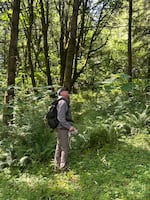
Oregon Forestry Department biologist, Mike Davis, uses a bird call player to try and solicit responses from northern spotted owls in the Tillamook State Forest, Oregon. 2026.
Courtesy: Oregon Department of Forestry
Oregon’s forests are home to a wide variety of wildlife, including threatened species like the northern spotted owl and the marbled murrelet. The Oregon Department of Forestry needs to count such species to help protect them and enhance their habitats.
After decades of biologists going out into the woods and physically counting animals, the agency is now turning to sound recorders and AI because they’re cheaper and can gather a lot more information.
“Autonomous recording units with rechargeable batteries, memory cards, and the software costs are coming in the $600-$700 range per device,” said Oregon Department of Forestry biologist Corey Grinnell.
The agency is currently spending millions to send biologists into the forests to conduct callback surveys, where they mimic a bird call and count responses.
Oregon Department of Forestry biologist Mike Davis said callback surveys also have limitations.
“For owls, the surveys are conducted at night and typically for just that one night at each location,” said Davis.

“There are safety concerns too: driving dark gravel forest roads, hiking into the mature forest stands where owls typically are, without any trails, and traversing steep, rugged terrain. Then standing or hiking for hours, oftentimes in the rain. It is not easy work nor a fun experience some nights.”
Such problems led the forestry department to start experimenting with recorders in 2022. The agency now has 23 devices and plans to deploy more as it moves away from callback surveys.
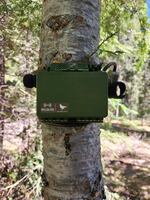
An autonomous recording unit deployed in the Tillamook State Forest. Oregon, 2026
Vanessa Petro
The autonomous recording units, or ARUs as the agency calls them, can record environmental sounds such as bird calls and frog choruses over long periods without any human intervention.
Davis said ARUs have other advantages too.
“They can be left out in the field several weeks or more, set up and retrieved from the field anytime, record multiple species, and can be analyzed back in the office.”
The units are similar to trail cameras. They run on batteries and have removable memory cards.
“We bring the cards back to our office and run specialized software that processes the audio recordings,” Davis said. “It converts the sound waves into spectrograms, which are visual representations of frequency over time. Each species’ calls produce distinct patterns on these images, allowing software to identify and differentiate vocalizations.”

The audio spectrum of a female northern spotted owl shows her signature four note call. Oregon, June 11, 2026
Courtesy of Oregon Department of Forestry
There is some concern that using recorders might put biologists out of work. But lead ODF biologist Vanessa Petro isn’t so sure. She said that once the AI counts birds in a recording, the tally will need to be checked by an actual biologist.
“You need to validate,” she said. “So, if it’s saying there were x-number of spotted owl detections, you need to be able to confirm that and say: ‘Yes, they were northern spotted owl and not some other species that AI misidentified.’”
Petro said any savings generated by the recorders can be used to conduct other important wildlife research, which requires biologists.
The use of sound recorders has yet to be officially approved by the U.S. Fish and Wildlife Service, which monitors compliance with the Endangered Species Act.
“Once that happens, we can integrate them more into our management plans,” said Grinnell.
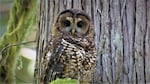
FILE - An undated image of a northern spotted owl in the old growth forest of Oregon.
Todd Sonflieth / OPB
ODF is also waiting for USFWS and the National Oceanic and Atmospheric Administration to approve a new Habitat Conservation Plan. It would give the agency 70 years of certainty for managing 17 different species, including the northern spotted owls and marbled murrelets.
The agency hopes the new Habitat Conservation Plan and the sound recorders will improve forest management.
“Our goal is to create healthy, productive forests, high-quality habitat for native fish and wildlife, clear cool water, benefits and revenues to rural communities and timber-related economies, as well as recreation and educational opportunities,” said Grinnell.
“To do that we embrace cutting edge technology to improve our data in the most cost-effective way.”