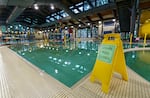
FILE — Pools like the one at Mt Scott Community center require adults to supervise children under 14, but that state rule may get revisited. This Portland pool, shown in this Jan. 19. 2022, is normally full of children but sat empty as shown in this file photo because of a shortage of staff.
Kristyna Wentz-Graff / OPB
Ahead of the upcoming summer, Oregon public health officials won’t require adults to accompany their children under the age of 14 at public swimming pools.
The Oregon Health Authority announced this week that it would “revisit” a rule adopted in April 2025 that required direct adult supervision for children at that age. The rules took effect in February.
But in the wake of public backlash, the agency now only plans to adopt a temporary measure requiring public pools to post a sign with the message that state health officials recommend that supervision. The Oregon Health Authority will convene a “public process” in the fall to gather input about a permanent or different rule.
“After hearing from parents and caregivers of older elementary and early middle school-age children, the Food, Pool and Lodging Health and Safety Program is proposing additional discussion with the community and regulated partners to gather more input, ensure equitable access to public pools and continue to keep kids safe,” Gabriela Goldfarb, manager of the Oregon Health Authority’s environmental public health section, said in a statement.
The original rule aligned with the Centers for Disease Control and Prevention’s Model Aquatic Health Code, which provides federal guidance on preventing injury and illness at public pools using the latest scientific research. The health authority pointed to research from the CDC finding high levels of deaths in swimming pools through the age of 13, then a drop starting at the age of 14. Drowning is one of the leading causes of death for children aged 5 to 14 due to unintentional injury.
But the state rule raised questions about implementation and whether it would keep kids from swimming. State and federal data has shown children in Oregon who die from drowning are often in lakes, rivers or other bodies of water on public lands, not in pools.
Oregon public health officials said they would communicate the rule changes to pool operators and local health inspectors, and suggested they would consider swimmers’ concerns in developing an updated rule.
Public health officials have stated that they are seeking a diverse range of views for a fall workgroup on public swimming safety rules. Oregonians who are interested in participating can email pool.safety@oha.oregon.gov.
“Given the technical nature of most of the rules, OHA typically gets participation from pool facility operators and builders, and not the community members using the pool,” Goldfarb said. “Going forward, when CDC updates its model codes, we’ll work to identify proposed changes that need community conversations to find the right path for Oregon.”
Public health officials have stated that they are seeking a diverse range of views for a fall workgroup on public swimming safety rules. Oregonians who are interested in participating can emailpool.safety@oha.oregon.gov
Oregon Capital Chronicle is part of States Newsroom, a network of news bureaus supported by grants and a coalition of donors as a 501(c)(3) public charity. Oregon Capital Chronicle maintains editorial independence. Contact Editor Julia Shumway for questions: info@oregoncapitalchronicle.com. Follow Oregon Capital Chronicle on Facebook and Bluesky.
This republished story is part of OPB’s broader effort to ensure that everyone in our region has access to quality journalism that informs, entertains and enriches their lives. To learn more, visit opb.org/partnerships.