Grass seed growing at Ioka Farms in Silverton, Ore.
Courtesy of Ioka Farms and Marketing
Soccer fans around the globe have spent the last few days cheering on their favorite teams at the 2026 FIFA World Cup.
The 5-week tournament is being co-hosted by Mexico, Canada, and the United States. While there’s been a lot of excitement about what’s happening on the pitch, there hasn’t been as much fanfare about the pitch itself — much of it made with Oregon grass seed.
Grass seed is produced on an estimated 1500 Oregon farms, and while World Cup regulations prevent the identification of which stadiums have our state’s grass seed, it’s been confirmed that around 40% of the 16 stadiums do.
The Oregon Seed Council’s second vice president, Rachel Hankins, joined OPB’s “All Things Considered” host Crystal Ligori to explain how Oregon grass seed made its way into World Cup stadiums.
Crystal Ligori: So, we’re here to talk about grass seed, which is something Oregon actually makes a lot of, right?
Rachel Hankins: Yes, Oregon actually produces two-thirds of the cool-season grasses, and that represents about $640 million a year, and we’re the 4th largest agricultural commodity in Oregon.
Ligori: What do you think makes Oregon grass seed ideal for a soccer pitch?
Hankins: I think the grass seed in Oregon starts with the quality that we have here. So it’s not just that we have the best environment for growing it, we also have the best growers and the experience and knowledge to have quality grass seed. Whether we’re talking about the cleaning that we do, or the weed control that starts in the field, or even starting with the genetics, we have several world-class breeding facilities in Oregon where those breeders are trying to create better grass seed varieties that regenerate faster, use less water, that are disease resistant, and that are going to make it more economical and better for these stadiums to have the Oregon grass in it.
Ligori: You mentioned Oregon having a great climate, and the World Cup is being played across multiple different countries. So that also means multiple different climates. While Oregon seed, of course, isn’t in all the stadiums, it is in a lot of them. Are there challenges to creating grass for multiple different regions?
Hankins: Each grass seed species is adapted for a different region. So whether you’re talking about a tall fescue or a perennial ryegrass, those have different applications in those stadiums, but the thing that I thought was the most fascinating was that they had to also take into account some of the variety characteristics, how wide-leafed it is, how is it going to react when you water it or to the cold or to the warm, because each of the playing surfaces have to play exactly the same for the athletes.
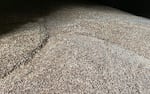
Grass seed harvested at Ioka Farms in Silverton, Ore. Oregon produces almost two-thirds of the total production of cool-season grasses in the U.S.
Courtesy of Ioka Farms and Marketing
Ligori: I know you can’t say exactly where the Oregon grass seed ended up, but can you give us an idea of how much of our seed is being used in this World Cup?
Hankins: Some sod farmers actually use live plants to plant their sod, and some use seeds. So, if you’re doing a seeding rate, you’re using about 50 to 800 pounds per stadium, which doesn’t sound like a lot, but now that these stadiums are retrofitted to have live grass rather than artificial turf. So, we’re not just looking at the economic impact in the seed that they’re using now; it’s the potential for the seed if they stay [with] natural turf. So I think we sold anywhere from 55,000 to 300,000 pounds [and] that could be an annual sale if they stay natural turf.
Ligori: Rachel, why is playing on natural grass better than just playing on fake turf?
Hankins: Natural grass, the studies are finding that it’s better for the athletes. It leads to less injuries and has more [environmental] benefits than artificial turf. With the artificial, there’s concerns about microplastics and having a lot of plastic waste in our recycling system, whereas with the natural turf, you have the benefit of it being cooler for the athletes to play on, it’s a carbon sink, it’s going to have water filtering–maybe not in a stadium–but when it’s on local parks and playing fields, you have those other benefits too that artificial doesn’t have.

Belgium's Romelu Lukaku (9) celebrates after Egypt scored an own goal during a World Cup Group G soccer match between Belgium and Egypt in Seattle, Monday, June 15, 2026.
Maddy Grassy / AP