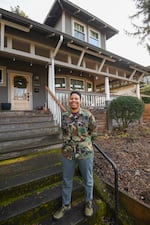
In this provided photo, Ebony Frison, Portlander and U.S. Air Force veteran, poses for a headshot.
Courtesy of Ash Stone / Courtesy of Ash Stone
In just a few weeks, our nation will commemorate the 250th anniversary of its independence.
As we approach this historic milestone, “Think Out Loud” hears from guests whose life experiences and personal histories illuminate different aspects of what it means to be an American.
For the second installment of this series, we’ll hear from Ebony Frison, a Portlander, artist, and U.S. Air Force Veteran.
After her time in the military, her art has largely included archiving photographic work by Newton Carroll.
Carroll was a Black American military photographer whose work depicted military members from segregated U.S. Army units during World War II.
What she found in those nearly 90-year-old images were faces and expressions and experiences of those service members that mirrored her own time in the military.
Her ongoing series, “Black Valor,” uses archival photos and documents to log her family’s connection to the U.S. Military and chronicles stories and images of Black life that are missing from official historical narratives.
Note: The following transcript was transcribed digitally and validated for accuracy, readability and formatting by an OPB volunteer.
Geoff Norcross: This is Think Out Loud on OPB. I’m Geoff Norcross. With the 250th anniversary of the founding of our nation happening next month, Think Out Loud is hosting a series of conversations about what it means to be an American. Yesterday we heard from married veterans who said they found purpose and pride in the shared sacrifice of a military career. We’re going to get a different perspective today. Ebony Frison is a veteran of the U.S. Air Force and an artist who lives in Portland, and she joins us now. Ebony, welcome to Think Out Loud. It’s good to have you.
Ebony Frison: Yeah, thank you for having me.
Norcross: Why did you go into the Air Force?
Frison: I went into the Air Force as a means of surviving. My family migrated here in the 60s from Texas. My grandparents were sharecroppers. My great grandparents were born during Reconstruction, and my great grandparents were born enslaved. So my grandfather was a sharecropper. He moved to Oregon following his siblings, and they worked in Zidell shipyards and built ships for the war. So I went into the military because no one in my family had graduated from college. I didn’t know what that was and it wasn’t a conversation. I went to the Air Force because it was the only option.
Norcross: Really? Did anybody else in your family go into the military too?
Frison: Prior to me? Yes.
Norcross: What did they tell you about what you would expect when you got there?
Frison: We didn’t have that conversation.
Norcross: Why do you think that is?
Frison: We as a family and a community sometimes don’t talk about the things that are hard. We hope for the best and we keep secrets, right? So it wasn’t talked about. I remember going to the recruiter with my aunt and one of the questions that she asked was, “What happens if you’re in the military and they find out that you’re gay?” I was like, why is she asking this question? And I thought it was the oddest thing. And the recruiter said, “Well, they’ll kick you out.” I just remember thinking like, wow, that’s really odd. Like that’s a really odd thing.
Norcross: This is in a time of don’t ask, don’t tell.
Frison: Correct. Don’t ask, don’t tell. So yeah, my family didn’t talk about it. We survived.
Norcross: Why did you choose the Air Force and not another branch?
Frison: Initially, it was going to be the Army, but I knew some folks that had been in the Army and in the Air Force, and they recommended the Air Force. I think that was based on their experience, right? They were white women. Both of them were pilots, one Air Force, one in the Army. It was sort of explained to me that the Air Force was better. I don’t really know what that better means except for now I understand that Air Force is really based on education and testing, whereas the Army is based on you working hard and being a good soldier.
Norcross: What was your experience?
Frison: It was fun at first. Basic training was great. I was an athlete, so I had a really good time. Made a lot of really good friends, and Guam was amazing. But then I decided to come home and I went to McChord Air Force Base, which is in Tacoma now. Now it’s like Joint Base Lewis-McChord. It was absolutely horrible. It was not an experience that I would recommend for anybody. I was targeted for a lot of reasons. I was treated very poorly and because of that, I was in a very deep depression. I made mistakes while I was in that state, which led to me being court martialed, and I received a bad conduct discharge.
Norcross: Do you mind being specific? What happened?
Frison: I was hanging out with the wrong people. I didn’t want to live anymore. I was giving away my things. When I was five years old, I went with my brother’s dad, and I remember going on a journey to take a car and to park this car in Vancouver. I remember asking, “Why are we parking this car over here?” The response was like, “Well, he doesn’t want his car anymore.” So I just was like, okay, whatever.
So then fast forward, I’m in the military. I’m not wanting to live this life anymore, and I’m giving things away. I’m not caring what people are doing with them or really how I’m being treated. I’m not taking care of myself. I had a friend who I thought was a friend who was repairing my vehicle for me. I just gave him my car and I said I didn’t want it anymore and that I didn’t care what he did with it. And they found it. He had taken all of the radio equipment and things out of it, and they destroyed the vehicle. Later on I was charged for that. The military said that I was in two places at once. I did give them a false statement. I told them that I didn’t know who had my car.
Norcross: Why did you do that?
Frison: I was scared. I had sought help from my command several times, and every time I sought help, I would be put down. Then when I would report that, I would be retaliated against. So I felt alone and I felt like I didn’t know what to do when the right thing to do was to continue telling the truth. In that moment, I did not. I lied. So because of that, and because I was queer, because I was going through so many things, this was the opportunity that they had to court martial me and to kick me out.
Norcross: What did it mean for your military career to end that way?
Frison: It meant a lot of things. It meant shame, it meant disappointment. But at the same time, it was life saving. I had recognized that I was repeating a lot of the behaviors and patterns that I grew up with. And they weren’t positive. So, in that moment I was checked in a way to sort of look at myself and change the way that I was engaging with other people and the way that I was handling my emotions.
Norcross: Sounds like kind of a wake-up call for you.
Frison: For sure. Often I’ll tell people that being in jail was, I’m not going to say it was the best experience, but I will say that it was better than being sent to Iraq, because that’s where I was going next. I don’t think that I would have survived that. I think that I would have died over there. Whether that means I would have lost everything there and returned just a shell or like maybe I would not have returned. But I don’t truly feel like I would have made it back.
Norcross: Let’s talk about your photograph project. You’ve been looking through archive photos of segregated units and we’ll talk about what you found. But can you tell me about why, what started you on that quest?
Frison: For sure, this sort of happened… one of those weird kinds of ways that spirit helps. So I was a social worker for a while and I was going to go to nursing school, but decided that I was gonna get an art degree. While I was learning these different processes, I was thinking about what I was going to do for my thesis. I didn’t want to do military art. Meaning, I didn’t want to do combat art, and I didn’t want to do things that people have seen already. I wanted it to be something that people could relate to, whether or not you’ve been in the military.
Oregon, we’re in a pretty unique space, meaning we don’t have an active military base. So, a lot of times people have a different response to that here. Let me rewind. I woke up one morning and I was having a conversation with my mentor, Michelle Ross, who is this tremendous mentor at PNCA. I was explaining to her, I don’t want to do military art, but why haven’t I seen any images of the segregated units in any of the research or or readings I’ve done?
She suggested that I look on eBay, and I had been looking on eBay, but I hadn’t found anything. She was very insistent, just like, “Go home today, look on eBay.” I go home, I type in on eBay, and the first thing that pops up was this archive of negatives dating 1944 to 1945, World War II segregated units during the European tour. They were expensive. However, I worked it out and made payments, got them. As I was digging through, I started to see images that brought up memories for me. Memories of my time. Images that reminded me of photos that I also have. Facial expressions that I have also expressed in photographs.
So then I started thinking about my time in the military. I started thinking about this fight for freedom and the struggle to survive, and what that means and what that meant for me. As I go on, I start to realize there are no combat photos in this archive. This archive is full of men and women building infrastructure, building camaraderie, building friendships and families, and just really enjoying themselves in another country where they’re allowed to be themselves.
Norcross: There was a particular photographer that jumped out at you in the archive. Can you tell me about Newton Carroll and what his photographs reveal?
Frison: Newton Carroll is a beautiful photographer. His photographs reveal love and sacrifice. When you’re in the military, you are with strangers. They become your brothers and your sisters. Every time I look at these images, I’m reminded, yeah, it’s World War II. These men are fighting segregation. But they’re free right now in this image. They’re frozen in time. Dancing with white women in Europe, right? They’re frozen in time sailing on boats in the sea in Italy.
Norcross: And you know that they’re going to come home and not be able to dance with white women?
Frison: Correct. I mean, Medgar Evers was I believe a Marine and he was killed in his driveway by a military police officer. When I think about the military, for some people, it’s not a choice. For them, it was not a choice.
Norcross: Like you.
Frison: Correct. However, I could have had other choices. They didn’t have other choices. Just like my grandfather did not have another choice to be a sharecropper. Just like the enslaved really didn’t have a choice, they were forced into something. Yet, they survived, right? They did what they had to do to survive. These men were selected to fight the war, and they did that.
Norcross: What did you do with these photos?
Frison: I’m currently working on the archive right now. I’ve used some of the prints for my thesis. There are some prints currently on view for the Oregon Artists Biennial at Oregon Contemporary and also at Ori Gallery on Mississippi. I was invited to apply for the Creative Heights grant. So if I get that, I have an amazing project. I’ve put together a really amazing team, and we are gonna make some artist books, prints, and the biggest thing of all that I’ve never done that I’m really excited about is creating a film; a time-based film that includes video and poetry and a lot of these images. But right now, I’ve been putting them all on my website so that if folks want to see them, they can go to my website and take a look.
Norcross: You’ve given us wonderful background about your history, your time in the military, what it meant for you and what you felt when you saw these photos. What does it mean to you to be an American right now?
Frison: Wow. I have a lot of privileges that my ancestors didn’t have. Yet, it’s still a struggle. So I think being American, for me, being a Black American, means to sometimes be unconsciously targeted. It means that you have to love yourself, because when you’re out by yourself, people may not see you and respect you. People see a color. I know that some people may disagree with that. But I’m definitely speaking from experience. So for me, that’s what it means, but it also means that I can make choices about the people that I am around. I can travel freely. I can travel to other countries. So I do have freedoms that my ancestors were not allowed to have, and I do experience like unconscious biases like on a regular basis. Which I think that most people will say that they don’t have those, but I think everybody does.
Norcross: What about patriotism? What does that word mean to you?
Frison: Oh, I struggle with that. I’m just now feeling comfortable really talking and telling people that I’m a military vet.
Norcross: Why were you uncomfortable before?
Frison: It was such a struggle. My squadron did a really, really good job at beating me down and making me feel shameful that it was something that I wanted to ignore and I wanted to go away. I was a really great soldier. I was given a lot of awards and things like that. But at the end of the day, that was just beat out of me. It’s just one of those things that I’ve just stayed away from.
Norcross: The recruitment for the U.S. military is vast. It happens a lot. You see it everywhere, especially with the U.S. Air Force. I mean, the flyovers at the Super Bowl. Whenever you see efforts to bring people into the military, what do you feel?
Frison: I’ve recently had some friends that will send their kids to me to have a conversation. It’s not for everybody, but it can be for someone, right? If you test well and you want to go into a profession that ‘s not like a traditional college profession… If you wanna fly airplanes, you should probably go to the military, right? But if you want to be a doctor, you can go to med school, and you can get that paid for. You do not need to go to the military to become a doctor. So I think it truly depends on what the person wants to do with their life and why they’re going.
If it’s someone that thinks that they don’t have any options, I will list all of the options for you and tell you just to keep the military in your back pocket. Even then, if you do want to go, get a college degree first and then go. Because then you’re an officer. So, I’m not completely against it because obviously, we need it, right? But at the same time, I don’t think that it needs to be the thing that people do to survive. There’s other options.
Norcross: How has being exposed to these archived images of troops overseas during World War II changed your approach to these very big questions about what it is to be an American and what patriotism means? I mean, how did those images speak to you and change your perspective?
Frison: For sure. On top of my experience, if it were a segregated experience, I can’t imagine how much more traumatic that would have been for me. So when I think about the men and women in these images, and I think about what they had to do on a daily basis, it sort of freed up space for me to think about my own situation, right. To consider I had choices and they didn’t, and to learn from that. So I think that just knowing that the people before me did not have a choice in the world. That even when I thought I didn’t have a choice, I did. That’s enough for me to sort of play it back and to give myself grace. To allow myself to heal from that process or that situation.
Norcross: Well, I’m sure a lot of people want to see these images now. Where can we see them online?
Frison: They’re on my website, ebonyfrison.com
Norcross: Ebony, thank you so much for this conversation. I loved it.
Frison: Thank you.
Norcross: Ebony Frison is a Portlander, an artist, and a veteran of the US Air Force.
“Think Out Loud®” broadcasts live at noon every day and rebroadcasts at 8 p.m.
If you’d like to comment on any of the topics in this show or suggest a topic of your own, please get in touch with us on Facebook, send an email to thinkoutloud@opb.org, or you can leave a voicemail for us at 503-293-1983.