
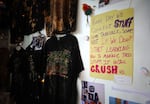
A quote from Becky Lange was pinned on the wall at Ground Score Association in Portland's Old Town on June 4, 2026. The event featured shirts, a tiny fabric dumpster fire on a keychain, and other crafts Lange made before she was fatally assaulted in May.
Alex Zielinski / OPB
The event was supposed to be a celebration.
The June 4 gathering at Ground Score Association, a nonprofit that picks up trash around homeless camps, was meant to be a gallery opening, where employee Becky Lange had planned to display her art: hand-dyed shirts (one reading “being homeless is in tents”), pieces of discarded tent fabric sewn together to resemble stained glass, tiny hand-sewn dumpsters spewing flames made out of fabric.
Instead, it was a memorial service.
On the evening of May 22, an acquaintance allegedly hit Lange in the head with a metal rod and left her crumpled on the sidewalk in Portland’s Old Town. Lange died 12 days later. She was 44.

A housing shortage and homelessness crisis have gripped Portland for more than a decade. While the government has been unable to swiftly address the dilemma, the public’s patience has worn thin. As the homeless population grows, people – and politicians – make blanket assumptions about the lives of people living unsheltered, often leaving individual stories lost in the shuffle.
Lange didn’t have a house. She dealt with addiction and other health issues. Her job consisted of digging through garbage. But that’s not what defined her. Those who knew her describe a civic leader, an advocate for overlooked, struggling Portlanders, an artist, and an entrepreneur – the kind of person city leaders say Portland needs more of.
“My fear is that the story of the life of Becky Lange is going to get caught up in her death. Just another example of a homeless person who met an unfortunate end,” said Nic Boehm, Lange’s boss at Ground Score.
“Even if you take away the art, even if you take away her organizing with the community, what you’re ultimately left with is somebody who you could measure the good they did by the ton.”
The path to Portland’s streets
For the many years that Becky Lange lived unsheltered on Portland streets, she found herself drawn to “ground scores.”
That’s a term for a treasure found while picking up trash or dumpster diving: a box of hair dye, a necklace, sewing thread, new boots. She saw value in what most considered garbage.
“It is so incredibly wasteful to not try to get every last bit of life out of something,” said Lange, in a 2025 episode of Ground Score’s podcast, American Wastepickers.
The day after Lange’s unexpected death, her friends, colleagues and family gathered at Ground Score – a half mile from where Lange was assaulted – to remember a woman who inspired others to find beauty in the unexpected.
Staff set out felt markers and paper for people to write about Becky and pin to the gallery wall.
“She always gave me a safe space to create and be myself,” read one note on a blue piece of paper. “I was very lucky to learn from her.”
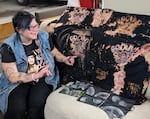
Becky Lange, in an undated photo, is sitting next to shirts she hand-dyed for a Ground Score art show.
Taylor Cass Talbott
Jenn Lange, Lange’s younger sister, teared up as she walked around the room, reading the notes and talking to people who knew Becky.
Jenn lives in Pennsylvania and flew out shortly after the attack to sit by her sister’s bed in the intensive care unit.
The girls had a hard childhood: their mother died before they were teens, and the woman their father remarried wasn’t kind.
They’d remained close in adulthood, but had recently gone a year without talking. Before the attack, Jenn said she and her sister had just started reconnecting.
Over the past week, Jenn said, “I’ve been kind of rediscovering who my sister’s become.”
Jenn said her big sister moved to Oregon after graduating from Penn State University around 2006. Becky wanted to pursue journalism and seek new experiences.
But that career never came to be.
Instead, Lange lived unsheltered in Portland on and off over the years.
In an interview with the Portland Mercury in 2020, she said she had recently been forced to move out of an apartment to make space for a roommate’s boyfriend, and she couldn’t find another rental in her price range.
Since 2020, she fluctuated between sleeping outside in a tent and crashing on a friend’s couch – a pattern that continued until her death.
Missy Johnson met Lange about five years ago, when they were both living unsheltered. They became fast friends – Johnson called Lange her “soul twin.” Johnson beamed when she talked about her late friend, sitting in the craft room at Ground Score, where she and Lange spent long hours making art.
She said Lange would talk to her often about wanting to find a house.
“But it just seemed like it was too far out in the cards for her to stress about too much,” Johnson said.
Johnson and others who knew Lange say she had tried to get into different housing programs.
But they either posed requirements that were too burdensome (like not allowing pets) or things fell through at the last minute.
Finding purpose
Lange made the best of her life unhoused – planting tidy vegetable gardens alongside her tent and hanging artwork.
But it wasn’t without tumult.
Time after time, Lange would lose belongings through the city’s campsite removal processes, often called sweeps. That experience motivated Lange to get more connected with Portland’s unhoused community – and try to help.
At Ground Score, a nonprofit focused on hiring people experiencing homelessness, Lange got a job in 2021 picking up trash at homeless encampments across the city.
Often, she’d show up after the city had removed tents and personal belongings, leaving behind people in a state of crisis.
“Becky lost all her stuff through sweeps multiple times,” said Angela McGuire, Lange’s manager at Ground Score. “But she was still willing to show up and help people understand what was going on when it happened to them, and help them get their stuff back. The fact that she had been in their shoes made it easier for them to connect with her.”
Lange started attending public meetings where she spoke out against city policies that impacted homeless people, and she joined at least three different volunteer boards across Multnomah County to represent the interests of people living unsheltered.

Becky Lange speaking at a Nov. 1, 2022, public hearing at Portland's Blanchet House, where elected city leaders heard testimony about a proposed camping ban.
Kristian Foden-Vencil / OPB
“Becky had a voice, and she could speak eloquently, and she could pull people’s attention in,” said Ground Score founder Barbie Weber. “And it wasn’t just a sob story. There was also a, ‘this is how you fix it’ part.”
One of those was the Lived Experience Council. This self-governed group of people experiencing homelessness was coordinated by the advocacy nonprofit Shelter Now.
It focused its bimonthly meetings on discussing issues that impacted their lives and recommending policies to local governments.
Lange led a campaign to press local elected leaders to establish a kind of temp agency to connect people experiencing homelessness with jobs. She contributed to research on village-style shelters. And she met with city leaders to offer her thoughts on new shelter programs.
“She was always someone who was trying to fight for the dignity and respect of everyone, regardless of their housing situation or what substances they may be using or their mental health situation,” said Sean Green, board chair of Shelter Now.
“She was one of the advocates who was trying to truly make that a space where the group was set up to influence policy. Not just rubber-stamp things to make politicians feel good.”
Yet, Green said, Lange’s advocacy was often ignored. Her pitch to state and local leaders to create an employment program for homeless people never got a response, he said
“If someone from a nonprofit or the business community called up a leader in government, wrote a letter, they’d get a meeting,” Green said. “She didn’t get that chance.”
“She wasn’t finished”
Lange found purpose in her work, and she wanted others to have the same opportunity.
Several colleagues said she talked about wanting to start her own job training program for people living outside.
In the 2025 episode of Ground Score’s podcast, Lange said her biggest goal was to keep the organization’s studio space – where she made most of her art – open longer hours and make it accessible to more people.
“Kind of an art therapy thing,” said Lange. “I would have space for them to come and learn different art skills and technical skills that people can use to help support themselves outside of just enjoying doing art.”
Lange spent many evenings in Ground Score’s craft studio, hunched over her sewing machine and brainstorming new projects.

An undated photo of Becky Lange working on a sewing project at Ground Score's craft studio in Old Town Portland.
Taylor Cass Talbott
Her mark is left on the room, in her handwritten posters on the wall, in the winged bats made out of felt scattered on the table, in the tub labeled “Becky” full of fabric scraps and incomplete projects.
Not long before her death, Lange hosted Ground Score’s first art workshop in the studio.
It was intended to be the first of many, according to Co-Executive Director Taylor Cass Talbott.
She said she hadn’t seen Lange as engaged in her community and art as she was in the months before her death.
“You could just see this trajectory of her really growing into her confidence,” said Cass Talbott, wearing one of Lange’s bleach-died shirts at the early June gallery opening. “She was really finding her voice in new and different ways. She wasn’t finished.”
A life cut short
It’s not clear what led up to Lange’s fatal interaction with a man named Roberto Velasquez on May 22.
Friends say the two were acquaintances. Court reports categorize her killing as domestic violence, indicating that they had either been in a relationship or were living together.
Velasquez has been charged with murder, assault and unlawful use of a weapon. He has pleaded not guilty to all charges.
Numerous national studies have found that people experiencing homelessness are at higher risk of being victims of violence.
Local data reflects that trend.
Out of the 372 people who died in Multnomah County while homeless in 2024, 18 of them were killed by another person – or 5%.
According to the Oregon Health Authority, 6,569 people died in Multnomah County in 2024. Sixty-three people died from homicide, or just under 1%.
Weber said that despite her uncertain housing situation, Lange had been in a happy, healthy place in her life before her death.
“She always had some drawbacks, some things that she was struggling with,” said Weber, cradling a coworker’s orange kitten named Creamsicle as she wandered through the Ground Score gallery. “But she had this kind of perpetual motion, she kept going – and she was doing really good.”
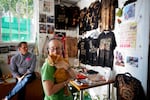
Ground Score co-founder Barbie Weber holds a friend's cat named Creamsicle during a gallery opening featuring Becky Lange's artwork on June 4, 2026.
Alex Zielinski / OPB
Weber visited Lange at the hospital after her assault. Weber said that, as she sat by Lange’s bed, Lange moved her body and responded to Weber’s voice.
“I’ve seen a lot. I’ve experienced a lot of loss,” said Weber. “But that was really hard for me.”
Keeping the fire lit
There are many unknowns about the circumstances surrounding Lange’s death. But her life may offer answers to some of the city’s current challenges.
Boehm, co-director of Ground Score, said that leaders grappling with the city’s ongoing homelessness crisis could learn from the way Lange lived.
“Becky, to me, really represented the notion that charity and services are not enough,” he said. “All of the free lunches and all of the shelters in the world can’t fix the problems that we have if we don’t give people purpose.”
Boehm said he saw Lange transformed by finding employment – around four hours daily with hourly wages starting at $21 – and an outlet for her creativity.
In April, Portland State University’s Homelessness Research & Action Collaborative released a study based on interviews with 541 Portlanders experiencing homelessness, where researchers asked about their biggest unmet needs. (Lange was on a committee that helped shape questions and collect surveys for this report.)
While rental and financial assistance led the list, nearly half of those polled said “job training” kept them from leaving homelessness behind.
While local elected officials have said workforce development for people living outside is a top priority, years of budget cuts have decimated public grants and funding for those types of programs across the city and county.
Earlier this year, Portland won a national award for Ground Score’s focus on connecting people experiencing homelessness with stable jobs cleaning up trash. The city said that the $275,000 award will help Ground Score hire more workers.
Ground Score plans to continue holding workshops in the studio. Leaders hope to turn the gallery space into a thrift store featuring particularly exceptional ground scores that staff stumble upon – another of Lange’s ideas.
Cass Tablott said she’d like Ground Score to change its current soda can lid logo to a dumpster fire to remember Lange and her signature piece.
“We are completely heartbroken,” she said, “But we will keep that dumpster fire lit for Becky.”