
FILE - City Hall on Nov. 12, 2025, in Portland, Ore.
Eli Imadali / OPB
After nearly two months of long-winded debates and indecision, Portland has a budget.
But no one is thrilled about it.
“This is not a great budget,” said Councilor Elana Pirtle-Guiney, before voting to support the spending plan Wednesday. “This is not even a good budget.”
Councilors passed the $8.5 billion budget with a 9-2 vote, with Councilors Eric Zimmerman and Dan Ryan voting in opposition. (Council President Jamie Dunphy abstained from voting, since his spouse works for a city-funded nonprofit.)
Yet all councilors expressed deep disappointment, citing Mayor Keith Wilson’s cuts to public safety, unionized employees and other programs. The budget process also cemented the clear political divide among the 12 councilors, a pattern that some saw as a risk and others considered inevitable.
“I’m kind of glad that we’re starting to have the discussion about the fact that there are actually two [voting] blocs here,” said Councilor Angelita Morillo.
The final plan
In all, the plan eliminates roughly 140 jobs. Since many of those positions are vacant, this means about 99 people will be laid off in August. The cuts will be felt across bureaus. The budget also pulls funding for hundreds of shelter beds and nearly eliminates an unarmed police program.
The final spending plan adopted by council softens some of the blows included in Wilson’s proposed budget, first introduced in April. But councilors were still up against a $170 million shortfall.
That deep funding gap came from a mix of factors, ranging from expiring short-term funds to declining tax revenue to inflation.
To address those gaps, Wilson’s budget focused on deep cuts to programs addressing homelessness, public safety and standard staffing positions across every bureau — like HR and communications. Councilors were able to restore some of these programs using various funding sources, including withholding annual raises for managers and cutting councilors’ security budgets.
That resulted in restoring funding for Portland Street Response positions, a 911 operator, administrative staff at police precincts, and a fire engine at a St. Johns station. Councilors kept an 80-bed city-funded homeless shelter in Portland’s inner eastside from closing by choosing to instead close a 90-bed shelter in Old Town Portland previously run by Multnomah County.

FILE - An undated photo supplied by the city of Portland shows members of Portland Street Response distributing water. City councilors were able to restore funding for Street Response positions, but other cuts were made to public safety.
Courtesy of City of Portland / OPB
But councilors were unable to undo Wilson’s plan to close some 500 shelter beds, reduce firefighter response hours and eliminate nearly all of the 42 public safety support specialists, those unarmed officers who respond to low-level calls.
“The mayor’s budget was short-sighted on public safety,” said Ryan, who voted against the spending plan because he said it was “out of touch” with Portlanders’ needs.
The budget also cuts dozens of “core services” jobs, a blanket term for roles that exist in most city bureaus, like technology, HR and communications. Some councilors attempted to save these positions by cutting into upper management budgets, but those ideas didn’t gain traction with the rest of council. Many of those positions are represented by a public union.
“To those union employees who are going to be laid off here, I am sorry that we did not do better,” said Councilor Sameer Kanal, addressing attendees at the Wednesday meeting.
Sophomore slump?
It’s the second budget adopted under this new City Council and form of government.
Last year’s budget process featured fiery debates and clunky, rushed meetings with 11th-hour decisions. In all, councilors introduced a total 170 amendments to the mayor’s budget.
In contrast, councilors weighed just around 80 amendments this year, allowing them more time to discuss proposals. But the extra time didn’t result in more consensus.
Roughly 40% of the amendments voted on this year resulted in a 6-6 tie, with the six more moderate councilors voting in opposition to the six-person progressive caucus.
(Under council rules, a budget amendment fails if it’s tied, and the mayor cannot cast a tiebreaking vote on an amendment.)
Councilors repeatedly blamed each other for not compromising.
“The word compromise doesn’t mean that everyone eventually agrees to your position,” said Morillo. “It means that we are all trying and negotiating with one another based on the things that are important to us.”
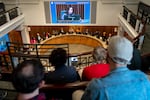
FILE - A City Council meeting on Nov. 12, 2025, in Portland, Ore. This is the second budget adopted under the 12-person council.
Eli Imadali / OPB
But the problem seemed more an issue of ideological differences than finding common ground.
Councilor Steve Novick balked at Morillo’s accusation that he hadn’t tried to compromise on a measure that would have lessened layoffs.
“One of the reasons we couldn’t reach agreement,” said Novick, “was that one of your bottom lines is no money for police training, because for some reason you think that poorly trained police is a public safety priority. We couldn’t reach agreement. It’s not that some of us didn’t try.”
Several budget items passed with agreement across the divided council. But those were largely overshadowed by the deadlocked votes on major proposals.
Not over yet
How to address the hours lost to deadlocked votes remains undecided. Council President Jamie Dunphy, who presided over the budget process for the first time this year, said it should encourage a different approach to governing on council.
“A lot of ideas died 6 to 6,” said Dunphy. “Why exactly that happened is a topic of great debate and endless spin, and it should lead us to consider how this process can change in the future to allow all of us to be more solution-oriented. To separate the things we want to support from the things we can’t live without losing.”
Others called for a rule change to allow the mayor to vote on tied amendments in the future.
“There’s always gonna be 6-6 until we have the ability to have the mayor break a tie,” said Councilor Loretta Smith.
Others are already considering ways around this system. Council Vice President Olivia Clark told OPB she plans on advancing one of her failed budget proposals through a standard city council ordinance — a workaround that would allow Wilson to cast a seventh vote.
That proposal would use money reserved for the city’s new police oversight board to fund positions in the police and fire bureaus.
“I am undaunted in working to restore those cuts,” said Clark. “I will very reluctantly be voting for this budget tonight, but I will say I am not giving up.”
Councilors from the progressive bloc are following suit.
On Thursday morning, five progressive councilors unveiled plans to introduce one of their failed budget amendments as an ordinance. Like Clark’s proposal, it would restore public safety cuts, along with a variety of other job reductions included in the budget adopted Wednesday.
“We didn’t find a solution during the budget process, but it’s not too late,” said Mitch Green, one of the councilors behind this proposal. “If we act quickly, we can still save critical positions, preserve institutional knowledge, and ensure the continued delivery of services Portlanders rely on.”
The budget goes into effect July 1.