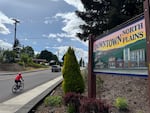
Civic leaders and community members in North Plains are in the midst of envisioning the future of their town with a population of about 3,500. The most contentious element in this Washington county town is over the size and shape of the urban growth boundary to plan for population and economic growth and expand its tax base. Downtown North Plains is the town's main commercial center, beginning at the intersection of Glencoe Road and Commercial Street, seen here on May 19, 2026.
Allison Frost / OPB
Editor’s Note: This episode of Think Out Loud was recorded on Thursday, June 11. Four days after we recorded the episode, the North Plains City Council voted to terminate the employment of city manager Bill Reid. At that same meeting, our first guest, library director Robin Doughty, was named interim city manager.
The city of North Plains has a population that hovers around 3,500. Like so many small communities in Oregon, it has a strong sense of identity and a closeness among residents that bigger cities just don’t have.
As part of our effort to cover both urban and rural communities all over the state, we sent out a community survey to find out what people in this Washington County town value and the challenges they face.
We heard predominantly about the quality of life in North Plains and the challenges of reconciling different views on how to improve life here and plan for growth.
We invited the community to participate in a conversation about the city at the Atfalati Ridge Elementary School in North Plains on June 11, 2026.
About 55 people filled the seats of the gymnasium, and many shared their thoughts about what they think makes North Plains special, and why they think the urban growth boundary should be left alone or expanded.
Our guests included Robin Doughty, director of the North Plains Public Library; Rowan Maiorano, assistant planner for the city; Daniel Stinchfield, who sits on the UGB Public Advisory Committee; Patti Burns, director of the Senior Center and Vice President of the North Plains Events Association; Lora Dexheimer, founder of the North Plains Food Bank; Russ Sheldon, business owner and former city councilor; and Emily Waldron and Elizabeth Beaupain with Friends of Smart Growth North Plains.
Note: The following transcript was transcribed digitally and validated for accuracy, readability and formatting by an OPB volunteer.
Dave Miller: This is Think Out Loud on OPB. I’m Dave Miller coming to you today in front of an audience at Atfalati Ridge Elementary School in North Plains.
We have done something a little different for this show. Normally when we decide to go to any given community, we know generally what we’re gonna talk about when we get there. In this case, we started by seeking out the input of local residents. We sent out a community survey to find out what people value and what they see as the biggest local issues in this city of under 4000 people in Washington County. Two big themes emerged. One was that people love North Plains, and they told us why it’s special to them. The other, which is related, is that for about three years now, the city has been rocked by a hugely contentious debate over growth, over whether and how to expand its urban growth boundary.
We’re going to talk about both of these topics today. We’ll turn to growth in about 15 minutes. We start with the quality of life in North Plains. Robin Doughty joins me now. She’s the director of the North Plains Public Library, which is celebrating its 20th year in the community right now. Welcome to the show and congratulations.
Robin Doughty: Thank you so much. I always love an opportunity to talk about libraries.
Miller: Well, let’s start right there because almost everybody who responded to this community survey mentioned how important the library is. So can you give us a sense for why you think people respond so much to the North Plains library?
Doughty: Well, I think in a small town, a library has a bigger role than it might in a more urban area because it’s the only place in town to do certain things and people use it for more things than you might realize. So we’re the only place in town to go make copies. There’s a lot of cyclists that come through town and they stop to fill their water bottle. We’re a place to bring your kids to do crafts. We always have a craft and of course what we’re known for, books. We have a wonderful collection of books, but because we’re a member of the Washington County Cooperative Library Services, our small town has access to 1.5 million books because we share with the rest of the county. And then a very robust digital library as well. And we have 24/7 high-speed internet at the library, so people in the more rural areas who may not be able to use our downloadable items could come to the library and download them on our Internet and be able to use them. And we have wonderful events and programming and classes that are free for the community.
Miller: I mentioned that you’re celebrating 20 years this year. How did the community come together to make this possible in 2006?
Doughty: Oh my gosh, it’s a pretty cool story. So, I guess you’d have to say the very first library in North Plains was when the principal of North Plains Elementary would open the school library in the summer for the community to use. Then a group of volunteers called Friends of the North Plains Public Library started a library out of the Jessie Mays Community Center in the closet. And that was the only library in town. The Friends of the Library started writing grants and doing fundraising to try and build a stand-alone library for the community. And a local business owner got wind of this, and this is Wayne Holm and his wife Jeanie, the owners of Oregon Canadian Forest Products, and decided to build the library for the community. And it’s so beautiful. It was just such a wonderful community effort. It was a great example of how the community of North Plains worked together to do something wonderful that benefits everyone. Our vision is that we’re the heart of North Plains where everyone is welcome and I really feel like we’re able to do that. And it’s special to me to be a part of it.
Miller: Patti Burns is in our audience here. Patti, you wear a number of hats, but to start with one of them, you are the vice president, I understand, of the North Plains Events Association. What are some of the big annual events here?
Patti Burns: So we have the Garlic Festival that’s coming up and that is a huge event for North Plains. It’s really kind of put us on the map.
Miller: For people who haven’t been there, what happens at the garlic festival?
Burns: Well, we have music, we have beer. We have food. We have over 100 craft vendors. The library is there. They have a book sale in Jessie Mays Hall. There’s a parade, car show and it just brings about 30,000 people to our community.
Miller: And there’s a mascot.
Burns: Yes, there’s Stinky.
Miller: Stinky. What do you think makes North Plains special?
Burns: Small town people getting together, having fun, going to the library. For the older generation, it’s coming to the senior center. We have music one day out of the month, we have meals, we have bingo, we have tax preparation, we have events for the elderly.
Miller: Right. I mentioned you wear a number of hats and one of them is you run the senior center, is that right?
Burns: Yes, I do.
Miller: And you also cook lunches there twice a week?
Burns: Yes, I do.
Miller: For how many people?
Burns: It depends. So the average now is about 20 people until the music comes in, and then it’s about 50.
Miller: And twice a week you cook for 20 to 50 people.
Burns: I do.
Miller: What do you get out of it?
Burns: A lot of work.
Miller: Well, that’s what you’re putting into it.
Burns: It is, but it’s wonderful to see the older people that… a lot of them live alone. And so they come, drink their coffee, have conversation, and feel like they’ve connected with other people their age, whether they’re talking about bumps and bruises and aches, pains, who’s died, who’s gone away into a care facility, but they’re connecting with each other.
Miller: And I guess I’m wondering what’s driving you. It seems like you’re spending so much of your own energy and time for these civic connections, whether it’s these events or toiling in the kitchen. Why do you do it?
Burns: It’s a good question. I’ve just always volunteered. I have four kids and I started when the oldest was 5 years old and I walked in on Halloween with a witch’s costume and embarrassed the crap out of her. And so I was just volunteering.
Miller: If folks, as we go, if you want to raise your hand to tell us what you think makes North Plains special, just raise your hand and we will find you. In the meantime, I want to go to Laura Dexheimer, who is the founder of the North Plains Food Bank. You started this in 2023. Why?
Laura Dexheimer: Because I was seeing our seniors going up to this giving table and nothing, there was no food there. And so I asked the person what they were looking for and was told that they were looking for food. And I said, well, why don’t they go to your local food bank and was told that it had closed over two years ago. So being in a food desert, there’s no grocery store. Now there’s no food bank. Where were these people gonna eat? So I immediately said, OK, I guess I’m gonna start a food bank. And I started with 163 people, and we’re now over 2000 people signed up for the food bank. Every week we serve about 200 households, which is about 600 people.
Miller: How far away do people come?
Dexheimer: I’ve got one lady who comes from Troutdale every week. She’s diabetic. I told her I would help her find a food bank closer to her.
Miller: She crosses through most of Multnomah County and a chunk of Washington County to come to you.
Dexheimer: Yeah, it’s because most food banks give out a box of food where we are like a grocery store, so we have fruit and vegetables and protein and milk and all kinds of stuff so she can look at a product and see if she can eat it or not. So, that’s what is the big driving force behind this, are people who are gluten-free or whatever can come. And we are community-based. We receive no government funding. We’re not part of the Oregon Food Bank. We’re all completely community-based. So we rely heavily on community donations and then grant money.
Miller: And it actually works. You can rely on the generosity of people right here and some grants, and you can feed thousands of people a week?
Dexheimer: Yeah. And we also glean from different grocery stores. So we bring in about 30,000 pounds of food every month, and it comes in and goes right back out the door.
Miller: Laura, Patti and Robin, thanks very much. Laura Dexheimer is the founder of the North Plains Food Bank. Patti Burns is president and manager of the North Plains Senior Center, among other things here in North Plains, and Robin Doughty is the director of the North Plains Library.
This is a city of around 3500 people in Washington County. For the last three years, it’s been ground zero in Oregon for the debate over growth, and that’s what we’re going to turn to right now. Folks in North Plains, meaning the people in the audience in front of me, do not need to be reminded of what’s been happening in the last three years, but our radio audience probably does. So here is my quick version of a very contentious saga.
In 2023, after a years-long process, the North Plains City Council approved a plan to add 855 acres to the city’s urban growth boundary that would have more than doubled the size of the city. I say “would” because it never happened. Voters overwhelmingly shot down the expansion. Seventy-one percent of voters said no. The state legislature tried to weigh in. They passed a law to prevent voters from having a say in this land use decision, but a judge said that was unconstitutional and the expansion failed. In the years since then, a new slate of council members was elected or appointed and now the city is moving forward on a new plan for a slimmed-down expansion of its urban growth boundary. But as we learned over the last few months as we got ready for today’s show, the level of mistrust and anger remains high. We’re going to hear various points of view about this over the next 35 minutes or so, and we’re going to do our best to foster a conversation that’s constructive about the city’s future.
Joining me now are Rowan Maiorano, the assistant planner for the city of North Plains, and Daniel Stinchfield. He is a member of the UGB Public Advisory Committee and a former member of the planning commission. Thanks very much to both of you for joining me.
Rowan Maiorano: Thank you, Dave.
Daniel Stinchfield: Thank you.
Miller: Rowan, I wanna start with you. Can you describe where the current UGB concept planning process stands today?
Maiorano: Thank you, Dave. The UGB concept plan is in progress. We’re really in the thick of the planning process. As of today, we have wrapped up the in-person portion of what we’re referring to as phase two of our public engagement, and that phase was concerning the alternative concepts. And alternative concepts are looking at a very high level 30,000 foot plan for potential expansion areas surrounding the current city of North Plains.
Those concepts look at varieties of different ways that we can fit in housing, employment lands – including industrial and commercial development – and parks facilities within those potential expansion areas. Now that the project team, which consists of city staff and consultants, will go back, they’ll review what we’ve gathered from this public engagement, and they’ll synthesize all of that into a draft concept plan reflecting what we know from our technical partners, what we’ve seen from our public advisory committee and what the public has told us broadly.
Miller: My understanding is that the UGB expansion that’s being talked about now as part of this process is something like 300 acres smaller than the one that 71% of residents voted down in 2024. Are there other major differences in addition to size?
Maoirano: There are not any differences other than size because the original expansion that was voted down was just a UGB line. So when you’re a small city outside of Metro, the process is to first go and evaluate your land needs through a process called a housing needs analysis and an economic opportunities analysis. And that tells you how much land you need for homes and how much you need for areas to employ people. Once you do that, you can look at areas that are suitable for expansion and draw a line around them for the amount of land you need. Then you’ll go through the planning process where we start coloring in those lines with the types of land uses. That’s as far as we got with the previous effort that was voted down and it was just drawing the line. Now we’re fortunate through our partners at ODOT and DLCD who run the Transportation Growth Management Program that’s funding the concept plan. We’ve been fortunate to be allowed to color in the line before we have drawn it
Miller: And say this is where housing development would go. This is where a data center could go, for example.
Maiorano: We’re not quite down to that level of detail. We’re really talking about just this is where residents could go, this is where employment could go, and this is where parks could go. The fine tunes of data centers versus food manufacturing versus a townhouse or a single family house, those will come later with zoning and development code updates and further planning such as comprehensive plan amendments.
Miller: Daniel, from the outside, I have heard about enormous levels of mistrust in this community in recent years, of neighbors having arguments with neighbors of bad blood. I’ve heard about death threats. What have the last three years been like for people here?
Stinchfield: North Plains has always been a really tight community. And, for myself, I’d love to see 671 people living in town and live the rest of my life that way, but it’s not reality. And if you don’t plan for what’s coming, you end up with things scattered all over the place, probably less community aspects of it. So actually getting something to plan for is important, but watching the community in the election and people that don’t live in the town attacking people that I’ve known my entire life. I know their character. I know how good they are. It pissed me off. I mean, just literally, the first time I really did not like people coming into our community and stirring stuff up. I can disagree with my neighbors. I disagree with a community member that lives outside of town, but we’re still friends.
Miller: You’re pointing at people are still in the audience, but you’re saying, so am I right in understanding the distinction you’re making there is people who are a mile or two outside of the current city line versus people who are 20 miles away?
Stinchfield: Even in this last election, it was, we’re going to run four people to take over your city council. That is a threat. And when you threaten a tight community like we are, we respond. And it was disheartening. It was devastating to this community to watch it happen. We have, I think, since, leveled out some stuff, but I’ve seen what happens to a city when they don’t plan for growth. You end up with three downtowns, you’ve got industrial areas that don’t make sense because they’re 20 miles from a freeway versus being less impactful to the town. So in the planning commission when I was on it was ’96, the state said this is an area that North Plains would grow into. That’s what they designated that land for and planned for it. So instead of putting industrial parks on the north side, you put them down close to the freeway so you don’t have big trucks rolling through.
And I go back, I’ve got four generations here in North Plains, when it was incorporated. How is my house a commercial zone? It’s in the middle of a residential area. We’ve cleaned up a lot of it, but it happened because we incorporated and they said, what do you want to be? And somebody said, I want to be commercial, I want to be industrial. And that’s how we ended up with this hodgepodge of everything mixed together. We had a meeting just the other night and somebody was saying, I’m surrounded by industrial. So why not look at it? I think it’s the first time North Plains has ever had the opportunity to say how we want to look in the future and plan it. And then when that comes in, build what we plan.
Miller: Well, I’d love to hear from folks in the big picture. Just throw up your hand if you would like to join this conversation, but I’m actually curious what you want North Plains to be like in 20, 30, 40 years. We can get a mic to you if you don’t mind telling us your name and where you live.
Pauline Rosado: Hi, I’m Pauline Rosado, and I live here in North Plains. In fact, I live right by McDonald’s, so I live in the heart of North Plains. I’d like to see growth, sustainable growth, and I’d like to see more stores, more commercial things so that this way people won’t have to travel out because a lot of our seniors can’t travel. They don’t have cars and they don’t have a ride, so they have to depend. So if they have something that’s close by where they can walk and get their exercise at the same time, then it would be beneficial for everyone and for families as well, because who wants to jump in a car just to go get a gallon of milk in Hillsboro when there could be a decent store with good prices for everyone.
Miller: What do you see as a connection between the kind of economic development within the existing city boundary? I mean, if you’re talking about having, say, a grocery store close to where you currently live, do you see a connection between that and the conversation that the city has been having for the last three years about expanding the city line?
Rosado: Well, my understanding was that they wanted to build a data center, and I think people in North Plains didn’t want that. And they also don’t want industry that is going to be in the heart of where they live. I mean, look at what happened in Longview with the paper mill, and here there were houses all around there, and these people had to be displaced because of that tragic accident. And I think that they don’t want that for their kids and they want to have at least something, but nothing to where they’re going to feel impeded by what’s going to happen.
Miller: How do you think about that, Daniel, as a member of the Public Advisory Committee? The issues that we’re hearing right there, the fear of people’s existing neighborhoods changing because of, in this case, industry coming in.
Stinchfield: Change is hard. But having a plan in place to really listen. I love listening to people that actually live in North Plains. This is what we want to do. We have an opportunity to do that. And we have a lot of people outside that want to tell us what they want to see us do, and it’s good to hear, but when it boils down to it, you pay taxes in town, we get that opportunity. I wouldn’t want Canada deciding what the United States did. They are neighbors. We call them a neighboring country, but they’re different.
Miller: In this case, is Hillsboro, Canada?
Stinchfield: No, they are a different city.
Miller: Well, I guess what I meant by that question is to what extent are fears of other neighboring cities expanding driving your concerns right now?
Stinchfield: I wouldn’t want them voting for our stuff. They don’t live here. They don’t have to pay the taxes here. They aren’t invested in this community as much as people that have lived here.
Miller: We’ve got a hand up in the back there, sir. What’s your name and where do you live?
Barrett Brown: My name’s Barrett Brown. We live on a family farm outside of town here. We did live in North Plains for a couple of years and I was the UPS driver in town in the ‘80s and ‘90s.
Miller: I see a lot of nodding heads here. I think they recognize you in brown.
Brown: So, before the stoplight, it’s my generation. I worry that the context here is mis-set around a growth controversy when I think actually we have a civic controversy. Our little town, I call it our town, even though I’m happy not to get a vote. I don’t deserve one, but I call it my town. This small quiet town was not ready for a high energy political campaign so the people who had their sleeves rolled up doing good civic work weren’t prepared for an extremely zealous, high energy meteor that dropped into the political life of the town. And that set off the kind of uncivil discourse and the damage to the most important asset this town has, which is its community. I think that’s the actual important context for this discussion, not growth or one policy or another. That’s marginal compared to the cohesive nature of this community.
Miller: How do you think you recover from that? How do you think you regain the kind of civic connection that you’re saying that the loss of which is the most important or most destructive effect? You’re saying, not that the growth debate is a distraction, but it pales in comparison to the loss of civic connection. How do you get that back?
Brown: Well, I think most of us know instinctively that we need to be residing in a place of imagining the best possible motives by your neighbor. When you hear something, imagine that they’re probably not evil, awful people, they probably just have a different set of information than you do and to give it some time. So, with a very complex planning process like natural resource management or wolves, for example, the people who really invest the time and roll up their sleeves and do the work to collaborate, they’re doing great. It’s the people who are one layer out who identify a particularly zealous, self-righteous position and swoop in after all this hard civic, volunteer work. We need to be able to resist that with calmness, strength, and it’s hard to say we could go back and do it differently because it did catch us by surprise. But we know, like I said, assume good intentions and spend some time…
Sorry, I’m going on a little bit long, but I knew this planning process was happening in North Plains, and I lived outside the town on high-value farmland, but I barely knew some of the players who were working on this, and I figured, well, they’re good folks, they’re probably doing good work. And I knew if I wanted to be involved, I knew where those meetings were. I could have gone, watched every single one of them and felt really connected, but I trusted them. I think we all know that’s where we all should be, especially folks who live in this town, which is to partner on solutions and look for the best motives behind the people doing that work.
Miller: Emily Waldron has raised her hand on the steering committee of the local chapter here of Strong Towns. Why’d you raise your hand?
Emily Waldron: Well, first I was gonna say I feel more like Puerto Rico than Canada because I still live outside of town. I’m the third generation of my family to live on a tree farm just two miles down the road, raising the fourth generation of my family there. And my family has always been very involved. My grandparents sat and ran the planning commission, even though I live in the exact same house that they did outside of town with Daniel and with Stuart King, who’s the current head of the planning committee. And they were always involved at the senior center. My dad went to high school with a lot of people that were here when they were young. My cousin went to school with a lot of people and it’s hard because we still are really involved in the community like this. I still have the exact same library. I still go to the same restaurants. If my kids are going to school, we’re sitting in the elementary school that I send them to. It’s not like the core of North Plains exists in a bubble, and the rest of us outside of it aren’t a part of it at all. We are and we’ve been involved. And so to have this like head turn of your address is this, and so even though you’ve been involved for generations, and my family’s been in our place for over 50 years, we’re not supposed to be here. We’re not supposed to care. We’re not supposed to have anything.
Miller: And you’ve been made to feel that way. You’ve been called an outsider.
Waldron: Oh, all the time. It’s like the new slur, and it just kind of makes me laugh because I know how involved that it’s been and what it was before, but I wanted to answer the question of growth and what people’s visions are for North Plains.
Miller: Yeah, and if I could preface what you’re about to say just because of this, I’m glad you were getting there. One of the groups that you are a part of is called Smart Growth for North Plains. And so maybe you’re going to answer this with your question, but I’m very curious what you mean by smart growth here.
Waldron: I think it’s about having growth that respects the history of North Plains and us being a smaller community involving a lot of farmers and a lot more like lumber mill work and these sorts of things. We are surrounded by some of the best soil for farmland in the entire world, like we have Class I and Class II soils. Not even 5% of the soil on the face of the earth is classified that high for growing things. And for me, moving here, it was that I wanted this community and this blend to be what I raised my children in, and I wanted them to be a part of a town like this where there are people there that knew their great grandparents and they saw people at the library and they could walk freely. They’re small right now, but I imagine when they’re like 13 and 14 and they want to bike around with their friends, I feel totally fine because it’s safe for them to do that.
And so with smart growth, it’s the idea of how do we preserve the culture and community, and we can still grow, but planning growth that maintains who we are.
So the growth plan in the past when a lot of people got involved and we looked at what the city’s economic opportunities analysis was, it was to only focus on growing with warehousing and industrial around semiconductors and as we can fill in the blanks from a lot of Hillsboro, data centers are a part of that. And if you go to North Hillsboro, where it’s all the warehouses and the data centers, that doesn’t feel like a community, that doesn’t feel like somewhere you want to go and spend your time and have your kids and walk around with your neighbors. And so if we’re going to grow, how do we grow to increase that community? How do we grow to have the parks and the residential and to look at more commercial opportunities or, like people mentioned, grocery stores in the past, laundromats. We have hundreds if not thousands of bikers that come through to bike through all the land every weekend, having a bicycle shop that can service them, like there’s so many opportunities that would allow us to maintain ourselves as a community instead of just decimating it for these warehouses to make a dollar.
Miller: Are there people in the audience today who have a very different or even mildly different vision of what smart growth in this community entails than what Emily just outlined? I guess I’m curious where the common ground is, to better understand where the divisions are. Was there a hand there? All right, what’s your name and where do you live?
Mike Shirtz: My name is Mike Shirtz, and I live in a town in North Plains. I think part of the controversy with all this is when they started this UGB, it was such a big thing that nobody wanted it. All of us voters voted it down. So then they came back with the relook committee and they lowered it a little bit. Now, the citizens of this town are not opposed to growth. What Emily was saying, smart growth, let’s do it smart. We have codes that are outdated that need to be updated. So if you grow before you update those codes, you just create a whole other problem. And then as far as outsiders, you have, the people that live outside the city limits are classified as the outsiders. But they live in North Plains and those outsiders are the people that actually are responsible for building this town. So to call them outsiders, to me, is rude. They’re the ones that helped create this town.
What the people want is smart growth. We don’t need data centers and a bunch of commercial areas built right up to houses. Nobody wants that. We know that we need more commercial areas because we are what’s called a bedroom community. We need to offset that with more commercial business. We’ve got a bunch of places and land in town that we could upgrade. Nobody ever talks about that. The city will not; they’ll listen to the citizens and then disregard. There needs to be transparency and there’s not enough that. When you gain transparency from the city officials, you’re gonna start gaining trust from the people and until that happens, it’s gonna continue being like this, so that’s what needs to change.
Miller: Russ Sheldon is here, a business owner, former city councilor, member of the city council that approved the expansion that voters eventually said no to. Russ, thanks for being here. What would you like to see in the final plan?
Russ Sheldon: Well, the final plan needs to represent a balance. And there’s a lot of information that’s been given here tonight that I don’t consider to be valid. I will take issue with the 71% who basically shot down or approved the referendum. In other words, it stopped the actual council resolution from going through. There were 71% of those who voted, but it was only 44% of the electorate and that’s not a story they’re going to tell you. What I’m going to say…
Miller: But that’s who showed up and that’s who, I mean, yeah, you could make that argument about every election ever, right?
Sheldon: Well, yeah.
Miller: OK, so setting that aside, what do you want to see going forward?
Sheldon: Well, the city really has to focus on economy. Because the city will run out of money before too long, because of financial instabilities, because the city’s been reliant on the water fund for too many years, is going to basically put a stop to services that can be available without an increase in taxes. And most of the taxpayers don’t necessarily want to support an increase, and we’re already operating on a pretty low budget. So, the plan was about a balanced approach to increase the valuation of the property, bringing employment opportunity and prosperity to the city of North Plains. There’s no reason to have 97% of our people commuting away from the community. The no-growth folks, they want to tell you that it’s about sprawl. That’s the adjective they used, but that’s not a fair word because it has nothing to do with sprawl.
And when we started this, it was a very thoughtful and deliberate process, because the state’s land use law, in other words, is a multifaceted, very pre-scripted process. We followed and adhered to that process. That’s what was in place for us. We only looked at lands that were designated for us to grow and we didn’t have much opposition in the actual boundary area. So when you think about the boundary and what it can bring, it can bring intentional growth. That’s what I want to call it, not smart growth. Growing and planning that growth is contingent upon a community that’s healthy and prosperous going forward.
Miller: We have a hand up, as soon as you started talking a hand went quickly up in the air. What’s your name and where do you live?
Elizabeth Bopaine: My name’s Elizabeth Bopaine. I am a resident. I live here in Sunset Ridge where a large part of this industrial growth is going to impact my community. I also own a business in North Plains that is heavily family-based, community-based. To hear this, it’s a little frustrating because you guys did an analysis about housing. And I feel like you guys are trying to connect or put it all together in one bucket that, oh, well, we did this housing analysis where we need 168 acres roughly of housing. Oh, well, there’s going to be an imbalance. So we need to do this massive expansion of industrial to offset it, right? But you guys don’t come into the community and ask like, would you guys rather pay a tax levy to offset it? When I directly asked the city manager, what would that be in a levy instead, he couldn’t give me an answer, probably because we haven’t done our audits since 2021. How can you guys come in and tell us to do this 533-acre expansion in North Plains without knowing your finances? And if you guys have those numbers, why can’t you answer these questions directly to us? It’s so frustrating.
Miller: Do you think that residents here would approve a significant increase in property taxes
Banne: If it’s put 533 acres of expansion right behind these houses versus a levy? I think a lot of people would vote that in.
Miller: We had a hand up, sir, what’s your name? Where do you live?
Butch Kendall: Butch Kendall. I lived in North Plains for 51 years. Yes, I’m on the city council just before I got voted off. Anyway, we had to put on a police levy. The citizens voted that down. Just for the police, so she’s trying to say that we didn’t do our business. We did the right thing to do, and I was part of that that voted for that 800 acres, and we decided, OK, the citizens voted no, so we’ll do this relook committee. The city council has been doing it for eight years. We put it together and then they shot it down with outside influence. This is what the problem we’re having, I mean. 44 years, I’ve spent my life doing this, and it’s time that we move on.
Miller: When you say time that we move on, what do you mean?
Kendall: Put more land into the urban growth boundary, increase it. We can’t just draw a line and just not do anything. The city will not sustain itself.
Miller: So I’m curious, Daniel Stinchfield, as a member of the current UGB Public Advisory Committee, and it’s worth saying again, understandably, as we’ve been talking, we’re sort of going back and forth between things that happened three years ago and things that happened, what is it, a year and a half ago with the relook and also trying to think about what’s happening now or going forward. It’s actually a little bit hard to keep time in a kind of linear way in your head, but looking at the future, I’m curious how the debates that we’ve just been getting into in the last 10 minutes, how do you think they’re reflected in the public committee that you’re a part of?
Stinchfield: Well, one thing I really like is I hear different ideas. That’s the best way to go about this. And I believe at the end of this, we’re going to come up with what we don’t all agree to, but something we can all live with. And that’s why you have the conversations and not the attacks. When I say outside, I’m talking about the vote. People that vote in the city. I don’t feel that Hillsboro needs to vote for our stuff. I don’t believe people that live in the county vote for city things. We have financial things that our city council is looking at. And I hear somebody say, we’ll raise the tax base. So being a member of this community for as long as I have, North Plains historically has always been the place that I didn’t earn as much money, but I could buy a house in North Plains. I bought a house for $32,000, two lots. What’s that house worth today? $300,000-350,000. Luckily, my kids have been able to buy a home in North Plains, but before the rest of the stuff blew up.
Limiting the amount of land that we have to build on only increases the cost of living here. And we have to plan for what’s coming. The state in ’96 said, this is where North Plains can grow. It’s actually on the west side too. They designated that as something. I was on the planning commission. I sat for a while on the city council during that period of time, and they said that land is the land set aside for the city to grow in. If we don’t take that, Hillsboro is barking on the door because somebody’s going to get it.
Miller: As you’re working on a new plan to put forward to eventually give the city council, we’re talking about votes, but in the end, really it’s city council, as I understand it, that says yes or no. And then if they say yes, it’ll be the residents of North Plains who can then, like they did a couple of years ago, say yes or no.
Stinchfield: Absolutely.
Miller: So as you are thinking about different visions, versions of a plan, are you thinking, will residents vote this down? To what extent is that a part of your thinking right now?
Stinchfield: I think if the communications happen and you’re actually stating facts. I think at least my neighbors, I know some people say, well, my neighbors, I live over here, I live there, but the majority of people that I talk with, and I do know, I know folks here in town have been involved with a lot of stuff. And most want to see, they’re like me, they want to see a 670, but they also know they want to plan for what’s coming.
Miller: And those are related but not the same. There’s the line and then, and as we were hearing from Rowan, there’s, what do you do within that?
Stinchfield: So one thing they say, well, they did that. That wasn’t, we sat in a re-look. Emily was right beside me, and there was almost everybody except one, I think, liked the one plan and said we could live with that. And so that’s what became the deal we’re talking about now in these meetings because we’re looking at that amount of room.
Miller: Well then, I’m just curious. This is a very unscientific thing, but if you’re saying you talked to a bunch of people, they said we could live with that, how many of you in the room right now by a show of hands could live with the current plan that’s being talked about? OK, there are nowhere close to 50%, there was, I don’t know, that was about at, at best 20%. Not scientific, but helpful in its own way. We’ve got another hand up here. You’ve been very patient. What’s your name, and where do you live?
Tanya Golden: Tanya Golden. I live up Mason Hill Road, a few miles out of town. I was raised on a peach farm up there. I now grow saffron, Golden Tradition Saffron, and went to school here in North Plains Elementary from first grade on. So I’m hearing about expansion, expansion, expansion, and in my lifetime, I’ve watched Portland turn into Tigard, turn into all the way down 5 and come all the way out the TV Highway. Portland doesn’t stop. And that’s what’s going to happen here too. You’re just going to roll Portland right out here. Thinking forward 50 years, taking into consideration the climate shift and that temperatures are heating up, that water is becoming a scarcity, that food is becoming more difficult to grow in great portions of the world, that our global standing has shifted, like it or not, that tariffs have gone up and these are things that are probably not going to be remedied easily or soon. Food and land, especially this quality of soil, will be one of the most important resources, and I think it’s incredibly short-sighted to say, oh, we gotta develop that quickly before somebody else does. Why not look down the line a generation or two and see how much more valuable having that land and the resource to be able to grow food will be.
Miller: Do you not believe the argument that we heard earlier from Daniel that if you don’t develop this or take it and develop it in your own way that somebody else will? That’s one of the arguments that we heard from Daniel and from a number of other people. You’re saying don’t do that, but you’re not worried that it’ll be developed anyway without any input?
Golden: We’ve been fighting the urban growth boundary since I can remember.
Miller: We do have a planner here, Rowan. Is that true? Do you have any control over what happens outside of current city limits?
Maiorano: The city itself does not exercise control over outside of city limits. I think an important part of the equation that’s been left out is a planning process that occurred in the 2010s called the Grand Bargain. And that was an effort of the tri-county area, Multnomah, Washington and Clackamas to look at all of the land they had and designate it in three ways if it was already outside of a UGB. You could either be a rural reserve, an urban reserve, or undesignated. And a vast majority of the rural farm and timber land located in those three counties was designated at that point as rural reserves to be preserved for a 50-year period into the 2060s for only what we call resource land, so timber, agriculture, recreation.
Another portion of that land was designated urban reserves. That was largely around the existing Metro UGB areas that were prime for upcoming urban development adjacent to already urbanized areas. And then there was the undesignated lands, a smaller area, mostly around small satellite communities outside of the metro UGB – Banks in North Plains having some of the largest areas of undesignated lands. Those were lands where the county and ultimately the legislature said that it may be important for these communities to expand into these lands for a variety of economic and sustainability reasons.
And so those areas were left up to the determination of the municipality, which they surrounded and so it is our responsibility as a city to look at the tax base that we are provided the charge of and to provide services to our residents. And if we are in an unbalanced situation as the city of North Plains is, where almost 80% of our tax base is residential and it costs the city more to serve those residents than they bring in, that we must look at a balanced solution to responsibly manage the funds with which we’ve been trusted. And part of that solution is to look at areas which have been designated as potential expansion areas.
Miller: We are almost out of time, but I’m just curious, before we say goodbye, what gives any of you hope right now? And one last voice.
Alex Ugarte: Thank you. My name’s Alex Ugarte. I live in this neighborhood that Atfalati is in, and I’ve lived here since 2014, just kind of right behind where G4 is built. I wanted to say this forum here has probably been the best one I’ve listened to. It has the most voice from the community, whether it’s inside or outside. A lot of times, I’m hearing a lot of the same rhetoric, and it all sounds like it’s coming from the same individuals and it really just gets us nowhere. This here, I have felt the most actual thoughts and feelings from actual individuals versus, I don’t know, a group coming up with one thing and everybody kind of going with it. There’s been a lot of misinformation. This here is the actual information that we can get, take and work with as a melting pot to create the city that we want.
Miller: All right, I’m not gonna have anybody else speak at this point after the nice things you said, but thanks so much to everybody for taking part. Thanks also to the staff at the school for letting us take over the school on the last day of school here for the year, to the library for helping us and to the city for their help to make this show possible.
“Think Out Loud®” broadcasts live at noon every day and rebroadcasts at 8 p.m.
If you’d like to comment on any of the topics in this show or suggest a topic of your own, please get in touch with us on Facebook, send an email to thinkoutloud@opb.org, or you can leave a voicemail for us at 503-293-1983.