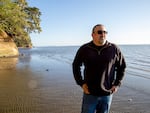
FILE - Chinook Indian Nation Chairman Tony Johnson stands on Johnson Beach in Bay Center, Wash., on April 17, 2025.
Erik Neumann / OPB
As we approach the 250th anniversary of American independence, “Think Out Loud” has been hearing from guests whose life experiences and personal histories illuminate different aspects of what it means to be an American.
We’ll continue that conversation with Tony Johnson, the chairman of the Chinook Indian Nation. The nation represents five tribes whose ancestral homelands surround the mouth of the Columbia River in present-day Oregon and Southwest Washington.
The nation received federal recognition in 2001, only to have it rescinded 18 months later. Johnson joins us to talk about the ongoing fight for recognition and the nuances of being Indigenous in the U.S.
Note: The following transcript was transcribed using AI and validated for accuracy, readability and formatting by an OPB volunteer.
Dave Miller: From the Gert Boyle Studio at OPB, this is Think Out Loud. I’m Dave Miller. As we approach the 250th anniversary of American independence, we’ve been talking to a variety of people whose life experiences and personal histories illuminate different aspects of what it means to be or to feel American.
We continue that series right now with Tony Johnson. He is a chairman of the Chinook Indian Nation. It represents five tribes whose ancestral homelands surround the mouth of the Columbia River in present-day Oregon and Southwest Washington. The nation received federal recognition in 2001, only to have that rescinded 18 months later. Tony Johnson, welcome back to the show.
Tony Johnson: Klahawiam, Dave. Masi pus kunamokst nsayka wawa.
Miller: What have you been thinking about as we approach this big July 4th?
Johnson: In the context of the 250th, I was alive and participated in events around the bicentennial in 1976. I think about what a very young, I’ll say 6-year-old, version of myself felt, compared to myself as an adult and with the lived experience of being in a community that lacks federal recognition but has all the experiences of a Native community. When I say that, I mean families forced to boarding schools, you name it. But having had the experience of good teachers, strong elders, and then having been a student of our traditional stories in teaching, my perspective has certainly changed. What I mean by that is there’s real clarity in my mind about just how young the United States is.
Miller: That is fascinating because the explicit, maybe implicit message of a lot of the celebrations is, wow, this has been a country for a long time, 250 years is a long time. But you’re saying, no, it’s young. What do you mean?
Johnson: In our context, we talk about a history that’s 10,000-plus years old. We have an entire set of stories which talk about this place when it was animals going around like human beings. In the context of these stories, we have a moment where the animals are preparing for human beings to be placed on the ground or to make their debut, I guess, here. That time depth is 10,000-plus years old.
Miller: Does that long view of your own nation’s time on this land – and the flip side of that being the relatively short existence of the United States – give you any hope that there is still time for a relatively young country to be closer to its founding documents or its ideals?
Johnson: Dave, it gives me a ton of hope because my dad would tell you that this history is the blink of an eye in our history. We know, and I think most folks would acknowledge, a tremendous disturbance that happened to the land, the resources here, post-contact. But the reality is, it is just this short amount of time. Not to just go into the recognition issue, but to say it, Chinook has knowledge of our place that we are incredibly excited to share with the people who live here. On the other hand, we are very cautious about just giving away more, when so much of what we’ve had has been taken, and I will say, ultimately exploited.
My point being is I think there is a lot of time. We’ve been here, we’re saying 10,000 years. We intend to be here another 10,000 or whatever. We believe that this country will grow into, yes, the values that were imagined in founding documents, and also, ideally, learn from a real depth of knowledge from the Indigenous people in the places that Americans are living today.
Miller: I take your point about this sort of dueling sensibilities of wanting non-Native Americans to learn from the Chinook Nation and other Indigenous peoples who have been here and are here now and will be here in the future. And also, at the same time, a fear that that could lead to just more culture, more language, more knowledge being taken. But since you mentioned it a couple of times, are there specific things that you have in mind that you most hope non-Chinook people will learn from the Chinook Indian Nation?
Johnson: It’s a very good question, and I want to say that I don’t have a fear of losing more, when Chinook is properly federally recognized. It’s in this moment that we find ourselves that is very tenuous, where we are having to be protective of our place and protective of those things in what I believe is a different way. But with that said, one of the things we talk about is, when we look at the ground here, we see landforms that have stories built into them.
One example, my dad’s grandmother was born on the north shore of the Columbia River around Pillar Rock. She was raised there. Pillar Rock was a boy. And that boy was turned to stone by a coyote. At that moment, it was a moment of teaching. I can say something more about the teaching itself, but the reality is that teaching has value to everyone. I believe that living on a land where the things that you see and experience daily have these really and truly important life lessons built into them can only be good for the society that’s living on it.
Miller: We could spend hours and hours talking about the fight for federal recognition. I said a one-sentence version of that recognition happening in 2001 and then being snatched away a year-and-a-half later. Where does the effort stand right now?
Johnson: Well done, saying a very complicated, nuanced issue in one sentence. Today, the Chinook Indian Nation is back to Congress in pursuit, through our delegation members in Oregon and Washington, of a restoration bill. So every Sovereign Nation in Western Oregon today, federally recognized, was restored through a restoration bill. As you mentioned, our Chinook Indian Nation chose another path, which is what’s today called the Office of Federal Acknowledgement. That resulted after 21 years in our recognition. But remarkably, it also resulted, 18 months later, in that recognition being rescinded.
The quickest path for us is a recognition bill, and so we pursue it. We have also been, by the way, in the courts recently. We’ll continue to pursue the Office of Federal Acknowledgement, which, thanks to our recent court case, now allows for repetitioning. By the way, Dave, that’s something we’re really proud of because every tribe that’s been denied recognition under that system now has another shot, thanks to the work of the Chinook Indian Nation and another tribe out east, the Burt Lake Band [of Ottawa and Chippewa Indians].
Miller: I want to turn briefly to the news of this morning. The U.S. Supreme Court went against the Trump administration and affirmed birthright citizenship. In that case, the administration had cited a 19th century lawsuit that denied U.S. citizenship to Native Americans. Legal scholars widely deemed that argument to be invalid. But what was it like to see it revived and attempted to be used against the children of immigrants in the U.S.?
Johnson: We remain dumbfounded by the arguments that we’ve seen in that context. I assure you that those are front and center on most Native folks’ kitchen tables, or it’s the talk of communities. Because the concept that anyone could be American, if Native Americans cannot be American, is beyond dumbfounding.
Miller: This does get to the question of dual citizenship, even if in your case, as we’ve been talking about, it’s not federally recognized. I’m curious what it means to you personally to be a citizen of two overlapping but separate Sovereign Nations, the Chinook Indian Nation and the United States of America?
Johnson: Obviously, there’s a lot of feelings associated with just what you asked. I would say we just acknowledge a very complicated history, right? I have seven great uncles, all brothers, who were fighting in World War II. We lost the youngest one of those brothers on Iwo Jima. I guess I’ll just say the numbers of Native folks from our communities who do serve or have fought for this country is, as you know I think, the highest percentage per capita. But with that said, we also live in a world where the Chinook Indian Nation has seen real harm from the United States.
I mentioned this earlier, but two or three generations of almost all of our families were forced into the Indian Boarding Schools. My dad has a relative who died in one of those schools. My dad has a relative who came back maimed from one of those schools. His grandmother, alongside many other folks, actually escaped from one of those schools. So there’s a complicated history.
Our Chinook Indian Nation membership is, of course, something we’re incredibly proud of. I appreciate you saying or referencing Chinook as a Sovereign Nation. It is so important to say that sovereignty comes from your connection to your land and ancestors. The truth of the matter is Chinook is not recognized today because we refused treaties that would have moved us out of our territory. Instead, we said we were staying with the bones of our ancestors. We remained here. It’s been to our benefit, in the sense of what I was speaking to earlier; the ability to look at this land and remember all of this important history and its associated teachings.
Miller: Tony Johnson, it was an honor talking to you. Thanks very much.
Johnson: Thank you very much. I appreciate it greatly. Klahawiam.
Miller: That’s Tony Johnson, he is the chairman of the Chinook Indian Nation.
“Think Out Loud®” broadcasts live at noon every day and rebroadcasts at 8 p.m.
If you’d like to comment on any of the topics in this show or suggest a topic of your own, please get in touch with us on Facebook, send an email to thinkoutloud@opb.org, or you can leave a voicemail for us at 503-293-1983.