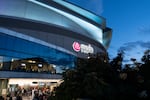
FILE - The Moda Center on Oct. 22, 2025 in Portland, Ore.
Saskia Hatvany / OPB
A Moda Center deal is in the works, and the Portland City Council will vote in just a few weeks to decide if it will spend public money on a renovation. But details are hazy about where exactly the funding would come from.
Mayor Keith Wilson and city councilors have suggested they’ll draw upon city revenue streams such as the Portland Clean Energy Fund and a fund within Prosper Portland, the city’s urban development agency. But the boards that govern those funds would first have to determine if their revenue can be spent on the arena.
It’s just the latest in a long saga that has involved negotiations between the Trail Blazers and city officials to keep the team in Portland and meet demands for renovations.
Alex Zielinski covers Portland politics for OPB. She joins us to break down the latest updates.
Note: The following transcript was transcribed using AI and validated for accuracy, readability and formatting by an OPB volunteer.
Dave Miller: This is Think Out Loud on OPB. I’m Dave Miller. We turn now to an update on public funding for a Moda Center renovation. The Portland City Council will vote in just a few weeks to decide if it will spend taxpayer money on a renovation in an effort to prevent the Trail Blazers from moving to another city. But even though the vote is looming, these councilors still don’t know exactly where the funding would come from.
Alex Zielinski covers Portland politics for OPB, and she joins us now. It’s great to have you back on the show.
Alex Zielinski: Great to be here.
Miller: In your reporting on this long saga, you put it plainly. You wrote this: “Portlanders have been torn between anxiety over losing the Blazers through a failed deal, and the prospect of handing tax dollars to the team’s billionaire owners.” Can you give us a short version of what’s come before this, what’s happened since the beginning of the year?
Zielinski: I will try. So the year began with the Blazers lobbying the state legislature to invest in renovating the 30-year-old arena. In email records between Blazer representatives and state leaders, there is this vague suggestion that the Blazers’ new owners may want to move the team to another city if the state doesn’t spend money on sprucing up the building – around $600 million that is. This lobbying worked. The state agreed to hand over about $365 million in bonds on the promise that the Blazers will commit to a 20-year lease to stay in Portland. This money is also contingent on Portland and Multnomah County pitching in, about $120 million from Portland and $88 million from the county.
So now it’s in the city’s hands. Since the Moda Center is owned by the city, it’s the city that will be leading negotiations with the Blazers over this lease, and the starting point requires the city council to commit to that $120 million before diving into negotiations. The problem is, as you mentioned, the city doesn’t have much spare money around, so they really aren’t sure where the funding will come from. Some are hesitant to support handing over that much in the first place. They have this deadline of August 12 to vote on whether to commit that amount of money to renovations. That brings us to today.
Miller: The timing is really confusing to me. How is it that there’s a deadline to commit public dollars to the Moda Center renovation, but we still don’t even know where the city’s money would come from?
Zielinski: Yeah, I mean, it’s definitely not the usual pace of bureaucracy in Portland. So the city is under this perception that they need to hammer out this deal by the end of the year to qualify for state bonds. But the state has told us that it might be less of a hard-and-fast timeline. It’s all pretty squishy.
I do think the pressure of the team’s new owners does play a part. They’ve spoken publicly about wanting construction to start next year, in order for the arena to be updated in time to host the NCAA Final Four tournament in 2030. So there’s a fire lit under them. But it’s not totally certain why there is this really hard deadline.
Miller: City officials have also said, according to your reporting, that they’re waiting on the Blazers to reveal some details about the renovation. So do you have a sense for what exactly they say they need to hear from the team?
Zielinski: They’re interested basically in understanding what kinds of renovations would be paid for with public money. The city’s own analysis has a long list of needed renovations for basic operations, like AV needs, bathroom upgrades, ADA-compliant stuff. But there’s worry that taxpayer dollars would go towards more luxury projects like executive suites. There’s this level of responsibility for spending public money that falls on them.
Another question is determining what needs to be done to qualify for city dollars. There are a number of revenue streams floating around that could be used to pay for renovations, but those construction projects must meet certain criteria to qualify for certain money. For example, the city’s climate funds need to be spent on projects that reduce greenhouse gasses. And if there aren’t any clear renovations that meet that requirement, it might not qualify for public dollars. So this is why the city says it’s impossible to know what revenue they’ll use to cover this bill, that they need to see the proposed renovation plans first.
Miller: What have the Blazers said about this?
Zielinski: The Blazers have told me that they are waiting for a funding plan from the city before they’re able to draft up architectural drafts on renovations. They don’t feel confident in the city’s commitment, and don’t really want to share stuff until that’s solidified. Basically, both sides are saying that the other is withholding information, which has thrown a wrench into negotiations.
Miller: How have city councilors you’ve talked to said they feel about the fact that they might have to vote on this funding plan without knowing how they’ll pay for it?
Zielinski: Not great. I think everyone on the council wants more information. A number of councilors have told me that they won’t vote on a funding package at all without knowing where the money will come from. It’s worth noting that this is an election year for half of city council, and the public is getting increasingly incredulous about this strategy. I can imagine that the election is front and center for those seeking another term, and who might be wanting to slow down to appease the public.
Miller: I got to say I’m still a little bit confused though just by the legality here. Can city councilors allocate $120 million without saying where the money’s going to come from?
Zielinski: Yes. It’s not unusual or illegal in any way to say “yes, we’ll pay for a certain amount of money on a contract,” and then spend the following months figuring out where that money will come from. It’s not an agreement to hand the money over right away. To be clear, this money would come in the next year or so. It’s kind of planting a flag of commitment to the Blazers, which is the strategy that Mayor Keith Wilson and some others say is more important than ironing out these funding details right away.
So I think that’s essentially the question for councilors right now. Will you vote to promise these funds and figure out an agreeable funding source before the money needs to be paid out, or pump the brakes?
Miller: So let’s dig deeper into those potential, and maybe likely, funding sources. The two that I’ve seen people talking about, one is less contentious I think. It is from Prosper Portland, the city’s economic development bureau.
The other you mentioned briefly, but we should talk more about this now. This is PCEF, the Portland Clean Energy Fund, which we’ve talked about a number of times over the last couple of months. This was created to do, among other things, reduce carbon emissions in Portland, also workforce development and to deal with equity. Where do city councilors you’ve spoken with stand on using PCEF funding for the Moda Center?
Zielinski: I’d say at least half of them are a hard no on using any PCEF funds for renovating a basketball arena. And that’s further cemented by the fact that there are no details on how the new construction would reduce carbon emissions, an actual argument for why this money should be spent on Moda. That said, there are very few other revenue streams in the city that are as plentiful as PCEF. It’s often eyed as kind of this piggy bank for other projects. And councilors aren’t talking about any other big ideas for how they could cover this bill. There aren’t many other revenue streams to look at.
I will note that aside from PCEF and Prosper Portland funds, Mayor Wilson has talked about using the estimated $50 million in tax proceeds from the team’s sale to pay for renovations as well. So there are some things out there that are a little less contentious.
Miller: So there’s the gigantic question about where the money would come from, but there are also questions about what the Blazers, in turn, would be providing, the Blazers end of the deal. What kinds of commitments are city council members talking about hoping to include in an agreement?
Zielinski: Perhaps unsurprisingly, the big ask is money. Private investment in the arena, whether that’s a lump sum from owners, monthly rents or something like that. There’s also interest in some non-monetary public benefits, like a commitment to allow arena workers to unionize, naming rights for the arena, or setting lower prices for food and beverages at games. But those haven’t really been aired out yet, because counselors are so laser focused on this first chunk, which is the money.
Miller: Tom Dundon, the most prominent owner of the new ownership group, appeared at a Portland area business leader event last month and was asked about all these issues. What did he say?
Zielinski: Dundon said that he has no intent to put any additional money into the arena. He essentially said he’s already made a big financial contribution to the city, since he’s going to be paying taxes on the team. He took the opportunity to chide Oregon’s taxes, which people love to do. He suggested that the city should be grateful for that too, and not ask for more from him.
Miller: Does anyone at this point, even boosters of using public money for this renovation, seem to be happy with the way Dundon is approaching this political issue right now?
Zielinski: I don’t think so. I don’t have much of this on the record because it’s such a fragile deal, but I can tell you with confidence that no one close to the negotiations in City Hall, and outside City Hall as well, is feeling great about Dundon’s leadership right now. I think that performance that you mentioned at the meeting a few weeks ago did not help his case at all. Communications just aren’t great between the Blazers and the city.
I will say, there’s kind of an interesting reason why too. One of Dundon’s first actions after buying the team was to lay off a good number of the lobbying and communications staff in Blazer’s administration, people that the city had a good relationship with in the past. So those bonds are weak right now.
I’d be remiss not to mention also that just last night, NBA Commissioner Adam Silver spoke at a press conference about how these negotiations in Portland seem to have been going “off track.” Silver used his words very carefully, but he said he wants the Blazers to have a long-term future in Portland, and wants to see both sides get this done. So you can read into that however you may, but he might not be feeling that great about Dundon right now either.
Miller: Alex, thanks very much.
Zielinski: Thank you.
Miller: Alex Zielinski covers Portland city politics for OPB.
“Think Out Loud®” broadcasts live at noon every day and rebroadcasts at 8 p.m.
If you’d like to comment on any of the topics in this show or suggest a topic of your own, please get in touch with us on Facebook, send an email to thinkoutloud@opb.org, or you can leave a voicemail for us at 503-293-1983.