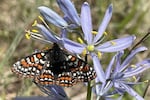
FILE - An endangered Taylor's checkerspot butterfly perches on a camas flower at Scatter Creek Wildlife Area in Thurston County, Wash., on April 30, 2025.
John Ryan / KUOW
Two Western Washington tribes are suing the Trump administration to save endangered-species habitats nationwide.
The lawsuit, filed Tuesday in the U.S. District Court in Seattle by the Swinomish Indian Tribal Community and the Squaxin Island Tribe, follows the Trump administration’s recent reinterpretation of the Endangered Species Act, which has been protecting imperiled creatures and their habitats since 1973.
On Friday, the Interior Department and the Department of Commerce announced they were nixing the decades-old interpretation of the act: Damage to an endangered species’ habitat would no longer be viewed as “harm” to the species, which is generally prohibited under the act. The species act would only be used to prevent directly injuring or killing endangered wildlife.
“It’s devastating to the Swinomish tribe, because the impacts that it’ll have on the ESA-listed Chinook salmon,” Swinomish tribal chair Steve Edwards said.
In a press release, Commerce Secretary Howard Lutnick said regulations under the Endangered Species Act had grown overly broad and burdensome to business.
“We’re returning the ESA to its foundational purpose to ensure legitimate conservation goals are met without sacrificing economic growth and American prosperity,” Lutnick said.
The new rule became final with its publication in the Federal Register Tuesday morning. The tribes quickly filed their lawsuit, and a coalition of nine conservation organizations filed a separate lawsuit the same morning.
“The Services’ new narrow interpretation of the statute is a radical and arbitrary reversal without supporting rationale,” the tribes’ suit argues. “Habitat degradation is a primary driver of the decline of salmon stocks in the Puget Sound region.”
RELATED: Environmental groups sue government to stop a big change to the Endangered Species Act
Puget Sound Chinook salmon and 27 other populations of salmon and steelhead on the West Coast are protected as threatened or endangered species under the Endangered Species Act. Chinook salmon is the primary food for endangered southern resident killer whales.
“Not only is it going to just impact the Chinook salmon and our way of life,” Edwards said. “We also think of the killer whales.”
Edwards spoke to a KUOW reporter while commercial fishing on Bellingham Bay.
Depleted salmon populations have forced Edwards, like many tribal members, to switch from catching salmon to Dungeness crabs.
“Crabbing is big for us, but that doesn’t mean that we forget about salmon,” Edwards said.

FILE - Adult coho and Chinook salmon swim in their raceway at the Issaquah Salmon Hatchery after returning from the wild for spawning in October 2021.
Courtesy of Oscar Kelley via Issaquah Salmon Hatchery
Tribes have poured millions into protecting and restoring salmon habitat, sometimes leading to tension with competing economic interests.
The Swinomish Tribe and local farming groups have clashed in court and elsewhere over how to restore habitat for Puget Sound Chinook salmon amid the farmlands of the Skagit delta.
The Skagit County Farm Bureau, Washington Farm Bureau, and Western Washington Agricultural Association did not respond to interview requests Tuesday.
Cindy Mitchell with the Washington Forest Protection Association, which represents private forestland owners, said the Trump administration’s narrowed definition of “harm” would not end all habitat protections for endangered species.
“It’s not going to affect our Habitat Conservation Plan,” Mitchell said. “We’re already 20 years into it.”
In 2006, Washington state adopted a 50-year Forest Practices Habitat Conservation Plan to strike a compromise between timber production and habitat protection for endangered species on private land.
Under the Endangered Species Act, landowners can enter into such plans to allow limited damage to endangered species’ habitats in exchange for other efforts to protect those species.
Mitchell said Washington state also has its own law designating and protecting endangered species.
Center for Biological Diversity spokesperson Noah Greenwald said companies would have little incentive to enter into or continue habitat conservation plans if habitat loss is no longer considered harmful to troubled species.
“If this rule stands, there’ll be more logging, more road building, more development that harms species than there would be otherwise for salmon and for southern resident orcas,” said Greenwald, whose organization is one of the nine environmental groups jointly suing the Trump administration.
Nick Smith, a spokesperson for the American Forest Resource Council, a Western states timber industry group, said the new rule could make projects like tree thinning in fire-prone forests easier to carry out.
“For too long, an expansive interpretation of the ESA has delayed the very projects needed to reduce hazardous fuels and make forests more resilient to fire,” Smith said in an email.
“This regulatory reform has the potential to improve the pace and scale of federal forest management and wildlife habitat restoration projects at a time when our national forests and at-risk species need it the most.”
U.S. Fish and Wildlife Service Director Brian Nesvik said the Trump administration is committed to protecting wildlife.
“We can protect species and respect communities at the same time,” Nesvik said in a press release.
The service, part of the Interior Department, is responsible for most endangered species on land, while the National Oceanic and Atmospheric Administration , part of the Department of Commerce, is responsible for most aquatic species.
Habitat loss is the leading cause of species going extinct.
Scientists say it’s not possible to save endangered species without also saving their habitats.
“Their interpretation is silly and lacks any modicum of thought,” Washington State University wildlife biologist Charlie Robbins said by email. “Animals don’t exist without appropriate habitat.”
John Ryan is a reporter with KUOW. This story comes to you from the Northwest News Network, a collaboration between public media organizations in Oregon and Washington.
It is part of OPB’s broader effort to ensure that everyone in our region has access to quality journalism that informs, entertains and enriches their lives. To learn more, visit our journalism partnerships page.