As firefighters scramble to contain dozens of wildfires across the state, the Oregon Department of Forestry announced it has deployed its last available complex incident management team.
Complex Incident Management Team 3 was sent to the Brewer and Box Springs wildfires in Central Oregon.
“The deployment is necessary due to the unusual early season ‘resistance to control’ nature of these lightning-caused fires in Central Oregon,” ODF spokesperson Joe Touchstone said in a press release.
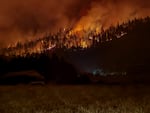
A provided photo showing the East Evans Creek Fire, active in in Jackson and Jefferson counties on July 18, 2026.
Oregon Department of Forestry Complex Incident Management Team 1
Thousands of lightning strikes in the middle of last week ignited dozens of wildfires, and fire season suddenly exploded. Hot and windy weather, combined with dry vegetation adding fuel to those fires, has made matters worse. And it’s expected to continue well into this week.
The Brewer Fire in Jefferson and Crook counties was burning nearly 18,000 acres as of Sunday morning. The Box Springs Fire in Jefferson County was 40 acres on Saturday and jumped to over 1,400 acres by Sunday. Both fires were listed at 0% containment.
“ODF fire managers stress patience and safety as resources are stretched thin and firefighters have been putting in long days and nights,” Touchstone said. “All local resources are committed but additional air and ground firefighting resources have been ordered through partnerships with other states.”
Another ODF complex incident management team, CIMT-2, is handling the Akawa Butte near the Jefferson and Deschutes county line. That fire was burning about 6,200 acres as of Sunday. Level 3 — GO NOW! — evacuation orders were issued for public areas including southern parts of Lake Billy Chinook, according to the Jefferson County Sheriff’s Office.
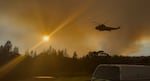
The East Evans Creek Fire burns in Jackson and Jefferson counties on July 18, 2026
Oregon Department of Forestry Complex Incident Management Team 1
CIMT-1 was deployed to the East Evans Creek Fire, which by Sunday was burning about 14,000 acres in Jackson County. It was only 8% contained, but officials said Sunday that an overnight break in the hot, dry weather helped crews strengthen the fire lines there.
The Oregon Department of Emergency Management has activated the State Emergency Coordination Center to coordinate the regional response to the fires.
The Oregon State Fire Marshal has also brought in task forces from California and Washington to help protect communities and critical infrastructure.
Other priority firefighting areas include two separate wildfire complexes in north-central and Eastern Oregon, which together have burned nearly 220,000 acres.
What’s now called the Rowe Creek Complex is made up of 12 active wildfires burning in Wheeler, Wasco and Crook counties. They had burned more than 126,000 acres by Sunday, and spurred some evacuations and closures of public lands.
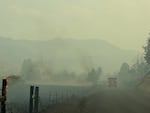
Smoke covers the area where the Rowe Creek Fire Complex is burning in Wheeler County on July 17, 2026
Oregon State Fire Marshal's Office
“In response to the growing fires, the Bureau of Land Management has closed all BLM-administered land along both sides of the John Day River, spanning from Service Creek north to the Columbia River,” ODF said in a statement. “Additional public land closures are being considered for portions of Crook County east of Prineville. Concurrently, the National Park Service has closed the Clarno and Painted Hills units of the John Day Fossil Beds National Monument to all entry.
In Gilliam and Sherman counties, the Hay Creek Complex has reached over 92,000 acres and was listed at 27% total containment Sunday morning.
The Hay Creek Complex includes the Hoag Fire, which started Thursday afternoon and has since destroyed multiple homes and outbuildings, prompted Level 3 — GO NOW! — evacuations, and has grown to over 50,000 acres. That fire was 50% contained as of Sunday morning.
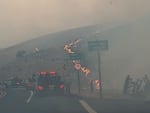
Wildfire burning along Middle Rock Creek Lane in Gilliam County, Oregon.
Gilliam County Sheriff's Office / Gilliam County Sheriff's Office
In Umatilla County, the Lower Dry Creek Fire started on Tuesday, had torched six homes by Wednesday and burned more than 8,000 acres by Saturday. But the Oregon State Fire Marshal’s Office announced Saturday that a break in the hot, dry and windy weather helped crews reach containment of the fire’s perimeter.
And in Grant County, crews have gained control of the Salmon and Olive Butte fires and lowered evacuation levels, even as wildfires continue to emerge.
An air quality advisory is in effect through Monday due to wildfire smoke in areas of Central and Eastern Oregon. And hot, dry weather is expected for most of Oregon, though at least until the middle of next week.
“The extreme fire conditions, the forecast, and these recent wildfires have challenged our firefighters,” said Oregon State Fire Marshal Mariana Ruiz-Temple. “We are using every tool at our disposal to protect homes and communities from these fires. I ask that every Oregonian pay close attention to these wildfires and, if you are asked to evacuate, to do so.”
Wildfire smoke impacts are expected through Monday with areas of decreased air quality across southwest Oregon and Northern California. Monitor air quality at https://t.co/TKH09kDZ0O and avoid going outdoors during periods of lowered air quality. #orwx #cawx pic.twitter.com/kV0Px4NRgy
— NWS Medford (@NWSMedford) July 17, 2026
Resources: Stay safe and informed during wildfire season with OPB’s wildfire guide at opb.org/wildfires. This resource offers essential safety tips and preparedness guidance to help you navigate fire and smoke events. This resource was created as part of our commitment to serving the public as wildfire seasons become longer and more dangerous.