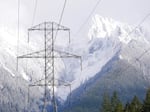
High-voltage transmission lines cross the Washington Cascades near the town of Index in February 2021.
John Ryan / KUOW
Environmentalists and construction workers are calling for reforms to make it easier to produce clean energy in Washington state.
Despite its green reputation, the Evergreen State trails every other U.S. state in adding wind and solar power to its electrical grid, according to a 2025 investigation by Oregon Public Broadcasting and ProPublica.
“We’re 50th out of 50,” state Sen. Victoria Hunt (D-Issaquah) said at a forum hosted by the nonprofit PNW Climate Week in July. “We need to do something about this.”
“What we’re most worried about is a cold snap in a low-snowpack year,” Hunt said. “We are looking at rolling brownouts and rolling blackouts. That’s what keeps me up at night.”
Building new transmission lines has been the main holdup for expanding the state’s clean energy supply.
Environmental groups are calling on the Washington Legislature to let transmission lines run in the underused land in highway corridors. The Washington State Department of Transportation has concluded it cannot allow such use of highway rights-of-way without approval from legislators.
“Expanding the options available for siting new transmission is a critical step toward modernizing the grid and ensuring communities and businesses have access to electricity around the clock,” Nicole Pavia with the Clean Air Task Force said in a press release.
Beyond the environmental impact, labor leaders say the bottleneck has left many construction workers jobless.
“The Pacific Northwest was a leader for a long time, and we’re definitely in a very deep lull right now,” said Matthew Heppner with the Certified Electrical Workers of Washington.
Heppner said unemployment in his union is about 16%, or three times the statewide average.
“The construction industry is struggling incredibly badly in Washington right now,” Heppner said. “We pushed for building clean energy. We thought we were going to do that.”
But those clean-energy projects foundered without access to transmission lines.
Oregon Public Broadcasting and ProPublica reported that the Bonneville Power Administration, which operates most of the Northwest’s electrical grid, has only added one mile of transmission lines in the past five years.
“So the only things we’re really building are data centers, which really sucks right now,” Heppner said.
“BPA has been understaffed and under-resourced, especially with staff buyouts under Trump,” said Casey McLean with the nonprofit Renewable Northwest. “The inter-connection queue is huge.”
With demand for power skyrocketing, the clean-energy bottleneck has meant more climate-altering pollution from power plants that burn gas or coal.
State law requires that Washington achieve a 100% clean electricity supply by 2040, a tall order made taller by data centers’ rapidly growing energy demands as use of artificial intelligence proliferates.
“Data center load is emerging as the dominant driver of long-term U.S. electricity growth,” the U.S. Energy Information Administration concluded in April in its Annual Energy Outlook 2026.
In March, the state created the Washington Electric Transmission Authority to coordinate, accelerate, and finance the construction of transmission lines. The new agency is expected to start operations in January.
McLean said the Transmission Authority is not a silver bullet.
“A lot of permitting reform is needed,” McLean said. “We have a lot of laws on the books to protect other things.”
Washington state Rep. Alex Ybarra (R-Quincy) said the town of Quincy, population 8,000, has benefited massively from the concentrated buildout of data centers southeast of Wenatchee.
“ I’ve got a brand-new hospital that opened up six months ago. I’ve got an aqua center, which is a big swimming pool, opened up four days ago. I’ve got a brand-new city hall, brand-new police station, a brand-new $100 million high school, the best high school in the state of Washington.”
Other electricity users have not seen their rates rise with the arrival of the energy-guzzling data centers nearby, according to Ybarra. The only downside he’s seen is one he experiences as a driver.
”We used to have one stoplight,” Ybarra said. “Now we have two stoplights and a roundabout. That’s a downside.”
John Ryan is a reporter with KUOW. This story comes to you from the Northwest News Network, a collaboration between public media organizations in Oregon and Washington.
It is part of OPB’s broader effort to ensure that everyone in our region has access to quality journalism that informs, entertains and enriches their lives. To learn more, visit our journalism partnerships page.