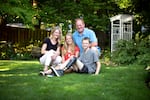
Portland author Lorna MacKinnon Day's son Sam was diagnosed with Ewing sarcoma, a childhood bone cancer, when he was 9 years old. MacKinnon Day tells his story and her own in her new memoir, "Light of Day." After his death she founded the Sam Day Foundation, advocating for more research into childhood cancers, which only 4% of all federal cancer research money goes toward. In this 2014 family photo, provided by MacKinnon Day, Sam was 13 years old.
Emily Andrews Photography
Portland author Lorna MacKinnnon Day has written a new memoir about her son’s diagnosis with a rare form of bone cancer at 9-years-old. “Light of Day” details the ways her family navigated six years of his treatment for Ewing sarcoma.
After his death, she founded the Sam Day Foundation, which advocates for funding childhood cancer research and supports the families of children living with cancer.
Nationally, only 4% of federal cancer research money goes toward childhood cancer, according to the Pediatric Research Foundation. This year, the Sam Day Foundation and Oregon Health & Science University secured a $3.17 million research grant to fund pediatric cancer research.
MacKinnon Day joins us to share more about her son Sam and her own experience in his fight to both survive and live well.
Note: The following transcript was transcribed using AI and validated for accuracy, readability and formatting by an OPB volunteer.
Dave Miller: From the Gert Boyle Studio at OPB, this is Think Out Loud. I’m Dave Miller. The Portland author Lorna MacKinnon Day has written a new memoir about her son, Sam, and his diagnosis with a rare form of a rare form of bone cancer when he was 9-years old. “Light of Day” details the ways her family navigated six years of his treatment for Ewing sarcoma before Sam’s death at the age of 15. “Each day,” she writes, “was its own dark passageway into the endless underground maze called childhood cancer.” The book also captures MacKinnon Day’s desire for Sam and the whole family to live well in the midst of that pain.
Lorna MacKinnon Day joins me now. It’s great to have you on the show. Thanks very much for coming in.
Lorna MacKinnon Day: Oh, thank you for having me.
Miller: I thought we could start by having you read a passage from early on in which you describe what Sam was like as a very young kid.
MacKinnon Day: Absolutely.
[Reading excerpt from “Light of Day”] “From the moment he could move, Sam was in search of adventure. Every new environment was a place to explore. For me, it meant the leisurely mornings at the park to chat with my friends while the kids played were never all that leisurely. Inevitably, two minutes into a conversation, I would say, ‘Wait, where’s Sam?’ He headed beyond the swing sets and sandboxes, venturing outside the familiar safety of the playground to find something magical.
“Because of his tendency to ignore instructions, I volunteered for all of the preschool field trips. Once, his preschool class toured the kitchen at a local pizza restaurant with an indoor play structure. The kids watched the cooks make a pizza while I kept an eagle eye on Sam. He tucked his hands in his pockets just like we talked about. Following the tour, the kids were given one square of pizza for their preschool snack. With a few squares left in the pan, hands went up to ask for seconds. There wasn’t enough for everyone to have a second piece, so the teacher said, ‘No, you only get one piece. Pretty soon you’re going home for lunch. So this is just a snack.’
“The kids were excused to the playroom with the multicolored ball pit, a large tunnel and slide, and a miniature Ferris wheel. The room was enclosed with plexiglass so the parents could nibble on their pizza slices outside and chat while still keeping an eagle eye on their kids. I was just a couple of minutes into a conversation with another mom before I scanned the room and said, ‘Wait, where’s Sam?’ His teacher was my good friend Stacy. She helped me search for him. A minute or two later, she returned with a wide grin. She pointed outside of the play area toward the table with the leftover pizza on it, and there he was, kneeling on a chair with his elbows on the table, eating all those remaining squares of pizza he wasn’t supposed to have. My little rogue preschooler.”
Miller: How did those qualities evolve as he got into elementary school?
MacKinnon Day: Gosh, he continued to break the rules and he was pretty smart about it, but usually got caught. In elementary school, he was the kid that knew the principal a little bit better than his peers.
Miller: And the principal knew him.
MacKinnon Day: Yes, absolutely, but he would get sent to the principal’s office, and then end up having great conversations and being buddies with the principal. So I like to say Sam got in trouble a lot because he broke the rules, but he did so to get the most out of life, and that’s what I loved about him.
Miller: You have a really lovely section about his imagination. Can you describe what he called “going deep in thought?”
MacKinnon Day: Yes. He was the kind of kid who liked to daydream, but it wasn’t the kind of daydream that I did when I was a kid where you sort of tune out the teacher, stare out the window and you’re not paying attention to what you’re supposed to. Sam’s daydreaming was intentional. It was like an intentional leisure activity for him, and he would announce to the family [what] he called “going deep in thought” instead of daydreaming. So he would announce to the family, “you guys, I’m gonna go deep in thought, so don’t disturb me,” because his mind was going to go someplace and he didn’t want any disruption.
Miller: How old was he when he would say that?
MacKinnon Day: He was probably around 7 [years old]. It was like 7, 8, 9 that he went deep in thought regularly.
Miller: And then how long would he be there with his deep mind spinning?
MacKinnon Day: Twenty, 30 minutes. Yeah, just imagining.
Miller: And then he’d emerge and what might he say?
MacKinnon Day: So usually he would emerge with some big idea, like, “hey Mom, can we build a big catapult in the backyard?” or “hey Mom, how old do you have to be to run for mayor?”
[Laughter]
Miller: He was going to fix the problems of the city.
MacKinnon Day: Yes. Sam had big ideas and strong negotiation skills, so that made him a little bit challenging to parent as well.
Miller: One of many heartbreaking moments, in a book full of them, is that after he was diagnosed with cancer, he told you that he couldn’t go deep in thought anymore. Did that ability return?
MacKinnon Day: It did. It took some time, but it was very scary early on to recognize that we weren’t just fighting for his life, we were fighting to save his spirit, too. And at the time, I thought we’re gonna keep Sam, but we’re going to lose his spirit. But after a few months, it’s hard to imagine, but you get into the swing of cancer treatment, and his spunky spirit re-emerged and his ability to go deep in thought stayed with him until the end of his life.
Miller: Very quickly after the diagnosis, you were immersed in terrible numbers, terrible choices. In those early days and weeks, how did you and your husband navigate what to tell Sam and what to hold for yourselves?
MacKinnon Day: Yeah, that’s a good question. We told him the basics. You have cancer in your leg. We need to treat it. You’re going to need medicine that’ll make you sick. To some extent, we followed his lead. And we didn’t want to force him to stop and pay attention to know these horrible things because he wanted to get on with being a kid. And that was just as important as him knowing what he was heading into.
And then Bob and I would escape to have our own conversations. He looked up more information than I did. I didn’t want to know the realities, or at least I wanted to pace myself. So, we took turns crying, sort of hiding from the kids and having our really hard weak moments. And we never, that I can remember … I don’t believe we told Sam anything that wasn’t true. We were always very honest. He asked, “If I don’t do this, will I die?” And Bob answered him, “Yes.”
Miller: And do this, at one point, that was get…
MacKinnon Day: The chemotherapy.
Miller: Or get his lower left leg amputated?
MacKinnon Day: Right.
Miller: Can you describe the early days and weeks after the amputation?
MacKinnon Day: After the amputation, gosh, there was a fair amount of pain. Bone surgeries resulted in a lot of pain, and he was on crutches for quite a while after his amputation. Chemotherapy causes the body to heal slowly, so it took a long time before he could even experiment with a prosthetic leg. And that meant that his brain rewired itself to a different midline.
At first, he was clumsy. He fell and experienced terrible pain from falling on his leg, but eventually he figured out how to use crutches and navigate in ways that just amazed us. And at the same time, he was also Sam, meaning he showed up back at school in a wheelchair. This first day back at school in a wheelchair, his leg was bandaged up with thick, thick bandages, and the kids were sort of looking at him but weren’t sure if they should stare. And there’s just a whole awkward thing because it’s so jarring to see someone come back to school and be missing their leg.
Then he got the kid’s attention. And he said, “Hey, you guys, look.” He lifted his leg up and pointed the end of his stump just below his knee out, and sort of turned it from side to side, and said, “It’s a submarine scope.” That allowed the kids to laugh and to also get a good look. He sort of gave them permission to look at his leg and what was different about him.
Miller: What do you think was going on in his mind when he did that? I’m wondering how you interpret his decision to do that. I’m wondering if it was just he was a little bit of a prankster in the center of attention or if it was a conscious decision to diffuse a situation.
MacKinnon Day: It’s hard to know. He was pretty attentive to how other people were feeling. In fact, years later, he saw young kids staring at him and their parents trying to tell their kids not to stare. And he said, “I want to start a campaign and make t-shirts that say, ‘let them stare,’ because if I was looking at me, I would be curious about what was going on.” And he didn’t mind talking about it, but he also was a kid who … Ultimately, for a kid who liked to create an experience, and he had a great sense of humor, having a prosthetic leg actually gave him lots of material to work with. And he started from day one. [Laughter]
So, that continued. It wasn’t just about diffusing the situation. It was like, “I have a prosthetic leg here. There’s some pretty interesting things I can do and this will be fun.”
Miller: When Sam was 10 and in remission, he was invited to go to a place called Camp Ukandu, which is for kids with cancer and their siblings. You write that you were really nervous about him going because of what we’ve been talking about earlier, his challenging behavior in preschool, in school. But then it turned out that you did not have to worry. Do you mind reading us an excerpt from the book here? We’re at the end of camp.
MacKinnon Day: [Reading excerpt from “Light of Day”] “On the drive home, Sam told us story after story about camp. There was Tutu Tuesday, a song called ‘Cows with Guns,’ and a cabin leader who woke them up in the morning with a guitar singing Johnny Cash’s ‘Ring of Fire.’ He told us how when he climbed the rock wall, his leg fell off halfway up. He bragged about how awesome he was at Gaga Ball and that Natalie had to come with him next year.
“He described the final campfire as more serious than all the other nights. Counselors and kids remembered the campers who’d died since the previous summer. They wrote their camp names on paper bags, each one with a battery-operated candle inside. The final gathering recognized the common thread amongst these campers. Sam struggled with the reality of it all and left the campfire in a mass of emotion.
“Afterwards, Sam had a difficult time processing until he got a visit from a therapy dog named Vegas. I sensed that at camp he had engaged in a much needed emotional release he may not have known he was holding in. To me, his face, though physically tired, seemed more serene. Away from healthy, unimpaired peers with cool haircuts and unscarred bodies, and afternoons filled with sports and gaming, something has moved his spirit to joy.
“Camp had been saturated with the grief and loss that goes hand in hand with childhood cancer. However, with other children living similar lives, the daily experience of their shared frustrations and triumphs created a sanctuary where Sam could fully indulge in the gift of life again, and possibly more profoundly than he ever had before. It was because he had known such sorrow that his joy was so piercingly present, and I thought, what a profound human reaction to connection and the presence of so many kids with cancer.”
Miller: What did Camp Ukandu end up meaning for both of your kids, for Sam and your older daughter?
MacKinnon Day: It was a scary place for them to go beforehand because Sam resisted. He didn’t want to go because he didn’t want anyone to be talking about cancer. And then what he realized is when you’re around all these other kids who have cancer, you’re not the oddball anyone. You’re not THE kid with cancer. So, he wasn’t different. He was just like everyone else, and he figured that out pretty quick, and just had a really incredible experience there.
Camp was always during his birthday. So he told his sister, Natalie, that he wanted that for his birthday the following year, for her to actually go to camp as well. And she thought, OK, just this once. But the two of them ended up becoming so close that week when Bob and I weren’t around. They just really bonded. I don’t know that they had deep, meaningful conversations, but something changed in them. And I’m incredibly grateful to Camp Ukandu for providing the space for that to happen.
My daughter, Natalie, still goes back as a leader. I believe it’s the place where she lets herself grieve. And she feels a closeness to Sam there.
Miller: Sam eventually got involved in surfing, which is one of the surprises in the book. How did that happen?
MacKinnon Day: Well, first of all, let me say he had his left leg amputated below the knee, but he also had part of his right foot amputated when he relapsed. So he had two amputations, and the partial foot amputation was more difficult than the lower leg amputation.
Through Nike contacts, we got connected to the Challenged Athletes Foundation, which is based out of San Diego. They have all kinds of adaptive sports, and they do running clinics and swimming clinics. They started doing a surfing clinic when Sam started going, and that was the thing. That was the thing that got him “stoked,” as the surfers would say. And I just saw him light up in a way that I hadn’t seen in quite some time.
Miller: What was it like for you on the beach to watch him going wave after wave, sometimes, especially early on, falling down or having sand get in the leg and then having to clean it up, put it back on? But he kept going out over and over and over, and sometimes he would have amazing rides on waves. What was it like to watch that as a mom?
MacKinnon Day: I think when Sam was diagnosed with cancer, moms are only as happy as their saddest kid…
Miller: Parents.
MacKinnon Day: Parents. I would say parents, thank you. And the same is true for the joy, especially in a situation like this, because there was so much sadness in our home. To see him, to witness him with so much joy on his face, it just was oozing out of him. I was just absolutely as delighted as he was to see him experience this. And I thought, OK, this is what it means to live well, and we need to do whatever we can to stay connected to this organization because of the opportunity it provides him.
Miller: You write early on in the book that your husband says that you are good at grieving. What does he mean when he says that?
MacKinnon Day: I know how to have a good cry. I don’t hold back, but I do it alone and sometimes intentionally. And yeah, there have been dark moments in my life, even before we lost Sam and certainly afterwards. I don’t necessarily try to be strong. What I believe is that when I fall apart for a period of time, I can pick myself back up again and I feel a little bit more strength having gone through that dark tunnel. So, I’ve recognized that there’s value in that.
I think what he means is Lorna knows how to cry and she knows how to say, “I need people to leave me alone for a period of time because it’s going to be a little bit hard for a bit.”
Miller: You did note there that you know how to cry and you do it alone. Why?
MacKinnon Day: I don’t know. Maybe I’m an introvert. That may be part of it. I come from a Scottish background where emotions aren’t necessarily all out there, a pretty private family, and I was a pretty shy person growing up as well. So that’s all probably a question for some counselor who could figure it out. But, I definitely like the privacy. Even though I can talk about it, I just don’t like to really fall apart in front of other people.
Miller: We haven’t mentioned this yet, but your husband Bob Day is a very well-known public figure in Portland. He’s been on this show many times. He’s currently the Portland Police Chief. He had various leadership roles throughout Sam’s illness before he was chief, but he was moving his way up the ranks. What was it like for you to balance this as a family, your husband often working long hours and often in the public light, as you all were dealing with Sam’s terrible illness?
MacKinnon Day: It was a mix of things. On the good side, the police bureau is an incredibly supportive community, and people showed up at our house when we needed projects done and we didn’t have the money to pay for it. We just had groups of people that I hadn’t met before show up and help us with things.
Miller: Wheelchair ramps?
MacKinnon Day: Not necessarily, but just little painting projects and home upkeep that we didn’t have the time to address anymore. People want to do something, so one thing they could do is just schedule a day, show up and help out. It was also an incredible support for Bob to be in a community of people who understood what was going on and were very supportive of him.
On the other side, police work is demanding. One of us had to let go of our work, and that was me. Both of us had careers that were direct public service. I worked with kids with disabilities and you can’t do that virtually. So, I was the one to leave my job and take on the primary care of Sam. While Bob is really good at what he does – he brings home interesting stories, he’s an interesting person for me to talk to, even though I talk to him every day – at the same time, I was becoming jealous of him because he had a community that was supporting him. He had work that gave him tremendous purpose. He was doing well in the police bureau, and I think that actually helped him with the stress and the grief of what we were going through. And I had to leave mine.
So those kinds of things made it more challenging, but he always found a way to make it up to the hospital for the hard appointments, and he always found a way to give me a break from taking care of Sam when he was several days in a row of chemotherapy. And my memories are that we were still a family with some interesting stories and sometimes watching dad on TV.
Miller: For some couples, losing a child can be too massive a blow for a marriage to withstand. How do the two of you get through together?
MacKinnon Day: Yeah, that’s true. There are quite a few. I wish I knew the number, but there are a lot of families and couples where the marriages don’t survive after losing a child.
There are periods of time where Bob and I were dealing with this very differently, and I would say right now, even shortly after losing Sam, we were kind of dealing with it really similarly. But I think the best thing we did for our marriage was to give each other permission to grieve the way we needed to grieve, even though it looked different. And there were times when he was grieving in a way that actually irritated me, and I was grieving in a way that irritated him. But the reality is everybody grieves differently, and we had to give each other the freedom to be able to do that.
And now that we’re not wrestling with that anymore, we understand each other, we feel very similar, we look back and think that was the smart thing for us to do in our marriage, even though it was hard at the time.
Miller: I want to turn to faith. It’s a big and complicated part of the story that you wrote. How would you describe your relationship with the church that you went to in your early years as a stay-at-home mom?
MacKinnon Day: My relationship with my church is still very good. It’s great. They’re a wonderful community of people. I was a leader in the church before Sam was diagnosed, and I would say I was always kind of a skeptical believer as well. So I was never one of those people that just took explanations about faith without exploring them. And going through what we went through with Sam, it definitely was faced with a lot more than when I was just a teacher and didn’t have tremendous trials happening in my life.
So, my faith looks really different now. And I still choose to go to my church, and my church still chooses to love me and know me, even though we might talk about it really differently.
Miller: You write about hearing certain platitudes, things like, “God only gives you what you can handle,” “God’s got this, he knows what’s best for Sam,” things like that. What would go through your mind when you’d hear those kinds of messages?
MacKinnon Day: Well, at the time … I think I can probably say this about a lot of cancer parents, is we become pretty sensitive people. We’re sensitive and we can react to things. And some of those just were so jarring for me to hear. “God’s got this. God’s got Sam. He’s going to take care of him.” And I knew the reality of childhood cancer. And it also didn’t make sense to me to imagine that God would have Sam in the palm of his hand but not the kid who’s three doors down, if they didn’t have a faith community or a faith backing them up. That didn’t work for me.
So, internally, I never spoke it out loud, but I reacted to a lot of those things. And it just sent me into some of my own deep-in-thought episodes where I think deeply about these things that people were saying to me and try to figure out, what do I really believe about those things that seem to be common language in a faith setting.
Miller: You said that your faith changed as a result of Sam’s illness and death. In what ways? How would you describe your faith now?
MacKinnon Day: Well, I rarely pray with words anymore. After sending prayers out to the community over and over and over again, and having really horrible things happen – a relapse, or the surgery didn’t go well, or being sent home from a clinical trial – I started to feel a little bit of a PTSD when I requested prayers, so I stopped doing that.
Now, I still believe in a divine source, but I feel less that I’m being guided into these different pathways that I’m supposed to go, and more that we have these incredible resources in our world that are accessible to anyone that help us get through difficult times. And that is the people who show up in our lives. It’s the purpose. Like the example I gave of Bob having a job. If you look at the “Book of Genesis,” God gave Adam a job to do. And I think that was more than just the fact that there was work that needed to be done. When we’re able to do meaningful work, we’re healthier, happier people. And I think environment makes a big difference in how we get through this life as well.
So, I take those things as gifts from the divine. I try to put myself in those settings and I say thank you.
Miller: Kate McMahon, a longtime TV producer here at OPB and a lot of other places, wrote a beautiful foreword to your book. She noted that you reached out to her when you found out that her daughter had been diagnosed with bone cancer. The two of you have since become collaborators and friends. She wrote this: “Having a front row seat to watch how Lorna operates, I marvel at how a bereaved mother can be seen as such an icon of hope to parents terrified of becoming like her. She is the definition of spiritual alchemy, the transmutation of someone’s soul energy from negative to positive.”
Where does your energy to help other parents dealing with childhood cancer come from?
MacKinnon Day: I think that’s one thing I recognized. After Sam died, I had a period of being pretty angry, and that worried me. I was afraid. In fact, I think it was when he was still alive, I was getting so bitter and angry, and I got nervous because I knew I didn’t want to be a bitter and angry person for the rest of my life. I’m not quite sure where the shift happened other than that awareness. And actually, there’s a few things in the book that helped me figure out how I was going to choose to exist in this.
I don’t give cancer any credit for good things that have emerged, but what I am grateful for is that the human heart has the capacity to grow even after such a tragic experience. So I say all the time, my heart is and will always be broken, but somehow it’s bigger. And, I’m no longer afraid of stepping into the space that other people are in with the incredible pain of childhood cancer. If someone like Kate lets me in, then I’m going to walk with them with hope, chronically, unapologetically hopeful.
Miller: What have you learned about how to start conversations with parents who are early on in what you dealt with?
MacKinnon Day: They usually want to talk, and oftentimes they want to talk about what happened – she had this lump in her leg, she complained about it. For some reason, it seems like that’s therapeutic to go through the process of the diagnosis. And then we initially start to relate on those things. I generally hold back from telling my story about Sam because I’m pretty well-informed about the kind of care that families get, especially here in the Pacific Northwest. I’m well-informed about the research and multiple different types of diagnoses. So I can talk about that without going to Sam’s story because I know that families need – they probably need to be hopeful – and my story represents what they are most afraid of.
I actually wouldn’t recommend this book to families who have a kid fighting cancer right now. But we can go deep pretty quick. I think somehow they know that I’m on their side, I’m their cheerleader and I also get it.
Miller: The word “hope” has come up a number of times in this conversation. It comes up a number of times in the book. A short, simple word, seemingly easy to understand, but what do you mean when you say hope?
MacKinnon Day: Hope is definitely a theme in the book. I didn’t understand it before Sam was diagnosed because hope is an overused word. It doesn’t carry a whole lot of weight. But when you are worried that you might lose your child, hope means the world. Every day that I had hope was 100 times more tolerable than a day without hope. Sam had relapsed and I’d had this little conversation with myself about whether or not I should be hopeful, because the world says don’t get your hopes up…
Miller: Because they could be dashed and that could hurt more is the implied part after that famous phrase?
MacKinnon Day: Exactly. So I wrestled with whether or not it was foolish or I was doing myself a disservice to be hopeful, but what I knew is that when we had hope we could live better. So we chose to have hope.
Miller: Wait, can you choose to have hope, or does it just come to you?
MacKinnon Day: I believe it was a choice for me because I really wrestled with it, whether or not I should prepare myself to lose him or be hopeful, because hope also invites you to engage in it. You don’t hope to run a marathon without training for it, right? So, we had hope there was some research that’s happening. That’s the only reason we could have hope, by the way, is there was some exciting research happening for Ewing sarcoma at the time. So we stepped into that by beginning to fundraise and support that research. And being on the internet and finding the researchers who were doing this work, and getting to know them, and getting Sam lined up for the possibility of that drug becoming available.
So, it was sort of a stepping into that hope and allowing myself to feel OK from time to time that this might work, this might work, and it’s OK to not think about it not working. If I have to, I’ll face it when it comes.
Miller: I wonder if you could read us one more excerpt from the book. This gets to the challenging balancing act, where hope is on one side of it.
MacKinnon Day: [Reading an excerpt from “Light of Day”] “Now, several years since he’s been gone, I can wonder more freely about what Sam might have been feeling and thinking about his own mortality. I can wonder how the intensity of my care and the compulsion to protect Sam could have also shielded us from some other rich experience. I wonder when he thought it was likely that he would not survive. I wonder how much of his intention in life was pretending that there could be a cure for him and that I could find it. I wonder if he protected my hope simply because I needed him to. I’ve seen young adults accept their pending mortality with a kind of grace that seems to require a strength I cannot comprehend. They are the most profoundly deep and beautiful humans I’ve ever observed.
“At the time, I felt the most noble and powerful actions were to dedicate myself entirely to the pursuit of saving Sam. If I lost him, I thought, I would know that I did everything I possibly could to save him. As I look back, I wonder if maybe the most noble and brave thing would have been to accept the inevitable and allow death to bring our whole family into a more profound experience of life. What would have happened if I’d let myself accept that my son was going to die? I wonder whether I could have been able to expand my own heart and soul instead of protecting it for as long as possible. I have not decided which is better. I’m most comfortable continuing to wonder.
“I’m proud of how my family chose to live well and say yes to as much adventure as we could pack in, but I wonder whether Sam could have lived a more extraordinary life if he’d felt free from the need to help protect his mom’s heart. Extraordinary people have the most expansive hearts, and yet most of us are not extraordinary. We are simply regular people navigating extraordinary heartbreak.”
Miller: When you are having those moments of doubt or second guessing, are there specific things that you’re wondering about having done differently?
MacKinnon Day: I wrote about a few of them in the book. There were times, for example, when he relapsed – and this is true for a lot of kids when they relapse – it’s almost worse than the initial diagnosis because they know what it takes. They have to go back into this horrible, horrible treatment. And it was so scary to see him in a dark place. And he went to a dark place for a few days when he relapsed.
I worked hard to try to cheer him up. We were in the hospital. Let’s rent an inspirational movie. Do you want to have a friend come over? What can I do to cheer you up? And maybe I should have taken a step back and allowed him to be in that dark place. Because as I’ve said about myself, sometimes just going through that grieving period, you actually emerge on the other side of that stronger. It’s just so frightening to watch your child go through that. So, that’s an example of something of maybe I could have been more patient, and allowed him to feel the pain and to be a little pissed off about it.
Miller: When did you start writing seriously about what you and Sam and your whole family were going through?
MacKinnon Day: I started writing when he was still around and that was mostly because, as I said, I couldn’t work. I was looking for things to do with my time and with my brain. He just left us with so many incredible stories. I wanted to capture them. So I did start writing Sam’s stories when he was still alive. It was a year or two after he had died when I decided this needed to become a book. I had some great coaches and writing programs that helped me write well. And those people in my life, the mentors, encouraged me to write it as my story. It can’t just be Sam’s story, it has to be my story going through this period.
So a lot of these were written early on, and thank goodness because I forget things that have happened. Bob and I remember things differently, but it’s written down and I wrote it down a long time ago. So yeah, it was probably a year or two after losing him that I decided this was going to be a book. It’s been a long journey.
Miller: Did writing about your experiences affect the way you’ve come to understand them?
MacKinnon Day: Absolutely. In fact, there were times when I had a writing coach say, for example, can you add a few more stories about Natalie, my daughter, in there? And I had to sit and think about the relationship Natalie and Sam had with each other. And it actually brought up these beautiful memories. It almost allowed me to go back in time, and to watch them again, and realize, oh, this is how Natalie responded to him from the very beginning, how she took care of him and how he sort of expected her to be there. And those were hard. It doesn’t come naturally. It’s that writer’s block that you sit with for a while. But when a story like that comes out of it, it feels so good.
Miller: What led you to create the Sam Day Foundation?
MacKinnon Day: Well, I knew too much after losing Sam. I had seen how devastating childhood cancer is. I know how bad the treatments are, how old they are, how toxic they are and how they don’t always work. And, as I talked about hope, the only reason we had hope was because we knew research was happening. It’s not true for all kids, especially with sarcomas. And I think every kid should know that somebody’s working on it.
So, we launched the Sam Day Foundation to primarily invest in research for pediatric sarcomas and brain tumors, and because it’s been far too long and childhood cancer is seriously neglected. That’s why the treatments are so old, and the progress that we’re making is decades behind the progress we’re seeing in adult cancers.
Miller: Why do you think that is?
MacKinnon Day: It’s because they’re the fewer numbers. Our country works on a system where the numbers, especially when it comes to investments in drugs, it’s much more profitable for a pharmaceutical company to invest in a drug that covers a large population of people who are 70 years old. The numbers for kids are smaller, but if you look at the core value of that and think about all of the years of life that are lost when we lose a child like Sam, who could have really made an impact in this world, that’s a different kind of core value. But having small numbers means you have less material and less data to work with. It takes longer to procure that data and then to get larger grants to move the work forward.
Miller: Is there hope on the horizon now for real improvements, specifically in Ewing sarcoma treatment?
MacKinnon Day: Absolutely. And I know quite a few researchers in this space and they’re incredible people, and there’s some really good energy around this right now. We’re learning a lot about the basic biology of some of these sarcomas and that’s helping them solve some problems. They’re difficult cancers. They’re not just hard on a child’s body, they’re difficult to figure out. But there’s progress being made, absolutely. I’m excited about that.
Miller: Turning from the research side to the treatment side, you catalog some positive, some very positive, some very negative experiences with health care providers of all kinds. What have you come to understand about what makes a good healer?
MacKinnon Day: I think the best thing that Sam’s oncologist said to us one time was, “as long as we all understand what we’re dealing with, I don’t see why we can’t go forward with hope.” So that is just that permission to be hopeful. We all get it. Things are not looking good, but it’s OK. Let’s be hopeful and let’s move forward as long as Sam wants to keep doing this. I think that’s a sign of a good provider.
I think providers need the resources to be able to spend time. A lot of the time we get very frustrated at providers because they don’t follow through with things that we need, second opinions, scheduling and all these kinds of things. But a lot of that comes down to just having the resources that they need and a robust team to share the workload. Pediatric cancer patients take a lot, so an institution that values that makes a big difference, too.
Miller: What does it mean to you to live well today?
MacKinnon Day: It’s about having a rich life, about friendships that are not just surface, being there for people who are in deep pain, but also being there for people in the most beautiful moments. It means spending the time that I can with my grandson, and it means saying yes to adventure. Bob and I, on the anniversary of losing Sam, we woke up at 4 o’clock in the morning and did a sunrise hike on Mount Rainier. I could have slept in and done it during the day. But there’s a richness to an experience like that. So seeking those moments that make life rich is about living well.
Miller: Lorna MacKinnon Day, thank you very much. Lorna MacKinnon Day’s new book is called “Light of Day: Finding My Way Through Love, Loss, and Childhood Cancer.”
“Think Out Loud®” broadcasts live at noon every day and rebroadcasts at 8 p.m.
If you’d like to comment on any of the topics in this show or suggest a topic of your own, please get in touch with us on Facebook, send an email to thinkoutloud@opb.org, or you can leave a voicemail for us at 503-293-1983.