Wildfires have burned more than 40,000 acres of grassland, mature sagebrush, riparian habitat and dry meadows inside and outside the boundaries of the Malheur National Wildlife Refuge.
As the Stubble and Jackass Butte fires scorched this stretch of Eastern Oregon’s Harney County, they took with them vital wildlife habitat and at least two historical structures built in the 1930s.
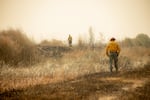
A provided photo shows crews responding to the Jackass Butte Fire near the Malheur National Wildlife Refuge on Aug. 2, 2026.
Image via InciWeb
With fires continuing to burn across the West, a conservation group that supports the refuge worries whether there will be enough federal funds to support its recovery.
“There are going to be a lot of public lands in need of federal funding to respond to habitat loss,” said Janelle Wicks, the executive director of Friends of Malheur National Wildlife Refuge, a nonprofit that promotes the conservation of the refuge. “And that is going to make what is probably not a huge pot of money to begin with spread pretty thin.”
With limited federal conservation and habitat restoration funds, she worries the response could be slow and could allow invasive grasses to take over — the very same invasive grasses that make wildfires in the Northern Great Basin worse.
“These are plants that are really opportunistic, and highly adaptable,” Wicks said. “And they’re going to come through and create monocultures that are really hard to reclaim with native plants.”
The Malheur National Wildlife Refuge covers roughly 187,000 acres in Oregon’s Harney County and is managed by the U.S. Fish and Wildlife Service.
The refuge made national headlines in 2016 after a group of armed anti-government protesters took over its headquarters office for several days.
But it has long been a popular spot for fishing, hunting, hiking and bird watching. Hundreds of thousands of birds stop by every year to feed, rest and nest there.
Once the smoke has cleared, Wicks said people will likely see a different landscape. She said she challenges visitors to stay curious and open to learn about what makes Malheur special, rather than focusing on what they may or may not see.
“It’s a challenging time for wildlife, for wild habitats, for public lands management, for our own human experience and relationship to it all, and I think that curiosity is really important,” Wicks said.
As of Monday, the Stubble Fire was 93% contained and the Jackass Butte was at 78%.